


Why good content needs good editing (and why it matters for your business)
 By Jamiek
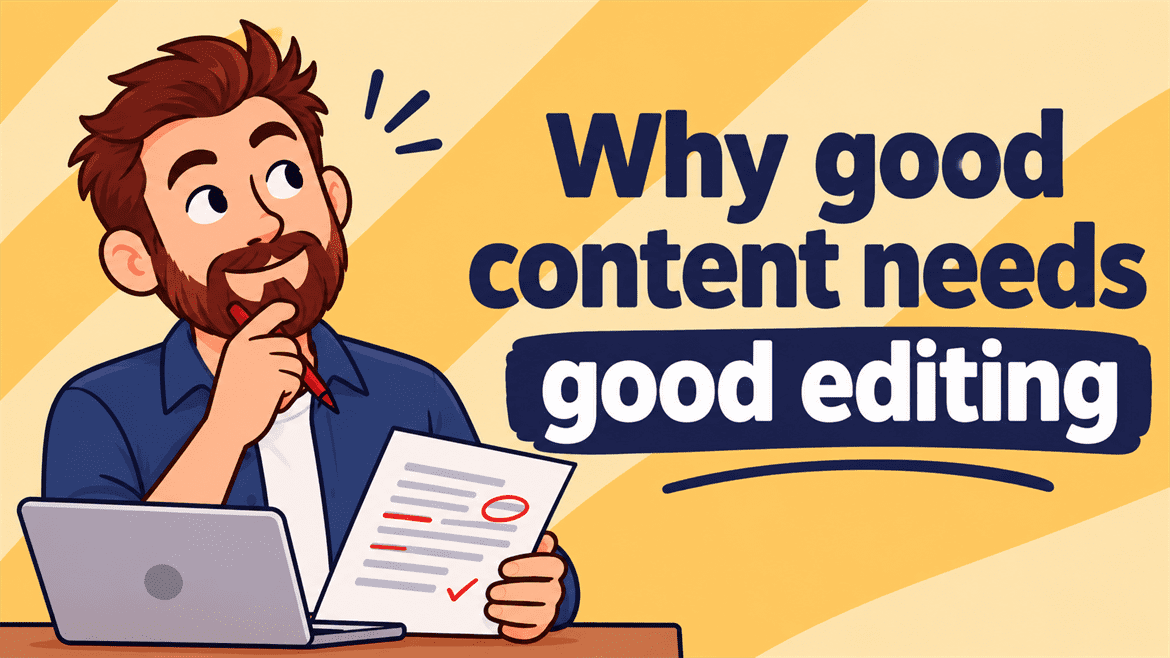
Producing content has never been easier, yet getting it right still takes quite a bit of work.
AI can generate a blog post in seconds. You can ask it to write a service page, put together a marketing email or come up with 20 social media posts before you’ve finished your morning coffee.
The trouble is, producing content and producing good content aren’t quite the same thing.
I’ve seen plenty of content over the years that was technically correct but didn’t really say anything.
I’ve also seen writing with a decent idea buried somewhere beneath three paragraphs of unnecessary explanation, a collection of repetitive sentences and enough corporate jargon to fill a small conference centre.
And that’s before we get to the occasional spelling mistake.
Good editing makes a difference. It helps content communicate clearly, sound natural, reflect your brand and achieve what you intended it to achieve.
For businesses, that matters.
Your website, blog posts, emails and social media content all contribute to how people perceive your company.
They influence whether someone understands what you offer, trusts what you’re saying and decides to find out more.
At Coastal Content, I provide professional content editing, copy editing and proofreading services for startups, small and medium-sized businesses, agencies and established organisations.
Whether you’ve written something yourself, commissioned a freelancer, used AI to generate a first draft or inherited a collection of existing content that needs attention, I can help make it better.
What kind of content can I edit?
I can edit pretty much anything your business uses to communicate with customers, prospects, employees or the wider world.
Different types of content have different requirements, but the underlying objective is the same, making sure the finished material is clear, accurate, consistent and fit for purpose.
Here’s what I can help with.
Web pages
Your website is one of your most important business assets, so the content deserves a little attention.
I can review and edit homepage copy, about pages, service descriptions, landing pages, product pages and other web content.
This involves looking way beyond spelling and grammar.
- Does the content explain what your business does?
- Is the messaging clear?
- Does it communicate the benefits of your products or services?
- Can visitors find the information they need?
Sometimes a few carefully considered changes can make a significant difference. Other times, the content needs a more substantial overhaul.
I can also review an entire website, identifying inconsistencies, outdated information, unclear messaging and opportunities to improve the overall experience.
Blog posts and articles
Blog posts are particularly interesting from an editing perspective because there’s often quite a lot going on.
An article might contain useful information but lack a clear structure. The introduction might take too long to get to the point, or the main argument might get lost halfway through.
I review blog posts and articles for structure, readability, flow, accuracy, tone and relevance.
I’ll look at whether the article delivers what its headline promises, whether the information is useful to the intended audience and whether the writing holds together from beginning to end.
I can also review SEO content, checking that keywords and search-related elements have been incorporated naturally without making the article sound as though it was written for a search engine rather than a person.
Marketing emails and newsletters
A marketing email has just a few seconds to get someone’s attention.
That makes clarity particularly important.
I can edit promotional emails, newsletters, welcome sequences, product announcements and other communications.
I’ll look at the subject line, opening, message structure, tone and calls to action.
Does the email give readers a reason to continue? Is the offer clear? Does the message sound like your business?
I’ll also look out for unnecessary wording. Emails don’t need to contain 400 words when 100 will do the job.
Social media posts
Social media content needs to be concise, engaging and appropriate for the platform.
I can edit LinkedIn, Facebook, Instagram and other social media posts, improving the wording, sharpening the message and making sure the content sounds natural.
This is particularly useful when several people contribute to your social media activity or when you’re adapting longer content into shorter posts.
A LinkedIn post, for example, might need a more professional approach than an Instagram caption.
Simply chopping a paragraph in half doesn’t necessarily make it suitable for either.
Video scripts
Video scripts need a different approach because they’re written to be spoken rather than read.
I can edit scripts for promotional videos, explainers, product demonstrations and short-form social content.
I’ll look at the language, pacing, structure and flow, making sure the script sounds natural when spoken aloud.
A sentence that looks perfectly fine on a screen can become surprisingly awkward when someone has to say it to a camera. I can help with that.
Other business content
Depending on your requirements, I can also edit:
- Case studies and customer stories.
- Product descriptions and sales copy.
- White papers and industry reports.
- Guides, ebooks and downloadable resources.
- Presentations and business documents.
- Customer onboarding materials.
- Internal communications and company documentation.
I can also help with AI-generated content, reviewing and refining drafts to improve their accuracy, structure, tone and readability.
As a trained copywriter and editor, I can offer the complete package. That means I can create content from scratch, edit material you’ve already produced, or combine the two when a project needs more substantial work.
You don’t need to find someone to write the content and another person to make it readable as I can do both.
A little about the different types of editing
I’ve worked in multiple different editorial roles over the years, including proofreading, editing and managing editing teams.
I enjoy all of them, although they involve rather different ways of looking at content.
It’s worth explaining the distinctions because the terms are sometimes used interchangeably.
Proofreading
Proofreading is generally the final check before content is published or distributed.
It’s about identifying spelling, grammar, punctuation and formatting errors, along with inconsistencies that might have slipped through earlier reviews.
Think of it as the final inspection before something goes out into the world.
It’s an important stage, but proofreading won’t necessarily fix a poorly structured article or unclear messaging. Those issues need attention earlier in the process.
Copy editing
Copy editing looks more closely at the language itself.
It involves correcting grammar and spelling, improving sentence construction, checking consistency and refining the writing so it’s clear and easy to understand.
For example, a sentence might be grammatically correct but unnecessarily complicated. A copy editor will look at how to simplify it without losing its meaning.
This is also where consistency matters. British or American spelling? Numbers written as words or figures? How should product names be presented?
These details help make content feel like it belongs together.
Content editing
Content editing takes a broader view.
Here, I’m looking at the structure, flow, messaging, tone and overall effectiveness of the material.
Does the article make sense? Is the information presented in the right order? Are there gaps in the argument? Is the content appropriate for its audience?
Sometimes that involves rewriting sections, moving information around, removing unnecessary material or suggesting additional information that would make the piece more useful.
Managing editor
I’ve also worked as a managing editor, which involves looking beyond the content.
This is about maintaining editorial standards across a wider operation, managing writers, training and developing them, reviewing output, providing feedback and ensuring content meets the required quality and objectives.
It also involves developing processes, style guides and workflows that help teams produce consistent work.
That experience is particularly useful for businesses and agencies working with multiple writers or producing content across several channels.
I understand what good content looks like, but I also understand what it takes to get there when several people are involved.
How good editing benefits your business
Editing might not sound like the most exciting part of marketing. Nobody tends to announce that they’ve just commissioned a particularly excellent copy edit.
Yet it has a direct bearing on how effectively your content communicates.
Let’s look at a couple of examples.
Example 1: Helping a startup establish its voice
Imagine you’ve launched a startup offering software to help independent retailers manage their stock.
You’ve written your website copy, produced a few blog posts and started publishing on LinkedIn. You’ve also used AI to generate some additional content to help get things moving.
There’s plenty of material, but something doesn’t quite feel right.
The website explains the software’s features, but it’s not particularly clear why retailers should care.
The blog posts contain useful information, but they’re repetitive. The social media posts sound rather generic, and the tone changes depending on who or what produced them.
Step 1: Review the website
I’d start by reviewing the main web pages.
I’d look at the messaging, structure, clarity and consistency, checking whether the content explains the product in a way that makes sense to independent retailers.
I’d identify where the copy needs tightening, where benefits need explaining and where additional information might help visitors make a decision.
Step 2: Edit the blog content
Next, I’d review the existing blog posts.
I’d improve their structure, remove repetition, check the information and make sure each article has a clear purpose.
If the content was AI-generated, I’d also look for generic explanations, unsupported claims and missing details that could make the articles less useful.
The aim would be to retain the useful information while giving the articles a clearer point of view and a more distinctive voice.
Step 3: Refine the social media content
I’d then look at the LinkedIn posts and other social content.
I’d make sure the messaging reflects the website and that the posts communicate useful information rather than simply repeating product features.
I’d also identify opportunities to turn useful points from the blog articles into individual social posts.
Step 4: Establish consistency
Finally, I’d look at how everything fits together.
The website, blogs and social media content should sound as though they come from the same business.
They don’t need identical wording, but they should communicate consistent messages and reflect the same personality.
The startup now has a much stronger collection of content to support its marketing, without having to throw everything away and start again.
Example 2: Promoting a new service for an established small business
Now imagine you run an established accountancy firm and have introduced a new invoicing service for small businesses.
You’ve already written a service page, drafted a blog post explaining the benefits of outsourcing invoicing and prepared an announcement email for your existing customers.
You might even have used AI to help produce some of the material.
The content is there, but you want to make sure everything is ready before launch.
Here’s how I’d approach the project.
Step 1: Review the service page
I’d start with the dedicated service page.
I’d check that the service is explained clearly, the benefits are easy to understand and the information answers the questions potential customers are likely to have.
I’d also review the calls to action, making sure visitors know how to enquire or find out more.
If important information is missing, I’d recommend what needs adding.
Step 2: Edit the supporting blog post
Next, I’d review the blog post about outsourcing invoicing.
I’d check the structure, readability and accuracy, making sure the article provides useful information and introduces the new service naturally.
I’d also look at the internal links, particularly the link directing readers to the new service page.
Step 3: Refine the marketing emails
I’d then edit the announcement email and any follow-up messages.
I’d look at the subject lines, opening paragraphs, key benefits and calls to action.
The email needs to communicate the new offering clearly without becoming a long list of everything the firm does.
Step 4: Review the social media posts
I’d edit the promotional posts, checking that each one has a clear message and suits its intended platform.
One might introduce the service, another could highlight a common invoicing problem and another could promote the supporting blog post.
I’d make sure the social content supports the wider campaign and doesn’t simply repeat the announcement email.
Step 5: Prepare everything for publication
Once the content is approved, I can help format and publish the website and blog content through WordPress.
I can also prepare the finished social media posts and emails, giving the business a complete collection of launch materials.
The result is a consistent campaign in which every piece of content has been reviewed and refined before it reaches potential customers.
Editing isn’t just about making individual pieces of writing better. It’s about making sure the content works together and supports what the business is trying to achieve.
How does working with a content editor work?
If you’ve never hired a freelance content editor before, you might be wondering what you need to provide and how much involvement is required.
Do you need to send me a finished draft? Can I work with something you’ve generated using AI? What happens if the content needs more than a few corrections?
The good news is that you don’t need to have everything figured out before getting in touch.
Here’s how I generally approach an editing project.
1. Tell me what you need
You might have a blog post that needs reviewing, a website that hasn’t been updated in years or a collection of marketing materials that need bringing up to the same standard.
Perhaps you’ve got a team of writers producing content and need someone to review their work.
Or maybe you’ve generated a pile of AI content and would like an experienced editor to go through it.
We can discuss what you have, what you want to achieve and the type of support you need.
2. I’ll review the content
I’ll look at the material, its intended audience and the purpose it’s supposed to serve.
I’ll also consider any existing brand guidelines, style guides or editorial requirements.
This initial review helps establish how much work is involved and which type of editing would be most appropriate.
A blog post that needs a little polishing requires a different approach from a website page that needs substantial restructuring.
3. I’ll edit and improve it
Once we’ve agreed on the scope, I’ll get to work.
Depending on the project, this might involve correcting errors, refining sentences, restructuring sections, improving the messaging or rewriting parts that aren’t working.
I’ll also check consistency, tone, readability and accuracy.
If something needs more than editing, I’ll let you know. Sometimes a piece of content needs additional information or a different approach before it can do its job properly.
4. I’ll refine and deliver the finished content
I’ll review the edited version and make any final adjustments.
You’ll receive the finished content, along with feedback or recommendations where appropriate.
If I’m working with your writers, I can also provide constructive feedback explaining what needs improving and why.
The aim is to improve the content and, where relevant, help the people producing it develop their skills.
5. I can create and publish content too
Editing isn’t the only service I offer.
As a trained copywriter, I can also create content from scratch if you don’t have anything ready to edit.
For example, if you need a new service page, I can research, write and edit it before preparing it for publication.
I can also manage WordPress content, formatting and publishing, so you don’t have to work out how to turn it into a properly formatted web page.
6. I can create the promotional content
If your project involves a new blog post, service page or marketing campaign, I can also create the supporting promotional material.
That might include LinkedIn posts, Facebook updates, marketing emails or other content designed to get your message in front of the right people.
Having one person look after the writing, editing and promotional content helps keep everything consistent.
You can commission a single editing job, arrange regular editorial support or ask me to manage a larger content project from beginning to end.
Why use a professional content editor?
Most people can spot an obvious spelling mistake. You don’t need years of editorial experience to notice when a sentence is missing a word or a paragraph has been repeated.
But effective editing involves considerably more than being a spellchecker.
It requires an understanding of language, structure, audience expectations and the purpose of the content.
It also means knowing when to make changes, when to leave something alone and when a piece needs a more substantial rethink.
I’ve spent more than 20 years working in digital content, writing, editing and managing content teams.
I’ve worked with individual writers, supported people whose first language isn’t English, maintained editorial standards and helped businesses produce content across different industries.
That experience gives me a broader perspective on the editing process.
- I can look at an individual sentence and decide how to improve it.
- I can review an entire article and identify structural problems.
- I can also look at a collection of content and spot inconsistencies that might otherwise go unnoticed.
AI has made editing even more important.
Generated content can provide a useful starting point, but it still needs to be checked for accuracy, relevance, repetition, missing context and brand voice.
Sometimes the writing is perfectly readable but lacks a meaningful perspective.
Sometimes it makes claims that need checking.
Occasionally, it manages to use 200 words to communicate something that could have been explained in 30.
I use AI tools in my own work and understand how they can support content production.
I also know how to review and improve AI-generated material, making it more natural, useful and appropriate for the intended audience.
And there’s another benefit to professional editing that businesses sometimes overlook. You don’t always need to commission completely new content.
A website review or content refresh can identify existing material that deserves another look.
Updating information, improving structure and refining the messaging can give older content a useful new lease of life.
You might already have much of what you need. It just needs some attention.
Give your content the attention it deserves
Your business puts time and effort into producing content. It makes sense to give that content a proper review before publishing it.
Whether it’s a web page, blog post, marketing email or an AI-generated draft, good editing helps make sure the finished result communicates clearly and reflects the quality of your business.
You don’t necessarily need to start again, hire a new writing team or commission an entirely new collection of content.
Sometimes a fresh editorial perspective is all it takes to make what you already have considerably better.
At Coastal Content, I provide professional editing, copy editing and proofreading for startups, small and medium-sized businesses, agencies and established organisations.
I can review individual pieces, refresh existing website content, improve AI-generated material or provide ongoing editorial support for your business.
And if you need someone to write, edit and publish your content, I can take care of that too.
Get in touch to discuss your editing requirements.
Tell me what you’ve got, what you’d like to improve and where you need a hand. We’ll work out the best way forward.
Hiring a content editor FAQs
1. What’s the difference between editing and proofreading?
Proofreading is generally the final check for spelling, grammar, punctuation and formatting errors.
Editing looks at the content more broadly, including structure, clarity, tone, readability and whether the material achieves its intended purpose.
For example, proofreading might correct a spelling mistake in a blog post. Editing might identify that the introduction doesn’t explain what the article is about, two sections repeat the same information and the conclusion doesn’t give readers a useful next step.
I offer both services, as well as copy editing and more substantial content reviews.
2. Can you edit content that was written using AI?
Absolutely. I regularly work with AI-generated content. AI can be useful for producing initial drafts, exploring ideas and developing content, but the results still need editorial attention.
I’ll review the material for accuracy, clarity, repetition, missing information, tone and relevance. I’ll also look at whether it communicates a meaningful message and reflects your business.
Sometimes the changes are relatively minor. Other times, the content needs restructuring or substantial rewriting.
The important thing is the quality of the finished content, regardless of how the original draft was produced.
3. Do I need to have a finished draft before contacting you?
No. You can contact me at any stage. If you’ve written something yourself or generated a draft using AI, I can review and edit it.
If you have an existing piece of content that needs updating, I can work with that too.
And if you haven’t started writing yet, I can create the content from scratch. As a trained copywriter and editor, I can take a project from the initial idea through writing, editing and publication.
4. Will you change my writing style or the way my business communicates?
No. The aim is to improve your content while retaining an appropriate voice for your business.
I’ll take into account your existing website, brand guidelines, style preferences and intended audience.
Some content might need quite substantial changes, but I’ll always consider what you’re trying to communicate and how you want to communicate it.
If I’m working with your own writers, I’ll also provide constructive feedback rather than simply rewriting everything in my preferred style.
5. Can you provide ongoing editing support for my business?
Yes. I can work on individual projects or provide regular editorial support.
For example, I can review blog posts before publication, edit website updates, check marketing emails or provide editorial oversight for a team of writers.
If your business produces a lot of content, I can also help establish editorial processes, style guides and review workflows to maintain consistency.
The level of support depends on what you need, whether that’s an occasional review or a more regular arrangement.

 Nov 12, 2026

