


Sales season email strategy: Build the sequence before you build the discount
 By Jamiek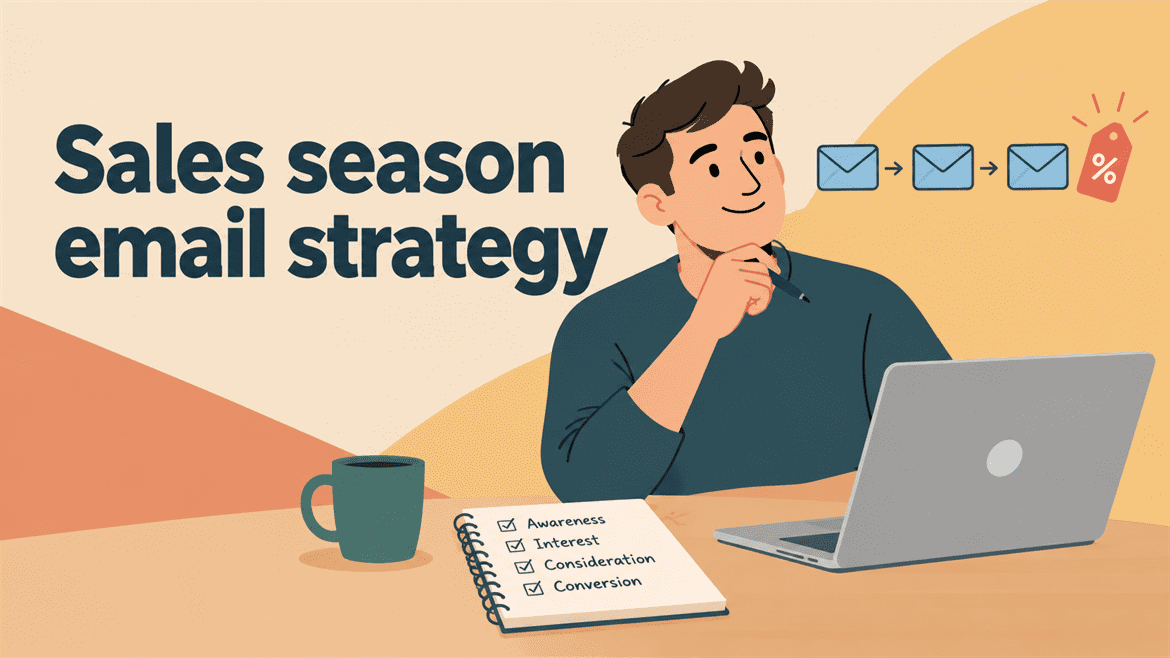
At 07:02 on the Tuesday before Black Friday, an email lands from a homeware brand. It says BIG SALE. At 07:11, a second one arrives. It says BIGGER SALE.
By Friday the brand will have sent eleven emails, none of which have met each other, and the recipient will have unsubscribed after email four.
Each of those emails was probably fine. Together they read like someone shouting increasingly specific things through your letterbox.
This is the first of two posts on writing emails for sales season.
This one covers strategy, when to send, how the emails fit together and why the other eleven months of the year decide how November goes.
The second post covers the writing itself (subject lines, CTAs, body copy), so I won’t make you read about it twice.
Black Friday lands on 27th November this year. That’s just weeks away, which is plenty of time if you start this week and no time at all if you start in November.
Why sequences beat one-offs
Nobody buys on first contact. Picture handing a stranger a flyer that says 40% OFF and expecting them to buy a sofa on the spot.
They’d go home, check three competitors, ask their partner and sleep on it.
Your subscribers do the same, except they spread it across several days and fourteen browser tabs.
A sequence meets people wherever their head happens to be:
- Early: Awareness and wishlisting (“I might want a new coat”)
- Middle: Comparison (“is this coat better than the other coat?”)
- Late: Urgency (“the sale ends tonight and I do want the coat”)
- After: Reassurance and the next purchase (“the coat arrived, what goes with it?”)
A single email can only talk to one of those mindsets at a time, which is why a series is always better than a one-off.
A handful of well-documented behaviours explain why the sequence format works:
- Anticipation. A teaser turns a discount into an event. People enjoy waiting for things, provided you tell them what they’re waiting for.
- Loss aversion. Deadlines move people, but only if they are real. Fake urgency gets noticed, remembered and punished the following year.
- Status. Early access makes a subscriber feel like a member of something. It costs you nothing to give and it’s the cheapest loyalty feature going.
- Decision fatigue. By the second week of November, your reader’s inbox is like a car park at Christmas. The email with one clear message beats the email with nine.
- Reciprocity. A useful email before the pitch buys you attention for the pitch.
That gives us the rule I’d tattoo on every campaign brief. Every email in the sequence gets one job and one sentence describing it.
If you can’t write the sentence, the email doesn’t need to exist.
The eleven-month problem
Imagine a brand that sends nothing from January to October, then emails a 40,000-person list nine times in eleven days.
To the subscriber, that feels like a neighbour you’ve never spoken to throwing a party and inviting you by megaphone.
It looks worse to the inbox providers. Gmail, Outlook and Yahoo watch how people engage with your sends over time.
A sender that appears from nowhere with a huge volume spike, to a list that hasn’t opened anything since spring, looks very much like a spammer. Some of your sale can land in junk folders before anyone sees it.
The fix is dull and effective:
- Keep a welcome sequence running all year, so every new subscriber hears from you within minutes of signing up.
- Send something useful regularly so your list expects you and inbox providers see consistent engagement.
- Collect preferences, wishlists and product interests through spring and summer so you’ve got segmentation data in October.
- Clean the list in September. Run a re-engagement email to anyone who hasn’t opened in a long while, then stop mailing the ones who don’t respond.
- Treat the smaller sales moments as rehearsals. Valentine’s Day, Mother’s Day, back to school, the January sales and the summer shopping events each deserve a mini version of the sequence.
If you sell to businesses, use the same pattern. Budgets get spent in Q4 and reset in Q1, so your sales season runs from roughly October to February, and your buyers spend a good chunk of it waiting on internal approvals.
The SLED sequence
I like a framework when it earns its keep.
SLED: Seed, Launch, Escalate, Debrief.
Seed (now until about 20 November)
Goal: Build warmth, segments and a list of people who want to hear the sale announcement.
- Early October: A re-engagement email to cold subscribers. Anyone who doesn’t respond is dropped.
- Mid-October: A wishlist or gift guide email that gets people clicking on things they like. Those clicks become segmentation data.
- Late October: The early-access invitation. Ask people to join a VIP list for first access to the sale. It’s the cheapest segment you’ll ever build and everyone on it has told you they’re planning to buy.
- Early to mid-November: A teaser that says what’s coming and when. It should build anticipation and should not read like a hostage note.
- Throughout: Update your triggered flows (more on that below).
Cadence: Roughly one email a week, rising to two in the final fortnight.
Launch (about 23 to 27 November)
Goal: Convert the people who already want to buy.
- Early-access email to VIPs and past buyers, 24 to 48 hours before the public sale starts.
- Public launch email, sent when the sale goes live. Your keenest shoppers are refreshing their inbox, and landing the email hours late wastes the moment they care about most.
- A follow-up to people who opened but didn’t click, later the same day, with a different angle (a bestsellers roundup works well).
Escalate (28 November to about 23 December)
Goal: Keep the momentum going without sounding like a car alarm.
- Weekend recap with bestsellers and stock warnings, as long as the stock claims are true.
- Cyber Monday on 30 November using a genuinely different angle, such as a new offer for a defined group or a fresh product category.
- Final-day sale emails, one in the morning, one a few hours before close.
- December gift guides, then delivery deadline emails with exact last order dates for every shipping method, then a last-minute digital gifts or gift card email.
Debrief (24 December to late January)
Goal: Keep the customers you’ve just won and learn from the rest.
- A Boxing Day and January sale email for people who missed out (26 December falls on a Saturday this year).
- Thank-you and delivery updates for buyers, then a review request once the product has landed, then a cross-sell a few weeks later.
- A win-back email for anyone who opened sale emails without buying.
- Write the debrief document, what you sent, to whom, when and what each email earned.
Timing each email
Stop trusting generic best-time-to-send lists. They average everyone’s list, including lists that look nothing like yours.
Send similar emails at different times across October, track opens and clicks, and by launch you’ll have your own answer.
A few principles hold up whatever your data says:
- Match the send to the moment. Sale emails go out when the sale goes live. Last-chance emails go out in the final few hours.
- Respect time zones. If you sell across time zones, schedule by each recipient’s local time if your email platform allows it.
- Space your sends. Two emails to the same person within an hour only works if the second is aimed at a different segment, such as openers versus non-openers.
- Test the evening. Plenty of people shop on their phones after dinner, so a short, mobile-first email sent then is worth a trial.
Frequency and fatigue
More emails don’t help when they all go to everyone.
Split the list into three tiers and give each its own rhythm:
- Engaged buyers: The highest frequency, first access to everything, plus bundles and addons.
- Engaged browsers: Medium frequency, heavier on product details, reviews and answers to objections.
- Cold subscribers: The lowest frequency, with one re-engagement attempt and a clean exit from peak sends as they can drag down your engagement rates and sender reputation.
Two extra moves are worth the effort:
- Suppress buyers from conversion emails the moment they purchase. Nothing says ‘we don’t know you’ like a BUY NOW email for the thing they bought an hour ago. Move them to a thank-you and accessories list.
- Add a preference link to the footer of campaign emails, such as ‘fewer emails during sale season’ or ‘sale emails only’. A controlled reduction keeps a subscriber who would otherwise have hit unsubscribe.
Update your triggered emails
Abandoned cart, browse abandonment, back-in-stock, welcome and post-purchase flows work while you sleep, and they’re frequently among the best performers in an account.
They’re also the ones everybody forgets to update.
Refresh them for the season. Add delivery deadlines, returns policy extensions and sale terms.
Check that your automations don’t collide with your campaigns, because a subscriber who gets an abandoned cart email, a sale announcement and a back-in-stock notice inside the same hour feels hunted.
Many email platforms let you cap how many emails one person receives per day. Use it.
The dull bit that wins
A lot of sale-season damage happens in operations before the copy gets a look-in.
Run through this a fortnight before launch:
- Build the approvals calendar backwards from each send date. B2B teams in particular should allow for the three-week approval chain that every one of us pretends (or wishes) doesn’t exist.
- Test every discount code in a real basket on a real phone.
- Sync your stock. Emailing 20,000 people about a product that sold out at 9am is not a strategy.
- Check your email platform’s sending limits and raise your volume gradually in the weeks before peak.
- Test emails, open them on phone and desktop and include a plain-text version.
- Brief customer service on the offers, the dates and the likely questions.
- Make sure your landing page loads fast on mobile with ten times the usual traffic.
Measure the sequence, not the email
Single-email metrics tell you very little during a sale, because people often buy after the third email you sent and the first one they opened.
Judge the campaign as a whole:
- Revenue per recipient across the whole sequence, by segment.
- Unsubscribe and spam complaint rates, treated as a budget you’re spending.
- Which email position converts, first touch, early access or last chance.
- List growth and engagement after the sale ends.
Depth of discount is a business decision, and copywriters can’t fix a bad one.
Deep discounts train subscribers to wait for the next one. If your margins can’t survive the offer, rewrite the offer before you rewrite the email.
Early access, bundles, free delivery, gifts with purchase and loyalty points all protect your price.
Where the writing comes in
Everything above decides who gets which email and when. What each email says is a separate craft, which gets its own post.
Right, over to you
If your sales season plan is currently a half-finished spreadsheet and a general sense of dread, I can help.
I write and edit email sequences, build the content calendar behind them, and tell you honestly when the answer is fewer emails.
Get in touch whenever suits. No pitch deck, no pressure, and I promise to send exactly one reply.

 Oct 13, 2026
