


How to write product pages that sell without lying
 By Jamiek
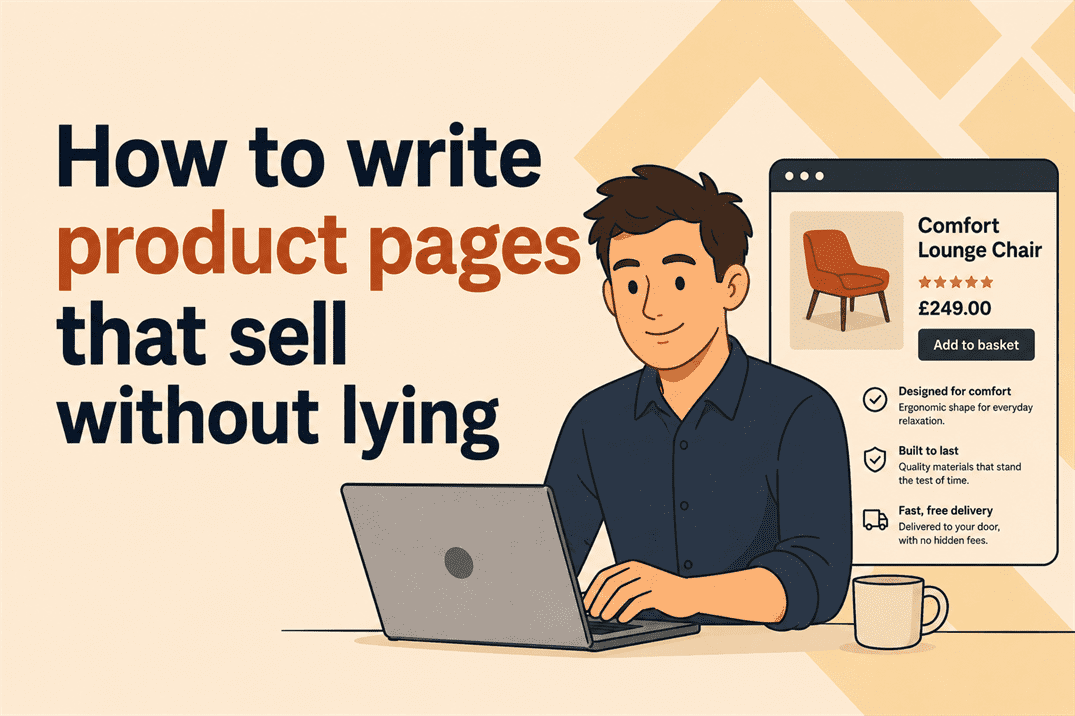
There’s a specific kind of product page that says “the ultimate solution for modern teams” and somehow tells you nothing at all.
You finish reading it no clearer on what the product actually does than you were before you started, but you do now know that the team behind it is very fond of the word “ultimate.”
This isn’t lying, technically. Nobody’s fabricated a statistic or invented a feature that doesn’t exist.
It’s something closer to confident vagueness and it’s just as useless to a buyer as an outright lie, because it gives them nothing to check, trust, or act on.
I’ve written a good number of product pages and the ones that actually convert share a habit.
They say specific, checkable things and they trust that the truth, told well, is more persuasive than a superlative ever will be.
Say what the product does before you say why it’s great
Bad product pages lead with the verdict. Good ones lead with the function, then let the reader form their own opinion, which tends to land on “great” anyway, just without being told to.
- Verdict-first: “The smartest way to manage your team’s workflow.”
- Function-first: “Assigns tasks automatically based on who’s free, then flags anything that’s about to miss its deadline before it does.”
The second version is more confident, not less, because it’s specific enough that a reader can picture using it.
The first version is a claim about a claim. It tells you the product is smart without showing you a single smart thing it does.
How to get there: Write the plain description first, no adjectives and only add the value judgement afterwards if it’s still needed. Often it isn’t.
Use proof that can be checked
“Trusted by leading teams worldwide” is a sentence that has never once made a buyer trust anything.
It’s unverifiable and buyers, especially technical ones, tend to distrust claims they can’t check.
- Unverifiable: “Loved by thousands of businesses.”
- Checkable: “Used by 40 logistics teams across the UK to schedule over 2,000 deliveries a week.”
How to get there: Replace any claim that’s vague enough to apply to a rival product too.
If a competitor could paste your claim onto their own site without anyone noticing, it isn’t proof.
Name the trade-off instead of pretending there isn’t one
Every product has a limitation, a best-fit customer, or a thing it doesn’t do well.
Sales sheets pretend otherwise and buyers generally clock the omission and wonder what else is being covered up.
- Pretending: “Works perfectly for teams of any size.”
- Honest: “Built for teams of 10 to 200. Smaller teams tend to find the automation overkill, larger ones may want our enterprise tier.”
How to get there: Ask, honestly, who this product is a bad fit for and say so somewhere on the page.
Counterintuitively, this tends to increase trust in everyone the product is a good fit for, because it proves the rest of the claims weren’t written to apply to absolutely everyone regardless of truth.
Let the feature explain itself
A feature described plainly is often more persuasive than the same feature dressed up.
The plain version respects the reader enough to let them draw their own conclusion.
- Hyped: “Revolutionary reporting that transforms how you understand your business.”
- Plain: “Builds a weekly report automatically and emails it to whoever needs it, so nobody has to remember to pull the numbers manually.”
How to get there: If the sentence would still make sense with “revolutionary,” “game-changing,” or “powerful” removed, remove it.
What’s left is usually the selling point and it was there the whole time, just buried.
Match the confidence of the claim to the evidence
This is the line between confident and dishonest and it’s worth being precise about.
A claim should only be as bold as the evidence behind it can support.
- Overreaching: “Guaranteed to double your conversion rate.” (Unless it genuinely is guaranteed, in writing, this is a lie wearing a marketing font.)
- Matched: “Customers typically see conversion rates improve by at least 20% within the first two months, based on 2024 account data.”
How to get there: For every bold claim on the page, ask what would happen if a buyer asked you to prove it.
If you can’t, soften the claim until it’s something you’d say out loud to a sceptical prospect without flinching.
Profitable product pages
Product pages that sell without lying aren’t the modest, hedge-everything version of a sales page.
They’re the version where every confident sentence is backed by something specific enough to check and every trade-off is named rather than hidden.
That combination reads as more persuasive, not less, because readers have learned to be suspicious of confidence with nothing behind it, and rightly so.
If your product pages are heavy on adjectives and light on anything a buyer could verify, that’s a fixable problem and usually a fairly quick one.
Get in touch and we’ll go through what’s worth saying on the page.

 Oct 29, 2026

