


The anatomy of a persuasive blog post
 By Jamiek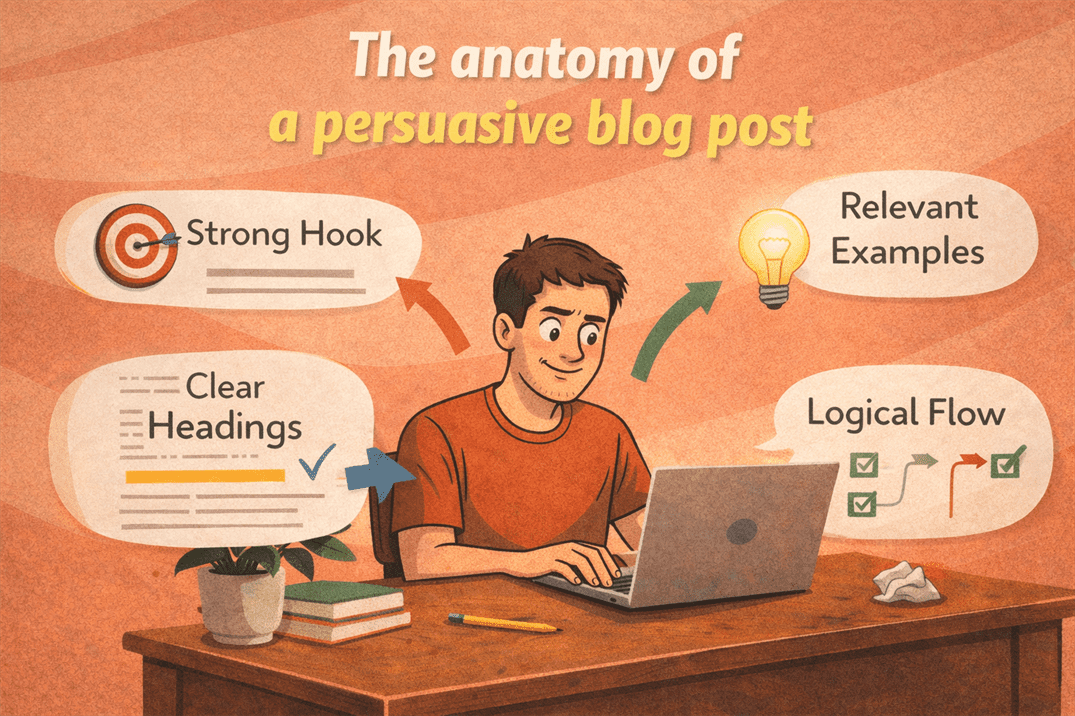
Whenever someone asks for the anatomy of a persuasive blog post, what they usually mean is, “Can you give me a formula I can follow so this converts?”
I understand the appeal.
Formulas feel safe. They give you the sense that if you just arrange the parts correctly, persuasion will happen in the background like a well-trained assistant.
But persuasive writing doesn’t really work that way.
It’s less about filling in sections and more about designing a sequence of decisions.
You’re not assembling paragraphs. You’re guiding someone from their current position to a slightly different one without them feeling pushed.
That’s what I mean by decision architecture.
It starts with tension, not structure
Before I outline anything, I ask myself what belief I’m trying to shift.
If there’s no tension, there’s no movement. And without movement, persuasion stalls.
Let’s say you’re writing about productivity.
You could list ten practical tips and technically deliver value. Or you could frame it around why most productivity systems collapse after two weeks.
The second approach creates a small but important friction. It acknowledges a frustration your reader already feels.
That tension is what makes them lean in.
Over time I’ve realised that the structure of the post matters far less than the situation you’re inviting the reader into.
When they recognise themselves in the setup, you’ve already done half the work.
The hook is about recognition
It’s tempting to open with something witty or grand. Writers love a strong entrance.
But persuasion doesn’t begin with clever phrasing. It begins when the reader feels understood.
When someone thinks, “Yes, that’s exactly my problem,” they relax.
They’re no longer evaluating whether this article might be relevant. They’ve decided it is.
That shift is subtle but powerful. You’re no longer trying to convince them to keep reading. They want to see where you’re going.
And that means your job isn’t to impress them. It’s to describe their reality accurately enough that they trust you to interpret it.
The middle needs progression, not information
This is where a lot of blog posts lose momentum. The introduction is strong, the promise is clear and then the body turns into a collection of loosely related points.
Information gets added, but the argument doesn’t move.
Each section should gently reshape the reader’s understanding. You’re not just explaining concepts. You’re layering perspective.
When I’m editing my own drafts, I’ll often pause and ask, “What does the reader believe right now and what do they need to see next?”
That question forces me to think in sequence rather than in bullet points.
If the answer to that question is unclear, the structure probably needs tightening.
Specificity is what builds credibility
General statements are easy to agree with because they don’t risk much. But they don’t persuade much either.
When you get specific, you show that you’ve actually seen this problem in the wild and aren’t theorising from a distance.
Instead of saying businesses struggle with content, describe how they publish consistently but rarely revisit their core message.
Instead of saying AI helps writers, explain that it can produce a first draft quickly but can’t decide which argument weakens the overall piece.
Specificity creates texture and texture builds trust.
Objections need to be acknowledged
Every reader brings silent resistance with them.
They might be thinking, “This sounds great, but I don’t have time,” or “That works for bigger companies, not for mine.”
If you pretend those objections don’t exist, the reader will disengage.
When you anticipate them and respond inside the post, something shifts.
The reader feels seen rather than corrected.
Persuasion isn’t about overpowering doubt. It’s about addressing it calmly and thoughtfully.
Momentum makes length irrelevant
A persuasive blog post can be long without feeling heavy, as long as there’s forward motion.
Each section should feel like it builds on the previous rather than circling the same idea from different angles.
This is why transitions matter so much. Not because they’re stylistic flourishes, but because they help the reader move smoothly from one realisation to the next.
When flow is strong, the post feels coherent. When flow breaks, even good insights start to feel disconnected.
The ending should change something
I don’t think of the conclusion as a summary. I think of it as the final adjustment.
By the time someone reaches the end, their perspective should have shifted slightly.
Maybe they see their problem more clearly. Maybe they feel more confident about a decision. Maybe they’ve reconsidered an assumption.
If nothing in their thinking has changed, then the post informed them but didn’t persuade them.
And there’s nothing wrong with informative writing. It just serves a different purpose.
What I do behind the scenes
Here’s the unglamorous truth. I rarely know the exact shape of the argument when I begin.
I draft freely. I explore. I follow threads. Then I step back and ask, “What decision am I trying to influence?”
Not what topic I’m covering, but what choice I’m shaping.
- Should they publish now or refine further?
- Should they invest in better positioning?
- Should they rethink their approach entirely?
Once that decision becomes clear, I reorganise the post around it. Sections get moved. Redundant ideas disappear. Stronger examples come forward.
That’s the architecture.
It’s less about formulas and more about intentional sequencing.
In a world where drafting is easy and abundant, the ability to shape decisions thoughtfully is where persuasive writing really stands out.
If you start thinking in terms of belief shifts rather than word counts, your blog posts will feel less like content and more like guidance.
And that’s usually what people are looking for when they click in the first place.
If you’re looking to create or refine clickable content, let’s talk!

 Oct 01, 2026
