


How we built a 12-month content strategy for a tech startup blog from scratch
 By Jamiek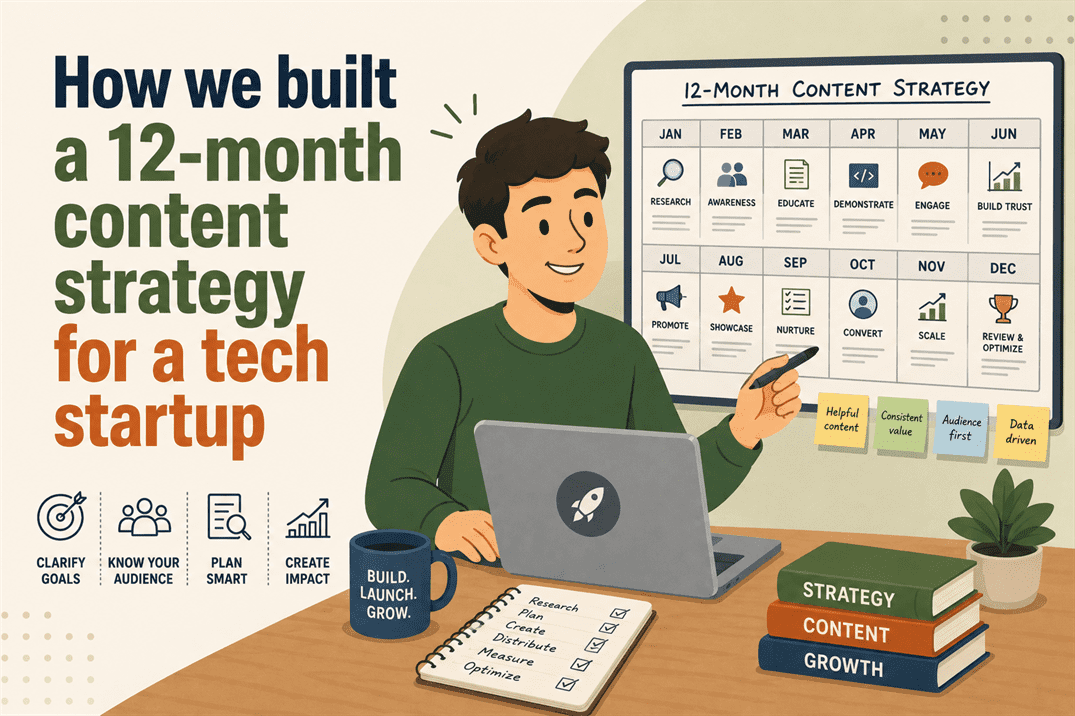
Every now and then a project lands that’s genuinely satisfying to work on.
No legacy content to untangle, no archive of posts written by a previous agency that rhymed “innovative” with “transformative” in every other paragraph.
Just a blank slate, a clear brief and a business that actually wanted a strategy rather than a vague assortment of posts pointed loosely at the internet.
This is the story of one of those projects.
The client
Appification (name changed, because they asked nicely) builds mobile apps for small and medium-sized businesses, booking systems, loyalty programmes, customer portals, that sort of thing.
Good product, clear value proposition, founders who understood their market.
What they didn’t have was any content presence.
The website existed. The blog section existed in the sense that it had a URL and a template.
There were zero posts, zero domain authority and zero reason for anyone to visit unless they’d already heard of the company through other means.
Their goal was straightforward, to build a blog that brought in the right kind of traffic, moved readers through from curiosity to consideration to conversation and didn’t sound like it was written by a committee that had never met a customer.
Twelve months. Full funnel. Starting from nothing.
The brief
Before a single post was planned, we spent time on the questions that actually matter.
- Who’s reading this?
- What do they already believe when they arrive?
- What do they think their problem is, versus what it actually is?
- What does Appification want to be known for, and what does that rule out?
The audience turned out to be two distinct groups that needed handling slightly differently.
First, small business owners who were vaguely aware they probably needed an app but hadn’t committed to the idea yet.
Second, business owners who’d already decided they wanted an app and were now trying to work out whether to build it themselves, use a cheap template solution, or hire someone.
Those are different people at different stages with different anxieties and a strategy that treats them identically produces content that serves neither particularly well.
So we built a funnel.
A proper one, with content mapped to each stage, planned out across twelve months in a sequence that made logical sense rather than just filling a calendar.
Months one to three: Making noise at the top
The first quarter was about visibility. Appification had no audience, no search presence, and no reason for anyone to know they existed.
The job of the top-of-funnel content was to be useful and findable on topics that the right people were already searching for.
No pitching. No “here’s why Appification is great.” Just genuinely helpful content that sat naturally alongside the questions a small business owner might type into a search bar at eleven o’clock on a Tuesday night when their booking system is misbehaving.
The posts published in this phase included:
“Does your small business actually need an app? Here’s how to tell”, the question everyone in the target audience had asked themselves, answered honestly, including the cases where the answer was no.
Nothing builds trust faster than a business willing to say “actually, you might not need us yet.”
“The difference between a mobile-friendly website and a mobile app (and why it matters)”, genuinely confusing territory for the audience, explained without jargon or the barely concealed contempt that a lot of tech writing has for non-technical readers.
“Five signs your customers are ready for a better digital experience”, observational, specific, easy to share.
The kind of post that gets forwarded to a business partner with “this is literally us” in the message.
“Why most small business apps fail before they launch”, contrarian enough to get attention, useful enough to justify the click. Also quietly positioned Appification as the sort of company that thinks about failure modes before the project starts, which is a reassuring thing to signal early.
By the end of month three, the blog had eight posts, a small but growing search footprint and content that was actually worth reading.
The bar for that last one is lower than it should be.
Months four to six: Building the case in the middle
The second quarter shifted. Readers arriving now were warmer, more informed and starting to evaluate options rather than just gathering information.
Middle-of-funnel content needed to do more work, demonstrate expertise, show a point of view, and make Appification feel like the obvious next conversation rather than one of several equally plausible options.
This is where the content got more opinionated. General helpfulness is fine at the top of the funnel. In the middle, you need to take positions.
Posts in this phase included:
“Build vs buy: the honest guide to app development for small businesses”, a genuine comparison, written without the thumb on the scale that most “vs” content can’t resist.
The conclusion was nuanced, which is what made it credible. Readers who weren’t right for Appification left with something useful. Readers who were right for them left with significantly more confidence.
“What does a custom app actually cost? A realistic breakdown”, the post every professional services business is terrified to write because it might scare people off.
In practice, it scares off the wrong people and reassures the right ones, which is exactly the function good content is supposed to perform.
“How a Birmingham café reduced no-shows by 40% using a customer app”, the first case study, introduced mid-funnel where it would land with people already in an evaluative mindset rather than people who’d never heard of the category.
Specific numbers, named outcome, no vague claims about “transforming the customer experience.”
“The six questions to ask any app developer before you sign anything”, positioned Appification as a company confident enough in its own answers to hand readers a scorecard.
This particular post did meaningful work in the sales process for months after it was published, because prospects would arrive on calls having already read it.
Months seven to nine: The content does the selling
By month seven, the blog had traction. There were readers arriving via search, posts being shared and a small but meaningful volume of people coming to the website with enough context that the first sales conversation could skip several of the usual preliminaries.
The third quarter leaned into that. Bottom-of-funnel content is unapologetically about conversion.
It’s not aggressive and it’s not pushy, but it’s also not pretending to be anything other than what it is, content that helps a warm prospect make a decision.
Posts in this phase included:
“What it’s like to work with Appification: From brief to launch”, the process piece that every professional services business should write and most don’t.
Buyers want to know what they’re buying into before they buy into it. Uncertainty costs sales and a transparent process piece removes it.
“Appification vs app builders: Why we’ll always tell you which one is right for you”, the comparison post that named the alternatives directly, engaged with them seriously, and made the case for Appification without pretending the alternatives didn’t exist.
Readers respect this. They’re going to compare you anyway so you may as well be part of the conversation.
“Three apps we built and what happened after launch”, a longer case study roundup covering three different client types, different problems, different outcomes.
The variety was deliberate. A reader who didn’t see themselves in the café story might see themselves in the retail loyalty programme story or the trades business booking system story.
“Still not sure if you’re ready? Here’s how we’d think about it”, the post aimed directly at people sitting on the fence.
Warm, specific and structured around the objections that kept coming up in sales calls.
Written with the explicit knowledge that some readers would read it and conclude they weren’t ready. That’s fine. They’ll come back.
Months ten to twelve: Consolidation and compounding
The final quarter wasn’t about adding new territory.
It was about deepening what was already working, filling gaps the first nine months had revealed and starting to build the kind of evergreen content that would keep earning traffic long after the publication date.
This included an updated version of the original “does your business actually need an app” post, now with more data and a broader range of examples.
A glossary piece covering the terminology that kept confusing prospects in early sales conversations.
A longer, more detailed process guide that expanded on the month-seven post.
And two new case studies covering client types that hadn’t yet been represented in the blog.
By month twelve, the blog had gone from zero to a functioning content asset with posts ranking for relevant search terms, a documented voice that any writer could follow and a clear structure that could be maintained and extended without starting from scratch every time.
What the project taught me
A few things that came up on this project that come up on most:
The posts clients are most nervous about publishing tend to be the ones that perform best.
- The pricing transparency piece.
- The honest comparison with alternatives.
- The case study that admits the first version of something didn’t work as expected.
Specificity is what makes content useful and useful content is what earns trust.
Sequence matters more than volume. Twelve well-planned posts that move a reader through a logical journey outperform forty posts pointing in different directions.
The blog-as-pile-of-content model produces traffic and very little else. The blog-as-argument model produces customers.
And no-audit projects are lovely, but the discipline required to build a strategy from nothing is the same discipline that makes a content audit useful.
You’re asking the same questions either way. You’re just applying them to the future instead of the past.
If you’re starting a blog from scratch, or restarting one that lost its way and you’d like someone to do the thinking before the writing starts, that’s exactly what I do. Get in touch and let’s chat.

 Oct 01, 2026
