


How to do basic keyword research without becoming an SEO obsessive
 By Jamiek
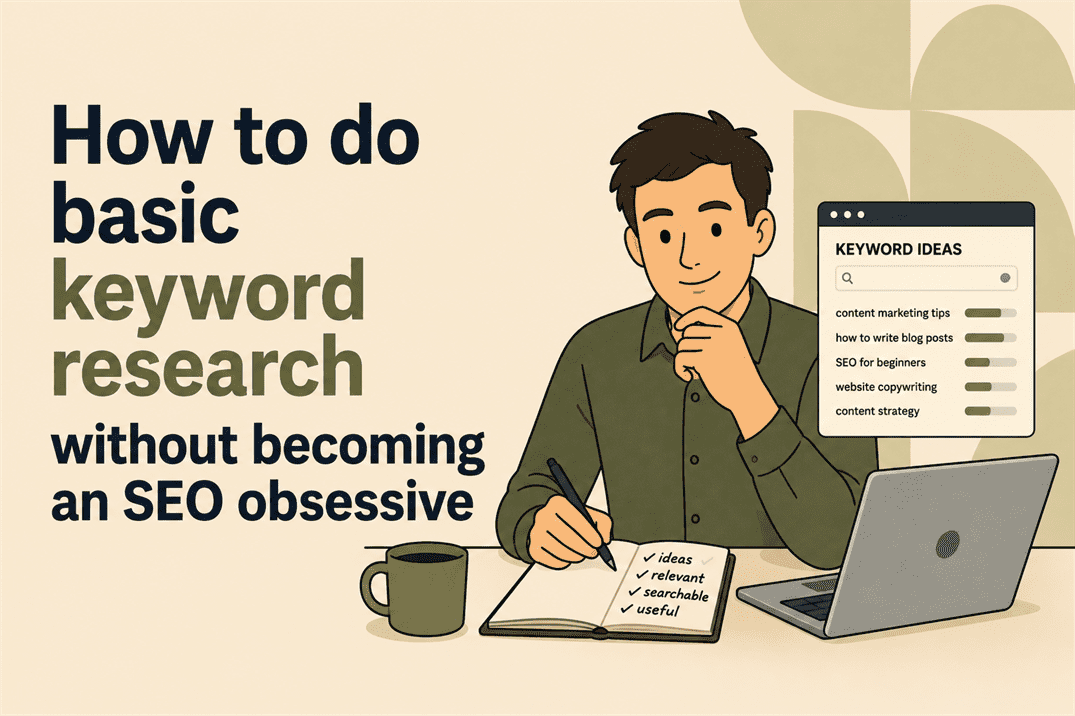
Somewhere out there is a small business owner three hours into a keyword research tool, comparing search volume on “accounting software for small business” versus “small business accounting software,” convinced the wrong choice will sink the company.
It won’t.
Nobody has ever failed to grow a business because they picked the second phrase instead of the first.
Keyword research has a reputation problem. It’s been dressed up as a discipline requiring spreadsheets, competitor gap analysis and an intimate understanding of search intent clustering.
For large companies with dedicated SEO teams, sure, that’s a reasonable use of time.
For a small business writing its own content, most of that is effort spent optimising a decision that barely makes a difference.
The skill is simpler than the industry makes it sound and doesn’t require a subscription to anything.
Start with the questions customers ask
Not the questions you assume they’re typing into Google. The ones they’ve genuinely asked you on a call, in an email, at the till, in a support ticket.
These are your best keyword research, because they’re phrased in the exact language your customers use rather than the language a marketing team invents for a landing page.
- Instead of guessing: “customers want to know about our pricing model”
- Use what they actually said: “how much does it cost to switch from [competitor]” or “is there a setup fee”
How to get there: Ask whoever answers your phone, your inbox, or your DMs to jot down the questions they hear repeated over and over.
Three weeks of that is more useful than any amount of time spent inside a keyword tool.
Use words customers use, not ones your industry uses
Every industry develops its own internal vocabulary and it’s easy to forget that customers don’t use it.
A software company says “workflow automation.” The customer searching for that exact solution might type “how to stop doing this by hand.”
- Industry language: “enterprise resource planning solution”
- Customer language: “one system for stock, orders and invoices”
How to get there: Read your own reviews, your support tickets and any customer interviews you have lying around.
The phrasing customers use is almost always more searchable than the phrasing your website currently uses, because it’s the phrasing of someone with a problem, not someone selling a solution to it.
Check people are searching for it as a sanity check
Google’s autocomplete and the “people also ask” boxes on a results page will tell you, for free, whether real people phrase this problem the way you think they do.
Google Trends is fine for a rough comparison between two phrases if you’re genuinely stuck choosing one.
Anything more elaborate than that, at this stage, is solving a problem you don’t have yet.
- Overkill: Cross-referencing search volume, keyword difficulty and cost-per-click using four different paid tools before writing a single sentence
- Sufficient: Typing real customer questions into Google and seeing what comes up, including what other people also asked
How to get there: Type the question the way a customer would ask it into Google.
If autocomplete finishes your sentence for you, people are searching for it.
Answer the question properly, don’t just repeat the phrase
Once you’ve got a real question, the job is to answer it well, not to work the phrase into the page a certain number of times.
SEO advice used to care a lot about keyword density, but that’s old news now.
Search engines got considerably better at understanding meaning rather than counting repetitions and readers were always going to notice unnatural repetition anyway.
- Old habit: forcing “affordable accounting software for small business” into every other sentence
- Better approach: genuinely answering “what does accounting software actually cost for a small business” once, clearly, with real numbers
How to get there: Write the answer first, as if a customer asked you directly. Go back afterwards and check the obvious phrase appears naturally somewhere near the top, in a heading if it fits.
Know when it’s worth going deeper
None of this means SEO stops mattering once you’re past the basics.
As a business grows, or as competition in a niche increases, there’s real value in proper keyword research, understanding search intent at a more granular level, building content around topic clusters, tracking rankings over time and making informed calls about which terms are worth competing for versus which ones to leave alone.
That’s a legitimate and often valuable investment of time and budget.
It’s just not where a small business should start.
Spending on advanced keyword research before you’ve even answered the basic questions your customers are already asking is solving tomorrow’s problem before you’ve dealt with today’s.
Get the basics right first.
The advanced version can wait until it’s needed and you’ll have a much clearer sense of what to ask for when it is.
To SEO or not to SEO
Good keyword research at a small business level is mostly listening.
Listen to the questions customers ask, use the words they use rather than the words your industry prefers, do a quick sanity check that people are searching for it and then answer it properly instead of stuffing the phrase in repeatedly.
That’s most of the job. Everything past that is optimisation for a stage of growth you can get to later.
If you’re not sure which questions are worth answering first, or want a second opinion before you start writing, get in touch and we’ll work through it together.

 Nov 07, 2026

