


How to brief a content writer so you don’t get generic work back
 By Jamiek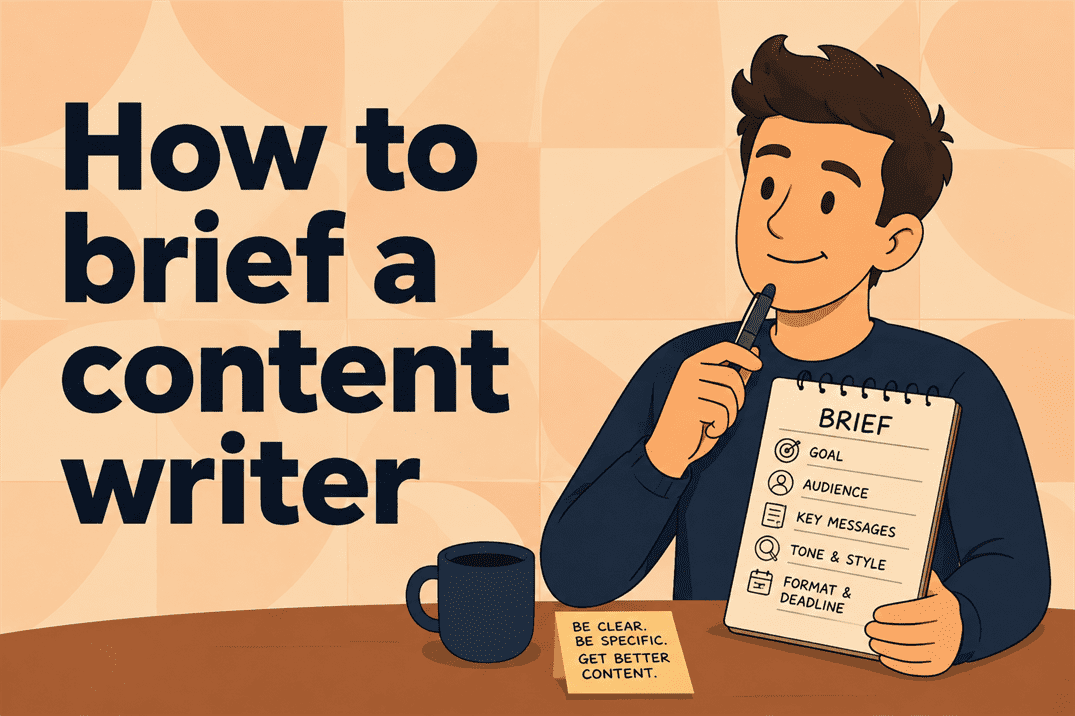
You’ve done this before. You send over a brief that says “write a blog post about our new feature, roughly 800 words, SEO-friendly, engaging tone.”
A few days later you get back 800 words that are technically about your feature, technically readable and say absolutely nothing a competitor’s blog couldn’t say about their version of the same feature with a global find and replace.
You didn’t get a bad writer. You got a bad brief and the writer did exactly what you asked for, which was not much.
The brief is doing more work than you think
A brief isn’t admin you complete so the writer can get on with the real job. It is the real job, or at least the first half of it.
Every writer builds from what they’re given.
Hand someone a vague brief and you’re not getting generic content because they lacked imagination. You’re getting generic content because nobody told them what would make this piece different from the fifty other pieces on the same topic already ranking on page one.
I’ve written before about what clients actually mean when they say “make it more engaging” and briefing has the same problem in reverse.
“Engaging” isn’t a brief. Neither is “SEO-friendly.” These are outcomes you want, not instructions a writer can act on.
The gap between the outcome you want and the instruction you actually gave is exactly where generic content lives.
What a real brief includes
Who this is actually for. Not “our audience,” which tells a writer nothing.
A brief that says “a procurement manager at a mid-size logistics firm who’s been burned by a vendor overpromising and is now reading everything with one eyebrow raised” gives a writer something to write toward.
You’d be amazed how much tone, structure and word choice fall into place once the reader stops being an abstraction.
The one thing this piece needs to say that nothing else does. If you can’t answer this, stop and work it out before you brief anyone.
A piece with no distinct point of view will read like every other piece on the topic, because structurally, it is every other piece on the topic wearing your logo.
What “good” looked like last time, and what didn’t work. Send examples. Not as a style to copy, but as a reference point.
“This one landed because it was specific about numbers” or “this one felt flat because we hedged every claim” tells a writer more in two sentences than a page of tone-of-voice guidelines usually manages.
The constraint that actually matters. Word count is a constraint, but it’s rarely the interesting one.
Is there a claim legal won’t let you make? A competitor you can’t name directly? A stat you’re not allowed to cite without attribution?
Writers can work around real constraints all day. What trips them up is discovering a constraint after the draft’s already written, because nobody mentioned it existed.
What briefing gets wrong most often
Briefs written by committee, where three stakeholders have each added a sentence and none of the sentences agree with each other.
If your brief contradicts itself, the writer has to guess which instruction wins, and they’ll usually guess the safest, blandest option, because that’s the one least likely to get flagged in review.
Vague briefs don’t just produce generic content. They produce cautious content, and caution is the enemy of anything worth reading.
The other common failure is a brief that describes the format rather than the argument.
“We need a listicle, 10 tips, 1,200 words” tells a writer the shape of the container without telling them what’s supposed to be inside it.
Format is the easy part. Any competent writer can hit a word count and a structure.
What they can’t do without your help is know what your company actually believes about the topic that’s worth saying out loud.
Brief quality is a shared job
This is the part that’s a little controversial. Clients often treat the brief as a formality on their end and the real work as something that happens entirely on the writer’s side once it’s handed over.
It doesn’t work that way and it never has.
A writer can ask good questions, push back on a vague instruction and read between the lines where they can.
But they can’t invent context you haven’t given them, and they shouldn’t have to guess what “our voice” means when nobody’s written it down anywhere.
If you’re working with a writer regularly, a style guide your team actually uses does most of this heavy lifting before you even get to an individual brief, because it answers the recurring questions once instead of every single time.
If you don’t have one yet, the first few briefs with any new writer are the place to start building it, since you’ll naturally end up documenting the answers to the same questions over and over.
A brief that actually works
Keep it short. None of the above needs to be a document.
A good brief for a single piece can fit in half a page, who it’s for, the one thing it needs to say, an example of what’s worked before and the constraint that actually matters.
Everything else, the writer should be equipped to work out or ask about.
If you send that over and still get generic work back, that’s a writer problem. Most of the time, when I’m asked to fix content that reads like it could belong to anyone, the fix starts one step earlier than the draft.
It starts with what the brief actually asked for, and whether anyone had answered the harder questions before the writer sat down.
If you want a second pair of eyes on a brief before it goes out, or you’d rather just talk through what you’re trying to get out of a piece, get in touch.

 Oct 15, 2026
