


What clients actually mean when they say “make it more engaging”
 By Jamiek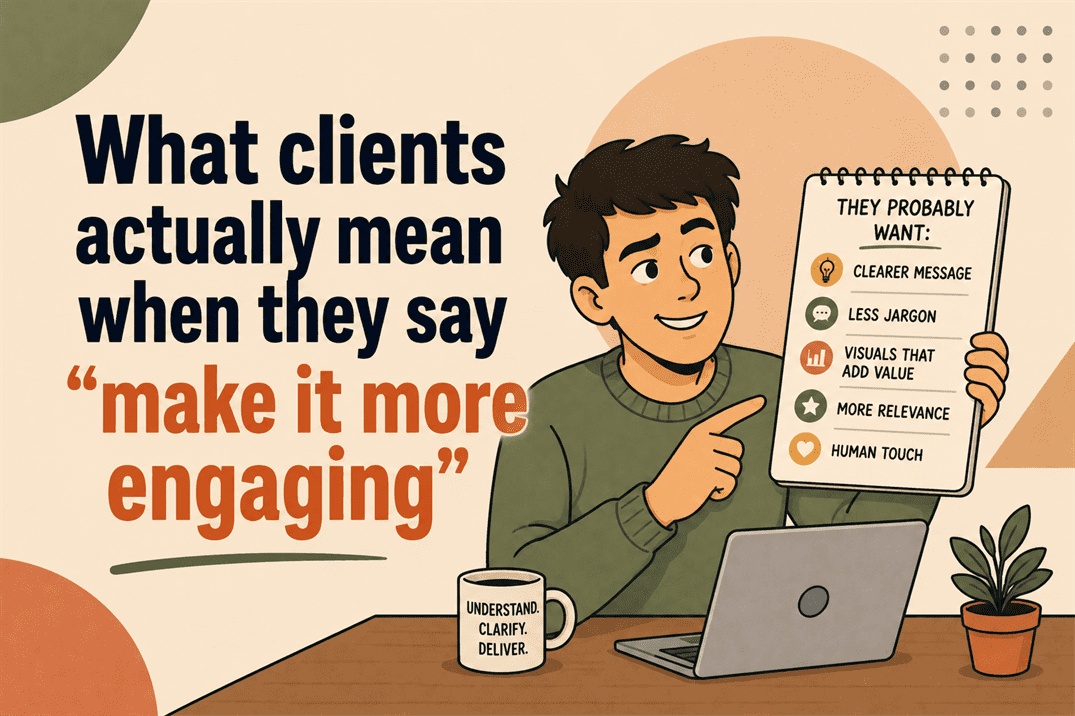
“Can you make it more engaging?”
Five words. Zero useful information. A complete request, apparently.
If you’ve spent any time in content writing, you’ve received this note. You’ve stared at it. You’ve typed “of course!” back with the energy of someone who absolutely knows what that means.
You’ve then opened the document, read the first paragraph three times and thought: more engaging than what? Engaging to whom? In what direction, specifically, would you like it to go?
You’re not being difficult. The feedback is genuinely incomplete.
The problem is that “engaging” is one of those words that means something precise in the client’s head and arrives as pure vapour on your end.
Like “punchy.” Like “fresh.” Like the truly unhinged “can it feel a bit more… I don’t know, alive?”
Here’s what they’re actually saying.
“More engaging” usually means one of six things
The good news is that vague feedback almost always maps to something specific once you know the translation.
After enough rounds of this, you start to hear the real note underneath the note.
“Make it more engaging” is almost never about the writing quality. It’s almost always about one of these:
- It doesn’t sound like us. The tone is slightly off-brand, slightly too formal, slightly too loose, slightly too generic. The client can feel it but can’t name it. What they want is a voice that sounds like a person they’d trust, not a document a committee approved.
- The opening isn’t pulling them in. They got two sentences in and felt nothing in particular. This is a hook problem. The post buries the interesting thing, opens with context instead of tension, or starts with a statistic that nobody emotionally needed.
- It’s too dense. Long paragraphs, no air, no variation in sentence rhythm. Readable in the technical sense. Tiring in the actual sense. The fix here is structural, not verbal.
- It doesn’t talk to me. Second-person address is missing or inconsistent. The piece is describing a thing rather than talking to the person reading it. There’s a meaningful difference between “users often find that…” and “you’ve probably noticed that…”
- There’s no forward momentum. Every section feels like a standalone unit rather than a step in a sequence. The reader finishes a paragraph with no particular reason to start the next one.
- It just ends. The conclusion announces that it is concluding and then stops. No landing. No final thought that earns the time the reader just invested. They wanted a payoff and got a summary.
How to diagnose which one you’re dealing with
When the feedback is vague, the fastest thing you can do is ask one clarifying question.
Not “can you be more specific?” because nobody finds that helpful and it puts the burden back on someone who’s already told you everything they feel able to articulate.
Instead, try: “Is it more the tone and voice, or the structure and pacing?” That’s a binary that most clients can actually answer.
Tone and voice gets you into word choice, personality and register.
Structure and pacing gets you into paragraphs, transitions, and flow.
If they say tone, read the piece aloud. The sentences that feel slightly performed, slightly stiff, slightly like a brochure wrote them, those are your targets.
If they say structure, look at your paragraph lengths. Look at your transitions. Look at whether each section earns the next one or just follows it chronologically because that’s the order you thought of things in.
If they genuinely can’t answer the binary, they’re probably talking about the opening. It’s almost always the opening.
The actual edits
Here’s a few suggestions to help:
- Hook problems: Cut the first paragraph entirely and see if the piece improves. It usually does. Most first paragraphs are warm-up laps the writer needed and the reader didn’t.
- Tone problems: Find one sentence that sounds exactly right and use it as a calibration point. Rewrite everything that sounds like a different author wrote it on a different day in a different mood.
- Density problems: Break up any paragraph over four lines. Add a short sentence after a long one. Let things breathe. The page should look like it has rhythm before anyone reads a word.
- Momentum problems: End each section with a sentence that points forward rather than summarising backward. Not “so, as we can see, X is important” but something that makes the next section feel like a natural destination.
- Ending problems: Write the last paragraph last. After a proper draft, not during it. Ask yourself what you actually want the reader to feel or do when they close the tab. Then write that, in plain language, without announcing that it’s the conclusion.
The broader point
Vague feedback isn’t laziness on the client’s part. It’s the natural limit of what most people can articulate about writing that isn’t quite working.
Your job, a significant part of it, is to decode it, name the actual problem, fix the right thing, and ideally explain what you did and why.
That last part is underrated.
A writer who comes back with “I’ve tightened the opening, broken up the mid-section for better pacing, and rewritten the conclusion to land on a clearer takeaway” is demonstrating something more valuable than writing ability.
They’re demonstrating that they understand how writing works, can diagnose it when it doesn’t and can communicate it like a professional.
Which is, not coincidentally, exactly what separates a content writer from a content strategist.
If you’d rather have someone who can hear the real note underneath “make it more engaging,” Coastal Content is that someone. The feedback loop gets a lot shorter from here.

 Oct 06, 2026
