


Writing sales season emails: Subject lines, CTAs and everything in-between
 By Jamiek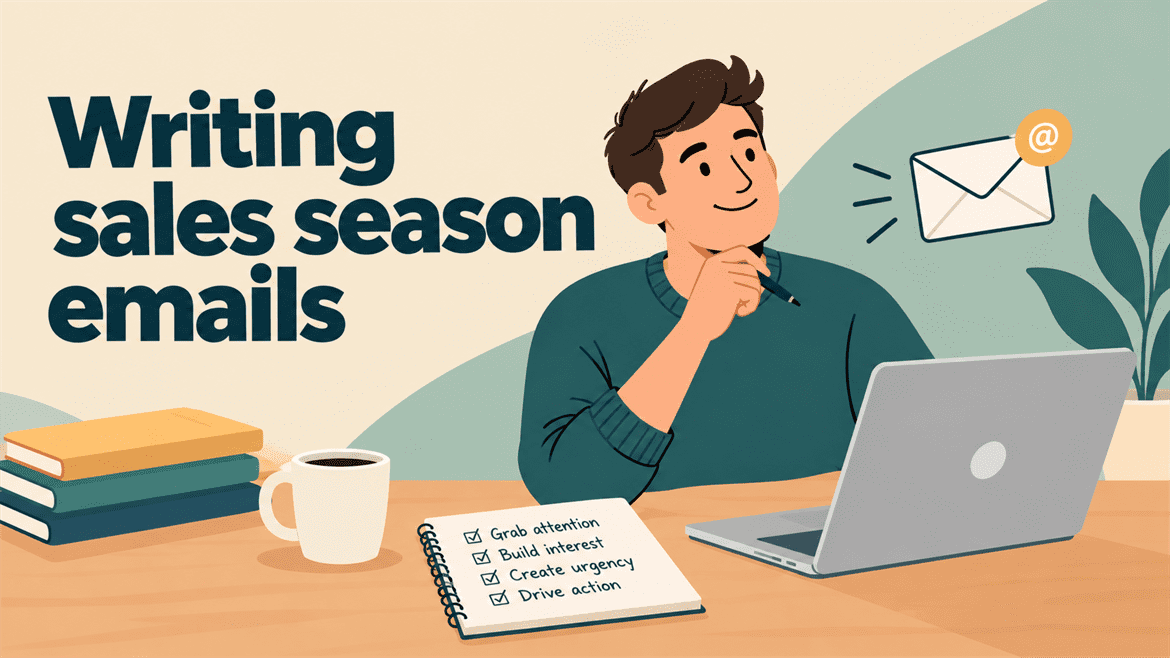
‘HUGE SAVINGS INSIDE.’ That was the entire subject line. Inside, I found a 10% code and a photo of a mug.
I’ve never met a saving that was both huge and unspecified and I’ve met a few.
Post one covered strategy, who gets which email, when, and how the sequence hangs together.
This post covers the writing. We’ll go through the brief, subject lines, preview text, openers, structure, CTAs, offers, personalisation and testing, then draft two full emails from scratch.
I use examples throughout, Fernhill Bulbs (garden), Daybreak Coffee Gear (espresso machines and grinders) and Tilly & Oak (homeware).
All three are invented and every example involving them is a figment of my imagination so I can show and tell.
Start with a five-line brief
Post one’s rule was one job per email. Here’s how I turn that rule into something I can write from.
I answer five questions before I type a word:
- Who: Which segment is reading?
- Mindset: Awareness, comparison, urgency or aftercare?
- Job: One sentence.
- Action: The one thing they should click.
- Proof: The one reason to believe the offer.
Imagine Fernhill is briefing its launch email.
- Who: VIP buyers and engaged browsers.
- Mindset: Urgency, because they’ve been teased for two weeks.
- Job: Get them to buy the Spring Border Bundle on Friday.
- Action: Click ‘Get the bundle’.
- Proof: The average review rating [real figure here].
Once the brief exists, the subject line almost writes itself and the body has a spine.
I also write the button text before anything else. If I can’t write the button, I don’t know the job.
Subject lines
A subject line has one job, to earn the open from the right person. Everything else is decoration.
These are the rules I keep coming back to, each with a hypothetical example.
- Say what’s inside, with a number. Fernhill could use ’50 tulips for £19, until Monday’, which tells the reader what, how much and when. ‘Big news from Fernhill’ would tell them nothing and sound like a fire alarm.
- Put the key words first. Phones cut subject lines off after roughly 30 to 40 characters, depending on the device and the email app. Daybreak could write ‘Free descaling kit ends tonight’, which puts the offer in the first four words, so it would survive the cut.
- Match the subject line to the stage in the sequence. A teaser, a launch and a last-chance email do different jobs so they should sound different (the list below shows one for each).
- Give curiosity a payoff. Tilly & Oak could try ‘We hid something in the candle range’. That works if the email reveals a hidden discount code in the first line, and it fails if the email is a standard promo, because the reader feels tricked.
- Pair urgency with a real time. ‘Ends Monday 23:59’ beats ‘Hurry!’ because the first one is checkable and the second one is noise.
- Skip the spam-filter bait. ALL CAPS, three exclamation marks and ‘FREE!!!’ tend to land in junk. Treat emoji as a test, never as a default, and check how they render on both phone and desktop.
- Personalise by segment before you personalise by first name. Daybreak could send grinder-clickers ‘The grinder that pairs with your machine’, which is relevant to them. ‘Sam, you’ll love this!’ is relevant to nobody called Sam.
- Write three versions and pick the one you’d be happy to read aloud to a friend.
Here’s how that could play out across one sale season, with one imagined subject line for each job:
- Teaser: ‘Something for your borders lands Friday at 8’
- Early access: ‘You’re in: Early access starts now’
- Launch: ‘Spring Border Bundle: 50 tulips for £19, until Monday’
- Follow-up to openers who didn’t click: ‘Still thinking about the Duo?’
- Last chance: ‘Free descaling kit ends tonight’
- Delivery deadline: ‘Order by 16th December for Christmas delivery’
- Post-purchase: ‘Your machine’s on its way (and here’s your first-shot guide)’
Preview text and sender name
Preview text is your second subject line, and most shops leave it to chance.
If you don’t write it, inbox apps fill it with ‘View this email in your browser’, which has never sold anything.
Fernhill’s launch email could use the subject line above with the preview text ‘Free delivery over £40. Ships in time for planting.’, so the reader would get the deal and the reassurance before they open.
The sender name matters too.
Daybreak could send every sale email from ‘Dave at Daybreak’ rather than switching between ‘Daybreak’, ‘Daybreak Offers’ and ‘The Daybreak Team’.
A consistent name builds recognition across the season, and recognition is the cheapest trust you can buy.
Opening lines
The reader made their decision at the subject line, so the first sentence should confirm it.
- Lead with the offer. Fernhill could open with ‘The Spring Border Bundle is live: 50 tulip bulbs in five colours, £19 instead of £24, until 23:59 on Monday.’ Nothing needs unpacking.
- Cut the throat-clearing. Imagine Tilly & Oak’s first draft opens with ‘At Tilly & Oak, we’re passionate about making houses feel like homes.’ The rewrite could open with ‘The candle range is 20% off until Monday.’ The passion can live on the About page.
- Reference the last email. Sequences work when emails talk to each other, so Tilly & Oak’s Friday email could open with ‘On Wednesday our VIPs got first pick. Today it’s open to everyone.’ The reader instantly knows where they are in the story.
- Make the greeting a decision. Fernhill could skip the greeting and go straight to the offer, while Daybreak could use ‘Morning,’ because it suits its voice. Either works. A broken ‘{{first_name}}’ placeholder doesn’t.
Structure that survives a phone
Most sale emails get opened on phones, so I design for a thumb and a two-second glance.
Here’s the order I use, with a hypothetical Daybreak launch email as the example:
- Headline with the offer: ‘Free descaling kit with every machine, until Monday’.
- One supporting sentence: ‘Worth £24, and it keeps your machine tasting good for years.’
- The primary CTA button: ‘See the two machines’.
- Two or three product blocks, not twenty. Daybreak could show the Duo and the Studio, because a shopper facing twenty machines closes the email.
- Proof: A star rating and one short customer review.
- A deadline and delivery line: ‘Ends Monday 23:59. Free delivery, usually 2 working days.’
- The same CTA button again.
- A footer with a visible unsubscribe link, a preference link and your address.
Length follows the job. A teaser can run 40 words. A launch email might run 80 to 120 plus the product blocks. A last-chance email earns about 50.
A December gift guide can stretch further, because the reader came to browse.
A few build habits save you pain.
- Write alt text for every image, because some apps block images by default and your hero banner becomes an empty box.
- Never send an image-only email, because filters dislike them and screen readers can’t read them.
- Include a plain-text version.
- Check the email in dark mode, where a logo with a white background turns into a small glowing rectangle.
CTAs
The CTA is the one line the whole email exists for, so it deserves more time than the paragraph above it.
- Name the outcome on the button. Fernhill could use ‘Get the bundle’, which tells people what happens next. ‘Click here’ and ‘Submit’ tell them nothing. ‘Shop now’ works as a fallback, though it rarely beats a specific label.
- Pick one primary action per email. Imagine Tilly & Oak’s launch email with one button, ‘Shop the candle range’, and one plain text link underneath, ‘See delivery dates’. Two competing buttons would halve the energy of each.
- Repeat the button after any long stretch of content and keep the wording identical. A reader who scrolled past the first button shouldn’t have to learn a new label.
- Add microcopy under the button. Daybreak could put ‘Free descaling kit. Ends Monday 23:59.’ beneath ‘See the two machines’, which answers the last-second ‘is this still worth it?’ question.
- Make it easy to tap. Buttons around 44 pixels tall, with space on either side, give thumbs a fair chance. Imagine Fernhill moves its button out of a cluster of footer links and into a row of its own: fewer fat-finger misses would be the likely result.
- Send the click to the right page. Daybreak’s last-chance email should link straight to the descaling kit offer with the Duo preselected. If the page headline, price and deadline all match the email, nothing feels like a bait and switch.
Here’s how CTA wording could shift across a sequence:
- Teaser: ‘Remind me on Friday’ or ‘Join the VIP list’
- Early access: ‘Claim early access’
- Launch: ‘Get the bundle’
- Last chance: ‘Get it before midnight’
- Delivery deadline: ‘Check my delivery date’
- Post-purchase: ‘Get the setup guide’
Urgency without crying wolf
Post one made the case for honest deadlines. Here’s the writing side of it.
- Put the exact deadline in the copy, with a time zone. Daybreak could write ‘Ends Monday 30th November, 23:59 GMT’, which a reader can screenshot and a customer service agent can enforce.
- Pull stock claims from live numbers. Fernhill’s ‘Only 11 left’ would come from the inventory feed, so it’s correct at send time. A hard-coded ‘selling fast’ for something with 4,000 units in the warehouse is a fib.
- Keep countdown timers tied to the real end time. A timer that resets on refresh teaches subscribers to ignore every timer you ever send.
- Give each follow-up a different reason. Tilly & Oak could keep a reason bank, price, stock, delivery deadline, a gift guide, a review, a bundle. Friday could sell on price, Saturday on stock, Sunday on a review and Monday on the deadline, so nobody gets the same pitch twice.
Framing the offer
The same discount can feel generous or stingy, depending on how you write it.
- Use the rule of 100. For items under £100, a percentage usually sounds bigger, and for items over £100, a pound figure usually does. Say Tilly & Oak sells an £18 candle and a £240 armchair. The candle would read better as ‘20% off’ than ‘£3.60 off’, and the armchair would read better as ‘£40 off’ than ‘17% off’. Test it on your own list.
- Show the value of a gift, not just its existence. Daybreak could write ‘Free descaling kit (worth £24)’, so the reader does the arithmetic for free.
- Break a bundle into a unit price. If Fernhill’s Spring Border Bundle is £19 for 50 bulbs, that works out at 38p a bulb, and that line could go in the first paragraph.
- Use delivery thresholds as a nudge. Say Fernhill offers free delivery over £40. A £19 bundle plus a £22 bag of narcissi would cross it, so a one-line suggestion in the email (‘Add the narcissi to unlock free delivery’) would do the rest.
- Keep reference prices honest. If you write ‘was £24, now £19’, the £24 should be a price you’ve genuinely charged. Pricing claims are regulated, so check the current rules for your market before the season starts.
Personalisation without the creep factor
Good personalisation feels like service. Poor personalisation feels like surveillance.
- Write for the segment. Daybreak could send grinder-clickers an email about grinders and machine-browsers an email about machines. Same sale, two different openers.
- Use browsing data gently. ‘Still thinking about the Duo?’ would be helpful. ‘We noticed you looked at the Duo three times on Tuesday’ would make people check their curtains.
- Reuse the preferences you collected in spring. If Fernhill’s sign-up form asked ‘Pots, borders or veg patch?’, those answers could decide the hero image, pots get the container bundle, borders get the Spring Border Bundle.
- Write a fallback for every merge field. If the first name is missing, Tilly & Oak’s email could say ‘Hello’ rather than ‘Hello ,’.
Voice
Sale season doesn’t give you permission to change personality. Each shop should still sound like itself in November so people would recognise the email before they read the sender name.
Short sentences help scanning, and I read every email aloud before it ships.
It takes ninety seconds and it catches more clangers than any spellchecker.
Two emails from scratch
Here are two hypothetical emails, built from the brief, the rules and the sequence above.
Both are samples to borrow from, and the details (prices, stock, ratings) are invented.
How Fernhill Bulbs’ launch email could look
Subject: Spring Border Bundle: 50 tulips for £19, until Monday
Preview: Free delivery over £40. Ships in time for planting.
The Spring Border Bundle is live: 50 tulip bulbs in five colours, £19 instead of £24, until 23:59 on Monday 30 November.
[Get the bundle]
Free delivery over £40. Ends Monday 23:59.
The bundle mixes early, mid and late varieties, so your border keeps flowering for weeks. That’s 38p a bulb, planted pointy end up, about 15 centimetres deep.
Rated [real rating] from [real review count] gardeners.
Want free delivery? Add the narcissi (£22) and you’re over £40.
[Get the bundle]
The subject line carries what, how many, how much and when. The preview text handles the delivery question.
The opener confirms the subject line, the button repeats the offer, and the microcopy closes the ‘is it worth it?’ gap.
The unit price and review add proof, the narcissi line handles the delivery nudge and the second button catches anyone who scrolled.
How Daybreak Coffee Gear’s last-chance email could look
Subject: Free descaling kit ends tonight
Preview: Black Friday offer closes at 23:59. The Duo has 11 left.
The free descaling kit (worth £24) ends tonight at 23:59 GMT. It comes with every machine, and the Duo is down to its last 11 units.
[Get it before midnight]
Free delivery, usually 2 working days.
Not sure which machine suits you? The Duo is the one for small kitchens and strong opinions. The Studio is the one for people who like to tinker.
[Get it before midnight]
This one runs short because the reader already knows the offer.
The subject line names the deadline, the preview adds a stock number (which would need to be real and live), and the opener repeats both.
A single line helps the undecided reader, and the button label matches the urgency.
Test the writing
Post one made Seed your test lab. Here’s what to put in it.
- Test one variable at a time. Imagine Fernhill sends two versions of its October guide, identical except for the subject line, to equal slices of the list.
- Write the hypothesis before you send. ‘A subject line with a price will get more clicks than one without’ is testable. ‘Let’s see what happens’ is not.
- Pick the metric first. Apple Mail Privacy Protection inflates open rates, so a shop like Tilly & Oak would do better to judge subject line tests on clicks and revenue, with opens as a rough guide only.
- Test things that matter to the sale: Subject line style, CTA wording, preview text and the offer framing (‘20% off’ against ‘£5 off’).
- Write down the winner and the reason. Daybreak could keep a one-page list of what worked, so December’s emails inherit October’s lessons.
The copy QA checklist
I run this checklist the day before every send. Each item comes with an example of what can go wrong.
- Price in the email matches the price on the site. Imagine Fernhill’s email says £19 and the product page says £21. That’s an afternoon of apologies waiting to happen.
- Dates, days and time zones agree. ‘Ends Monday’ next to ’30th November’ is only right if 30th November is a Monday, and this year it is.
- Discount codes match in case and spelling. BLACK20 and black20 should both work, but test it.
- Every link goes where you said it would. Imagine Daybreak’s button sends people to last year’s offer page.
- Alt text, preview text and a plain-text version are all in place.
- A mobile version has been checked by a human.
- The unsubscribe link is visible and works, and tracking tags are on every link.
The emails you forgot were marketing
Order confirmations and dispatch notices tend to get opened more than any promotion, so they deserve a line of care.
Fernhill’s dispatch email could say ‘Your bulbs are on their way. Plant them within two weeks, pointy end up.’
Daybreak’s order confirmation could include a link to the first-shot guide.
Neither email tries to sell anything. Both make the next purchase easier and both would be cheap to write.
Your turn
If your sale season emails are currently written the night before you send, with a deep sense of regret, I can help.
I write and edit email copy for online businesses, from subject lines to full sequences, and I’ll tell you honestly when the draft is already fine.
Get in touch whenever suits. No pitch deck, no pressure, and I promise to send exactly one reply.

 Oct 13, 2026
