


Common questions about outsourcing content (and the answers that matter)
 By Jamiek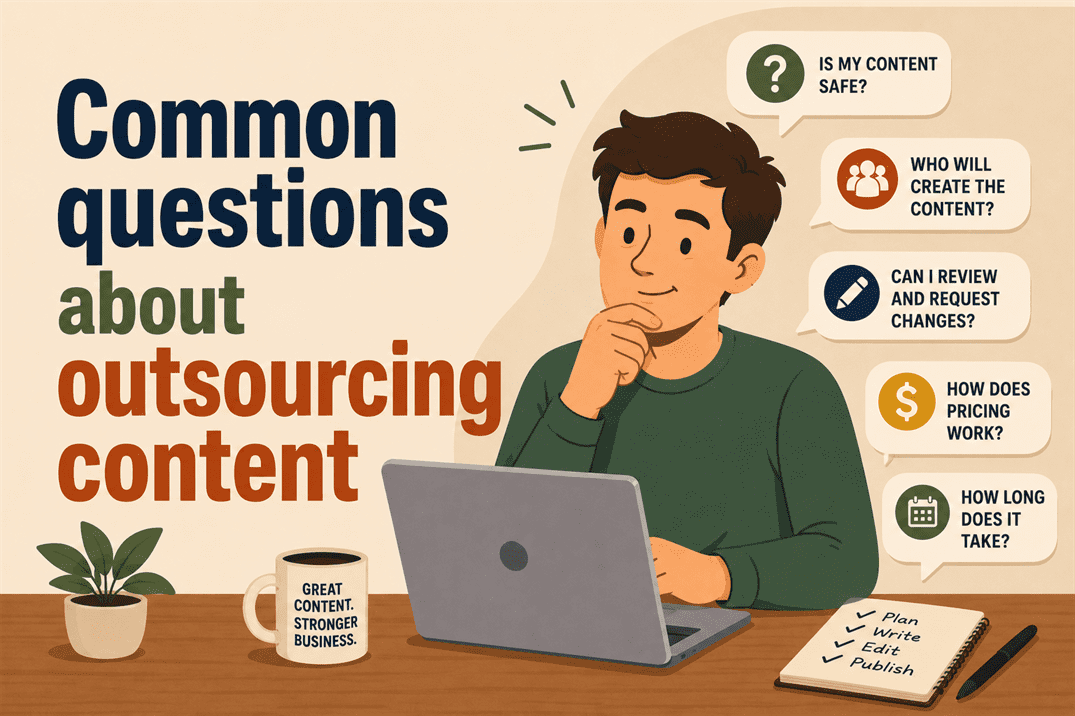
Let’s be honest. You’ve been putting this off.
You’ve got a half-finished blog post from February, a content calendar that was aspirational rather than functional and a growing suspicion that “we’ll handle content in-house” was something you said with more confidence than was strictly warranted.
The website exists. It just doesn’t do very much.
So now you’re thinking about outsourcing. Good.
Let’s get through the questions standing between you and actually doing something about it.
“How do I know if I’m ready to outsource content?”
You’re ready when the cost of not having good content exceeds the discomfort of paying someone to write it.
In practice, this tends to look like one of the following:
- Your website hasn’t been updated since a year ending in a small number
- Nobody on your team wants to write (and it shows)
- You’re producing content but it isn’t doing anything measurable
- You’ve realised that “Shaun from accounts occasionally writes a blog post” is not a content strategy.
You don’t need to have a fully formed brief, a defined audience, or a clear vision. A decent content consultant will help you work that out.
What you do need is a genuine willingness to invest in it and, crucially, a point of contact who can answer questions without disappearing for three weeks.
“Can an outsider really write about our industry?”
This is the most common objection and also the one that evaporates fastest once you’ve actually worked with an experienced writer.
A good content writer brings the ability to research quickly, explain clearly and write in a way that holds attention.
Here’s what you bring the deep technical knowledge, the client context, the industry nuance.
The job is collaborative. You’re not handing over the keys to the building, you’re hiring someone to turn what you know into something readable.
The caveat is that some industries genuinely need a specialist.
If you’re a neurosurgeon writing for other neurosurgeons about very specific surgical techniques, yes, you probably want someone with a science background.
If you’re a B2B SaaS company trying to explain your onboarding flow to potential clients, you want a writer who’s good at making things clear, and there are plenty of those.
Most businesses overestimate how specialised their content needs are and underestimate how transferable good writing skills are.
The writer who’s spent a year covering fintech and two years covering legal services and four years covering tech isn’t lacking industry knowledge. They’re approaching yours fresh, which is occasionally exactly what you need.
“What does good outsourced content actually look like?”
It looks like something you’d read to the end. That’s a low bar and yet it eliminates at least 80% of what’s being published right now.
More practically, it answers the question it promised to answer, it has a point of view rather than just a summary of existing summaries, it sounds like a person wrote it and it fits where it’s supposed to go.
A blog post for a curious early-stage buyer reads differently to a case study aimed at a procurement team.
Good outsourced content understands that distinction without you having to explain it every single time.
It also doesn’t require you to rewrite it. You might request tweaks, you might ask for a different angle, you might have feedback. That’s normal.
But if every draft comes back needing a complete overhaul, something has gone wrong earlier in the process, probably at the brief stage.
“How much should we be involved?”
As much as you want, as long as you’re available when it matters.
The writer needs certain things, an informative brief, access to your subject matter experts when relevant, timely feedback and approval before anything goes live.
Beyond that, the level of involvement is yours to choose.
Some clients want weekly check-ins and a content calendar they can see updating in real time. Others send a brief and reappear when the draft lands. Both work.
What doesn’t work is the disappearing act.
The brief gets sent, the writer delivers a draft and then it enters a review process that apparently involves seventeen people, none of whom can agree and the whole thing quietly dies.
Six weeks later, someone emails asking why the blog hasn’t been updated.
If internal bottlenecks are a genuine concern, it’s worth naming that at the start.
A good content consultant will either help you design around them or at least make sure you’re not paying for work that’s going to get stuck in a queue.
“Won’t AI be cheaper than hiring a writer?”
Cheaper, yes. The same thing, no. The same quality, definitely no.
AI is genuinely useful for tasks like research, outlines, first drafts on predictable topics, summarising, repurposing.
Used intelligently, it speeds things up and reduces costs. Anyone who tells you it has no role in modern content production is either bluffing or hasn’t tried it.
What it doesn’t do is bring a perspective. It doesn’t have the professional judgment to know when the safe answer is the wrong one. It can’t draw on twenty years of watching what works and what doesn’t.
It produces content that ranges from fine to suspiciously fluent, and your readers, increasingly, can feel the difference even when they can’t name it.
The businesses using AI well are using it as part of a workflow that still has a human making the important decisions.
The businesses using it badly are publishing the first output, calling it content marketing and wondering why nothing’s happening.
“How do we maintain our brand voice?”
This is a genuinely good question and the answer is, you have to be able to describe your brand voice first.
“Professional but approachable” is not a brand voice. “We sound a bit like a knowledgeable friend rather than a corporate entity, we use plain English, we occasionally make jokes but not at the expense of the people we’re trying to help, and we never use the phrase synergistic solutions” is a brand voice.
A good content consultant will either help you develop a voice framework or work from one you already have.
That framework then informs every piece of content, so you don’t have to re-explain your personality in every brief.
Done properly, a reader who’s been on your site before should be able to read a new piece and recognise it as yours without seeing your logo.
The first few pieces often involve more back and forth than later ones. That’s not a bad sign. It’s calibration.
The writer is learning the edges of your voice and you’re learning how to brief them.
After a few rounds, the gap between what you imagined and what arrives gets very small.
“What should we actually outsource versus keep in-house?”
A reasonable starting point, outsource production, keep strategy close.
The decisions about what to write, who it’s for and why it matters should stay with someone who understands your business deeply enough to make good calls.
That might be a consultant working alongside you, it might be an internal marketing lead, it might be you.
But handing over strategic control entirely to someone external without proper briefing is how you end up with a lot of technically fine content that points in the wrong direction.
Production is where the bottlenecks usually live.
Writing takes time. It takes focus. It takes the specific skill of being able to sit down and produce a readable thousand words on a topic that, if you’re honest, you’d rather be doing something else instead of writing about.
Outsourcing that makes sense for most businesses.
“What results should we expect and when?”
Later than you’d like and more gradually than a bar chart will ever adequately represent.
Content marketing is not a tap. You don’t turn it on and watch leads flow out the other end the following Tuesday.
It’s more like planting something. You do the work now, and it compounds over time.
More pages indexing, more trust accumulating, more people encountering your name at the moments that matter and filing it away for later.
The businesses that get the best results from content are the ones who commit to it as an ongoing activity rather than a one-off project.
A twelve-post burst in January followed by silence until someone panics in September is not a content programme. It’s two content programmes, both too short to build momentum.
Realistic expectations for a sustained effort over six to twelve months include improved search visibility on target topics, more inbound enquiries with better context about what you do, shorter sales conversations because prospects have already done some of the work, and the beginnings of a content library that keeps working after you’ve stopped paying attention to it.
Not all of those things are easy to put in a spreadsheet.
Some of the value is qualitative, you look like the kind of business worth trusting. That matters more than most attribution models give it credit for.
“How do we get started?”
Pick someone whose work you’ve read and respected. Brief them properly. Give them feedback. Stay in the loop without micromanaging. Pay them on time.
That’s it. That’s the whole framework.
The businesses that have the best experience outsourcing content are the ones who treat it as a genuine working relationship rather than a transaction.
Good writers will go further for clients who are organised, communicative and clear about what they want.
Mediocre outputs are often the product of mediocre briefs as much as mediocre writing.
If you’ve read this far and you’re thinking it might be time to actually do something about your content, I’d love to hear from you.
No hard sell, just a conversation about what you actually need.

 Sep 17, 2026
