


Why your brief is the problem, not the writer
 By Jamiek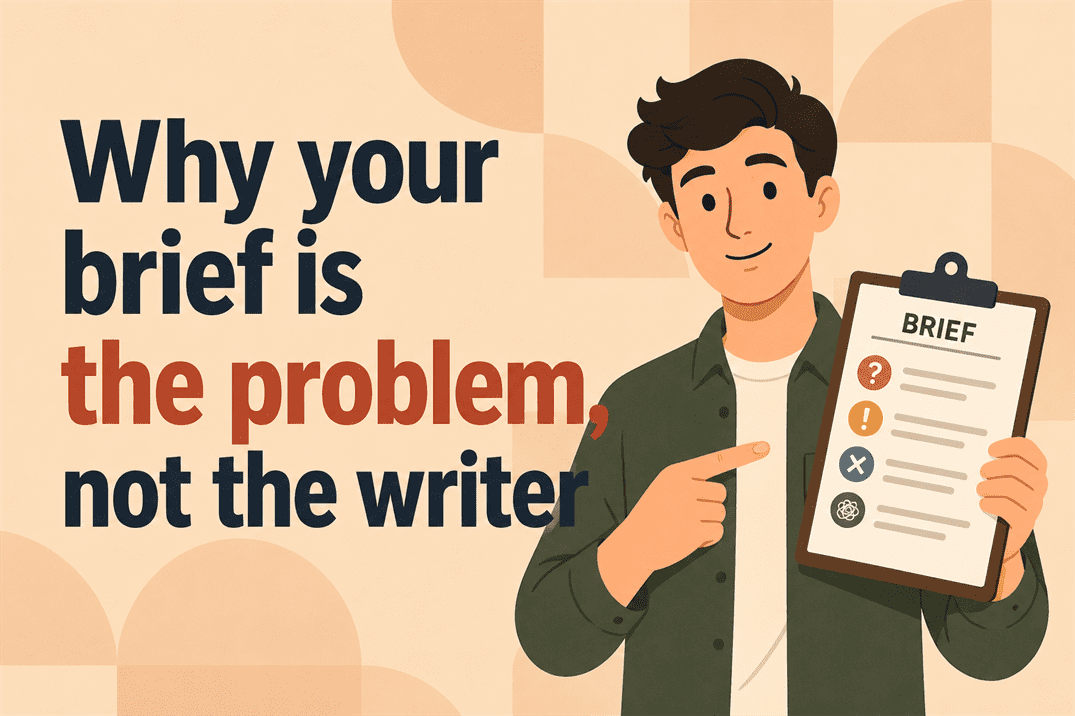
There’s a particular kind of feedback that lands in a writer’s inbox about once a month. It says something like, “This isn’t quite what we were looking for”.
Sometimes it’s more specific. Sometimes it’s less.
What it almost never includes is a clear account of what was being looked for, which is how the situation got this way.
I want to talk about briefs, because most of the dysfunction in a content relationship lives there and almost none of the blame gets directed there.
The brief is a contract
When you commission a piece of content, you’re entering into an informal agreement.
You’re basically saying, here is the shape of the thing I want and I’m asking you to fill it in.
The writer is saying: I’ll do my best work within that shape.
The problem is that most briefs don’t describe a shape. They describe an idea of a shape.
Something about X, maybe 1,500 words, here’s a keyword we’d like in there.
That’s not a brief. That’s the beginning of a conversation that never actually happened.
Briefs fail in predictable ways, which is almost comforting.
The main ones are:
- Scope without stakes. You’ve explained what the article should cover but not why it exists. Who reads it? What do they need to understand by the end? Without this, the writer is making editorial decisions that are really strategic decisions and they don’t have enough context to make good ones.
- Tone by example. “Like our other posts” requires the writer to reverse-engineer your voice from work they haven’t spent years writing. It produces a first draft that reads like an approximation of your style rather than an expression of it. If you can’t describe your tone in words, you might want a style guide before you write another brief.
- Moving targets. The brief was written when the strategy was in one place. By the time the draft comes back, the strategy has shifted and now the piece is subtly off in ways that are hard to explain. This isn’t the writer’s fault. It’s a process that doesn’t have a fixed point of reference.
- The missing constraint. Sometimes the most important information is what the content can’t do, topics you’re avoiding, a competitor you don’t name, a claim you can’t make without caveats. Writers can’t work around constraints they don’t know about.
What a good brief actually costs
Writing a thorough brief takes time. Maybe ninety minutes for a complex piece, twenty for a simple one. Most clients spend considerably less.
The logic seems to be that briefing is overhead and the writer will work it out.
But the writer will only work out what they can infer and inference is not the same as intent.
When the draft comes back wrong, the revision conversation takes longer than the briefing conversation would have.
There’s a second draft, sometimes a third.
The writer feels like they’re being moved in circles. The client feels like the writer didn’t get it.
Both are right and neither caused the problem.
A good brief isn’t documentation for its own sake. It’s the cheapest place in the process to change your mind.
The PRAT framework (sorry!)
A brief worth handing over covers four things:
P — Purpose. Why does this piece exist? One sentence like “we want people searching for X to find this and trust us enough to book a demo” is more useful than two paragraphs of background.
R — Reader. Who are they, specifically? Not “small business owners.” More like, “someone who has just started evaluating options, probably has a finance background, has probably heard of us but hasn’t converted yet”.
The reader shapes every decision the writer makes about depth, vocabulary and assumptions.
A — Action. What should the reader do, feel, or believe after reading? Even for a purely informational piece, this matters. “They should feel confident enough to take the next step” is different from “they should understand they’re not alone in this problem.” Different endings, different articles.
T — Terrain. What are the constraints and non-negotiables? Tone guidance, what can’t be said, what’s already been covered, who needs to approve it. If your SEO parameters are fixed, put them here too.
PRAT is not a beautiful acronym, but any brief that answers these four things in writing is one that can be handed to a writer without a follow-up call or endless revisions.
The payoff
Nobody’s pleased with themselves for writing a thorough brief. But the effects compound.
A weak brief leads to a weak draft, which leads to a revision cycle, which leads to a strained relationship, which leads to the conclusion that the writer wasn’t quite right, when in practice the brief wasn’t clear enough.
Good content starts before the writing starts. The brief is where it either gets a foundation or it doesn’t and no amount of writing skill compensates for the absence of one.
The writer isn’t the problem. Usually.
But this is the polite version of that sentence and the impolite version is that both parties have let clarity become someone else’s responsibility, and it keeps ending the same way.
Content is a collaboration. Ready to create? Contact me!

 Oct 22, 2026
