


If not metrics, then what?
 By Jamiek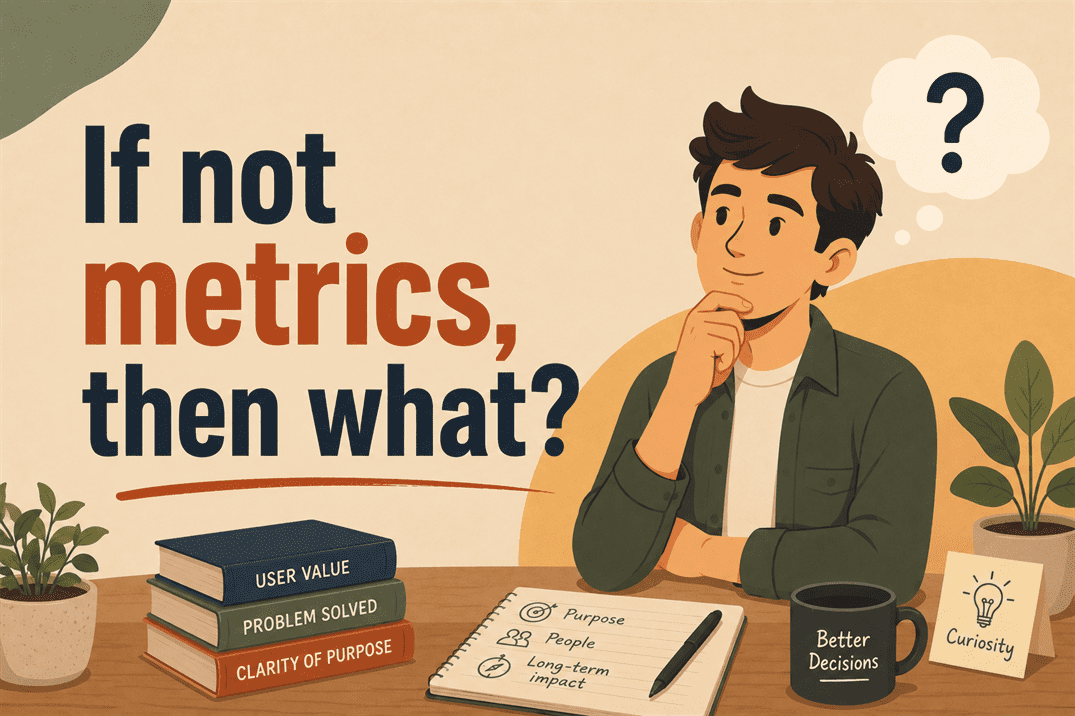
If you read The performance trap: When metrics start shaping mediocre ideas, you already know the argument. Chasing CTR does a disservice to content.
CTR is a number. It sits in a dashboard, goes up or down and gives everyone something to talk about in a meeting.
Brand voice doesn’t do any of that. It just sits there, refusing to become a percentage.
That’s the whole problem. Teams build around what they can see, and what they can see is almost always a number, because numbers fit neatly into a spreadsheet.
The stuff that actually builds a business, authority, distinctiveness, the slow build of trust that gets someone to email you instead of a competitor, doesn’t fit anywhere near as neatly.
It’s real. It’s valuable. And it’s nearly impossible to defend in a Q3 report without someone asking for a confidence interval.
So most content programmes end up measuring what’s measurable, then shaping their strategy around whatever survives that filter.
Eventually you’ve got a content engine that’s brilliant at hitting its metrics. Whether it’s brilliant at anything else rarely comes up in the review meeting.
The concreteness bias
There’s a cognitive tendency, well-documented and thoroughly ignored, to weight concrete information more heavily than abstract information even when the abstract information is more relevant.
It shows up everywhere.
It shows up in content marketing when a client says “the CTR on that piece was 2.3%, which is below our benchmark” about an article that sparked a genuine industry conversation and got cited by three people with newsletters bigger than theirs.
The click rate lost. The conversation won. The dashboard doesn’t know about the conversation.
This is how you end up in the surreal situation of a brand building a reputation for saying interesting things while simultaneously being told by its own reporting that the content isn’t working.
I’ve seen this happen. The people closest to the content know something good is going on.
The spreadsheet disagrees. The spreadsheet wins because it has a column and a graph.
What you’re actually trying to build
Here’s a useful question to ask any organisation before it starts producing content: What would it look like if this worked?
Not in terms of traffic or clicks. In terms of what you want people to think, feel, or do differently because your content exists.
- Do you want to be the company that practitioners in your field actually read?
- Do you want your content to be the thing a new hire is told to go through in their first week?
- Do you want buyers to arrive at a sales conversation already persuaded of your point of view, because they’ve spent six months reading you?
These are legitimate business outcomes.
They’re also almost impossible to attribute to a specific piece of content, which is why they tend to get edited out of the brief and replaced with something the analytics platform can handle.
Mailchimp spent years producing content, a whole publication called Just a Business, that was editorially ambitious, frequently had nothing obvious to do with email marketing and built an enormous amount of brand affinity with small business owners.
You could not easily have drawn a straight line from any individual piece to a conversion.
The cumulative effect was substantial. The dashboard, in isolation, probably had concerns.
Rory Sutherland at Ogilvy has made a version of this argument for decades, that the measurable and the valuable are not the same category, and that organisations systematically underfund the valuable because they can’t write it into a KPI.
He’s right. He’s been right for a long time. The dashboards remain unconvinced.
Some things worth measuring instead
None of this means measurement is bad. It means most companies are measuring the wrong things with impressive precision.
A few alternatives that are harder to pull automatically but considerably more informative.
Whether your sales team is using the content unprompted
If a salesperson is sending a piece to a prospect because it actually moves the conversation forward, that’s a strong signal.
Not because it clicks but because it works in the room. Ask them. They’ll tell you. They’re usually delighted that someone asked.
Whether people in your field are citing or referencing the work
Inbound links are a weak proxy for this. The stronger signal is whether practitioners name-drop your content in conversations, talks, or their own writing.
This requires qualitative research, which is a phrase that makes some stakeholders nervous, but it’s considerably more meaningful than whether your October post hit 3.1% CTR.
Whether the content attracts the right readers, not the most readers
A trade publication with ten thousand highly specific subscribers outperforms a general interest site with a million vaguely interested ones for almost any B2B purpose.
The metric for this is audience quality, which is annoying to define and essential to care about.
Whether the voice is consistent enough that a regular reader would recognise a new piece without a byline
This sounds like a vanity metric until you realise that recognition is the foundation of trust, and trust is what you’re selling.
The honest conversation
The real ask here is for organisations to hold two things at once, the concrete metrics, which are useful for distribution and operational decisions, and the qualitative judgments, which are where editorial thinking lives.
This requires someone in the room with the authority to say “the numbers look fine but the work is getting worse” without being immediately asked to express that as a data point.
It requires treating editorial judgment as a professional skill rather than a subjective preference that needs to be overruled by a graph.
That’s a cultural shift more than a measurement one. Some organisations are up for it. Some would genuinely rather have the dashboard.
The ones that do it well tend to produce content that sounds like something. The ones that don’t tend to produce a large quantity of forgettable content.
If you’re trying to build content that has a bit more going on than that, and you’d like to think through what “success” should mean, I’d be glad to help.

 Sep 15, 2026
