


Technically correct content isn’t a compliment
 By Jamiek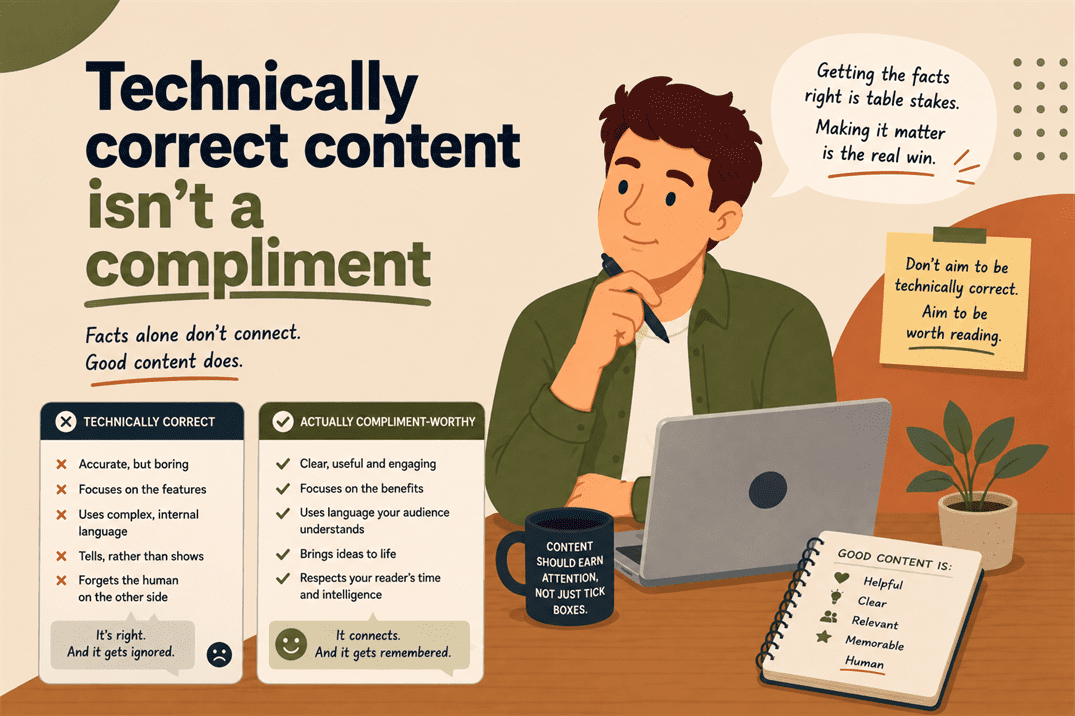
In March 2018, an ad ran inside Snapchat for a game called “Would You Rather.” It asked users to choose between slapping Rihanna or punching Chris Brown, a grim callback to Brown’s 2009 assault on Rihanna.
Every word in that ad was spelled correctly. Every fact in it, that both people exist, was accurate. Grammatically, it was flawless.
It still wiped somewhere in the region of $800 million off Snap’s market value in a single week, because the ad had been “reviewed and approved” by the platform’s own process before anyone asked whether accuracy was the only thing worth checking.
That’s the whole argument of this post.
Technically correct content clears a low bar. It’s the content equivalent of a car that starts, has four wheels, and drives, except nobody’s checked the brakes.
What “technically correct” covers
When people say content is technically correct, they usually mean the spelling’s right, the grammar holds up, the facts as stated aren’t wrong and it does roughly what it was asked to do.
That’s a real and useful bar. It’s also nowhere near high enough for anything a business is going to publish under its own name.
Technically correct content can still be misleading through omission.
It can still be legally exposed because a claim isn’t backed by evidence. It can still cause genuine offence because nobody read it the way a tired, distracted, or differently-positioned reader would.
None of that shows up in a spelling and grammar pass.
It shows up when someone reads the piece the way an editor reads it, as something that’s about to leave the building and become the company’s problem forever.
The SHIP test
I use a version of this on every piece of client content I write or edit and it’s the bit clients are usually paying for without quite knowing it.
I ask four questions before anything ships:
- Sense-check. Is every fact, figure and claim true, current and traceable to a source? Not “sounds right.” True.
- Harm. Could any group of readers, in any context, reasonably read this as mocking, excluding, or hurting them? Not “did we mean it that way.” Could it be taken that way.
- Impact. If this got picked up, screenshotted, or quoted out of context tomorrow, what happens to the brand?
- Proof. If a claim in this piece got challenged, legally or otherwise, could we back it up? If not, it doesn’t go in.
Fail any one of those and the piece isn’t ready, no matter how clean the prose is.
Here’s what each failure looks like when a business skips it.
Sense-check: When nobody fact-checked the maths
In late 2022, CNET began publishing dozens of AI-generated finance explainers under a “CNET Money Staff” byline, disclosed only if a reader hovered over it.
When the errors surfaced, the outlet ran a full audit and issued corrections on 41 of its 77 AI-written articles, more than half, with several flagged as substantial.
One piece explaining compound interest got the underlying maths wrong, misstating how much a saver would earn on a straightforward deposit.
This was a well-known publication getting the sums wrong in an article meant to help people manage their money.
That’s the sense-check failing at the one job it exists to do.
For any B2B content touching numbers, stats, or claims about what a product does, this is the everyday version of the same risk.
An unverified statistic, a misquoted study, a “up to 40% faster” pulled from a source that never said that. It reads fine. It’s still wrong.
Harm: When the review process waves it through
Back to Snap. The company’s own statement after the Rihanna ad called it “disgusting” and admitted it had been mistakenly approved by their review process.
This wasn’t a rogue piece of content that slipped past everyone.
It went through a process that was supposed to catch exactly this, and the process said it was fine.
A second, independent read, from someone whose job is to ask “how could this land badly,” is what that process was missing.
Impact: When a LinkedIn post gets ruled misleading
In December 2024, the UK’s Advertising Standards Authority upheld a complaint against Lloyds Bank over one of its LinkedIn posts.
The bank had run several environmental-themed posts promoting sustainability initiatives. The ASA found that one of them breached the advertising code on misleading and environmental claims, because it left out information about the bank’s wider investments that would have changed how a reasonable reader understood it.
Three of the four ads in the campaign were cleared. One wasn’t, because of what it left unsaid.
This is the risk that sits closest to daily B2B content work. LinkedIn posts, case studies, “proud to announce” copy.
Nobody sets out to mislead. But an editor who asks “what’s missing from this that would change how someone reads it” is doing a specific, valuable job that a writer focused on getting the post out by the deadline often doesn’t have the time to do.
Proof: When the slogan becomes a legal bill
Red Bull’s “gives you wings” tagline ran for years as obvious, harmless hyperbole, until a New York class action argued the company’s wider marketing implied real performance and concentration benefits that weren’t backed by evidence.
Red Bull agreed to pay more than $13 million to settle the case in 2014, while maintaining it had done nothing wrong.
The tagline itself was never the issue. The problem was the layer of claims built up around it that nobody had stress-tested against “could we prove this if someone asked us to.”
Most businesses aren’t writing slogans that reach class-action scale.
But “our clients typically see,” “industry-leading,” “proven to,” these phrases show up in case studies and landing pages every day, usually because they sound persuasive, rarely because anyone’s checked whether they’re defensible.
Why this is an editing problem, not a writing one
None of these four failures are about bad writing.
The Snap ad was grammatically fine. CNET’s articles read smoothly. The Lloyds post was polished LinkedIn copy. Red Bull’s tagline is one of the most effective four words in advertising history.
Every one of these pieces was technically correct and shipped anyway, because the person writing it was too close to it, too invested in the deadline, or simply wasn’t the second pair of eyes whose job is to ask the uncomfortable question before a reader, regulator, or class-action lawyer does.
That’s what an editor is for. Not comma placement. Risk.
If you’d like a second read on something before it goes out, whether that’s a single LinkedIn post or a full content calendar, get in touch.

 Sep 17, 2026
