


The five AI editorial skills every content team still needs
 By Jamiek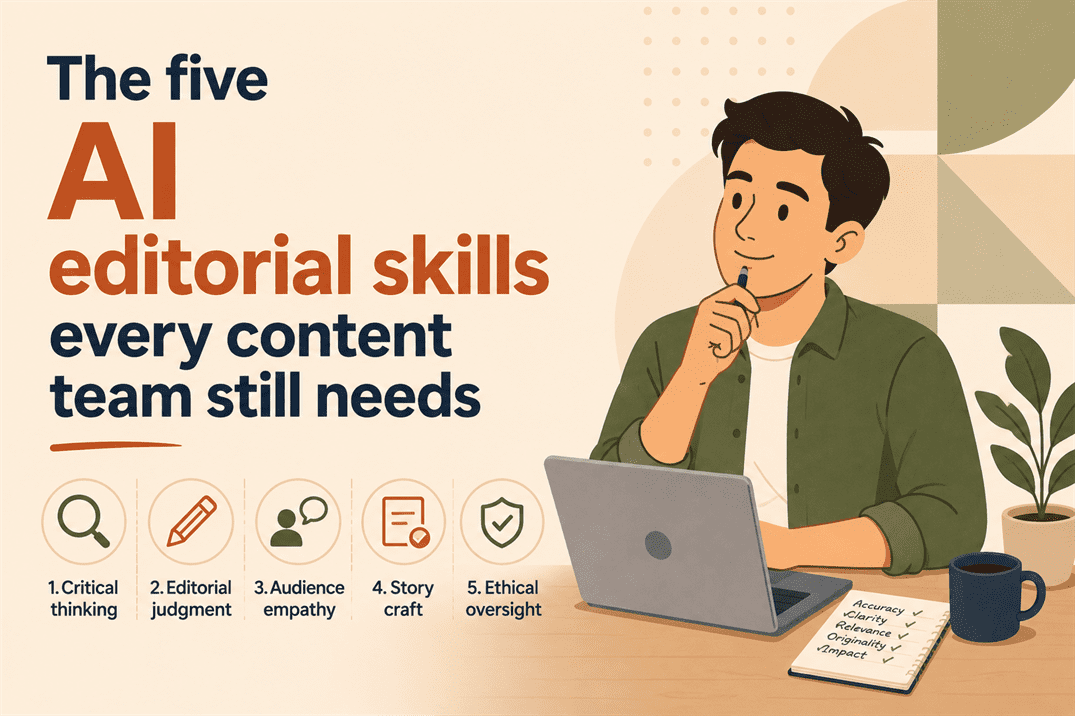
There’s a version of this post where I dramatically announce that AI is coming for editorial jobs and you should be panicking into your morning coffee.
I’m not writing that post.
There’s also a version where I reassure you that human creativity is a sacred flame no algorithm can extinguish, and we all leave feeling warm and validated.
I’m not writing that one either, partly because it’s not true, and partly because I’d have to type the phrase “sacred flame” unironically.
The truth, as usual, is messier and more interesting.
AI has genuinely absorbed a huge chunk of what used to count as editorial work. First drafts. Outlines. Reformatting for different channels. Metadata. Alt text.
The stuff that used to fill a junior editor’s Wednesday afternoon now takes about eleven minutes.
But here’s what doesn’t get said clearly enough: the skills that survive this shift aren’t the ones AI can’t do yet.
They’re the ones it fundamentally can’t do, because they require judgment that depends on context, relationship and something resembling a conscience.
None of which live in a training dataset.
So. Five skills. Not a comfort blanket. A practical brief for anyone trying to work out where human editorial capacity actually earns its keep.
What’s changed (and what hasn’t)
AI tools have made it almost comically easy to produce a grammatically correct, reasonably structured piece of content on any topic you care to name.
If your definition of editorial work is “making sure the words are in the right order,” congratulations, that problem is solved.
What hasn’t changed is the harder question underneath.
Is this the right content, for the right audience, saying the right thing, in a way that actually builds something?
That’s still a human problem. And it needs a specific set of skills that most job descriptions somehow forget to mention.
Skill 1: The editorial judgment to know what not to publish
This is the skill that gets overlooked most often, probably because it produces nothing you can put in a report.
A good editor’s most valuable contribution isn’t always the piece they improve. Sometimes it’s the piece they kill.
The brief they push back on before a word gets written.
The angle they redirect because they can see, from three hundred metres away, that it’s going to undermine something the brand spent two years building.
AI can flag thin content, spot duplicate topics and check against a keyword brief.
It cannot tell you that publishing a listicle about “10 ways to reduce churn” three weeks after your biggest competitor dropped a definitive guide on the exact same topic is going to make your brand look like it’s frantically photocopying someone else’s homework.
That call requires industry awareness, audience understanding and an editorial point of view.
Teams that lean too hard on AI-assisted production often end up with the precise opposite of what they wanted.
The editor who knows when to say “not yet” or “not this” is protecting the asset. Not slowing it down.
What this looks like in practice:
- Regular content audits that go beyond performance data.
- A brief process that interrogates purpose before it approves production.
- Someone with enough context to ask, “What does publishing this actually say about us?”
Skill 2: Structural thinking that goes beyond the template
AI is good at structure in the same way a conscientious student is good at essays.
It knows the formula. It executes it reliably. Introduction, main points, subheadings, conclusion, everyone goes home.
What it doesn’t do is rethink the structure when the formula isn’t right for the job.
- Some content needs to build an argument slowly before it earns the right to make a claim.
- Some pieces work better when they open with the complication rather than the context.
- Some audiences respond to something that feels conversational and deliberately unresolved, rather than tidy and gift-wrapped.
These aren’t arbitrary stylistic preferences. They’re decisions that determine whether the content actually lands.
An editor who understands structure at this level isn’t formatting. They’re creating persuasion.
That’s a distinct skill, and it’s one that AI drafts consistently smooth over because the safest structure is rarely the most effective one.
It’s like the difference between a house that’s technically habitable and one someone actually wants to live in.
What this looks like in practice:
- Editors who read the draft with a specific question in mind: “Does this structure earn the conclusion, or does it just assume it?”
- Writers trained to interrogate outlines before committing to them.
Skill 3: Brand voice calibration at the edge cases
Most teams have a brand voice guide. Most AI tools can approximate it reasonably well for standard content.
The problem isn’t the comfortable middle of the voice range. It’s the edges.
How does your brand sound when it’s addressing a sensitive topic?
When it’s responding to a customer complaint that went public?
When it’s launching something that directly takes on a competitor, or writing honestly about something it doesn’t fully know the answer to yet?
Edge cases are where voice guides run out of road, because they were written for the predictable situation.
Getting the tone right in those moments requires the editor to hold two things in tension at the same time, what the brand has established as its character, and what this specific moment actually calls for.
That’s not a formula. It’s a feel. You get it from being close to the work for long enough.
AI can draft. It can’t hold that tension or make that call.
An editor who can is genuinely irreplaceable, because edge cases are exactly the moments when getting the tone wrong is most expensive.
What this looks like in practice:
- A “voice pressure test” for anything unusual, sensitive, or high-stakes.
- Editors who know the brand well enough to feel the dissonance when a draft is technically compliant but tonally about three degrees off.
Skill 4: Audience empathy that goes beyond the persona doc
Personas are useful fictions. They compress a lot of real audience insight into something you can actually brief from and AI can work with them effectively.
But they’re a simplification and the gap between the persona and the actual reader is where content quietly goes flat.
Real audience empathy is built from direct exposure.
- Reading the comments.
- Listening in on sales calls.
- Noticing which questions come up again and again.
- Understanding which objections won’t die no matter how many times the FAQ page addresses them.
It’s specific, it’s current and it cannot be written into a persona document, no matter how thorough you make it.
The editor carrying this knowledge is doing something qualitatively different from the editor working purely from a brief.
They’re filtering every draft through a living understanding of who’s actually reading and what those people genuinely need.
They catch the moment when a piece is technically correct but uses language the audience doesn’t use.
They notice when the assumed knowledge level is off. They flag the section that’s going to make a specific segment feel like they’re being explained at.
AI can be told about an audience. It can’t know one.
That’s a meaningful difference, even if it’s an annoying one to have to keep saying out loud.
What this looks like in practice:
- Editors with some mechanism for staying close to real audience feedback, not just analytics.
- A team culture that treats this kind of institutional knowledge as worth building deliberately, rather than hoping it accumulates by accident.
Skill 5: Accountability for what the content does in the world
This is the most difficult one, so let’s get into it.
When a piece of AI-assisted content goes out and causes a problem, whether that’s a factual error, an unintended implication, an offensive framing, or a claim that quietly falls apart under scrutiny, someone has to own that.
The AI doesn’t.
The company does, and more specifically, the human who approved it does.
Accountability shapes behaviour in ways that performance metrics can’t replicate.
An editor who knows their name is attached to the work and who genuinely understands the consequences when that work fails, makes different decisions than a process optimised for throughput.
That’s not a moral argument. It’s just a practical observation about how humans behave when things actually matter to them.
Genuine quality control requires someone to have skin in the game.
That sense of personal ownership is one of the very few things AI-assisted workflows can’t replicate, no matter how sophisticated the prompt is.
You can’t automate accountability. I’ve seen people try and it goes about as well as you’d expect.
What this looks like in practice:
- Clear ownership at the editorial level, not just the production level.
- A sign-off process that means something rather than a compliance checkbox nobody reads.
- Editors who treat their name on a piece as a real commitment.
What this means for how you build your team
The takeaway here isn’t “hire fewer people who can use AI.” It’s almost the opposite.
The goal is to hire people whose editorial judgment is strong enough to run alongside AI, not people who’ll be outpaced by it the moment a better prompt comes along.
The skills above all have something in common.
They’re all judgment-heavy, relationship-dependent and context-sensitive. They require editors who understand what the content is for, who it’s for, and what it owes the audience.
That’s a higher bar than “can write clearly,” and it’s the bar that actually matters now.
If your current team structure assumes editorial skill is mainly about execution, whether that’s writing speed, hitting a word count, or following a style guide without complaint, you’re building on the wrong foundation.
AI handles execution now. The value of a human editor is increasingly in the decisions that surround the content, not the content itself.
For editors who’ve always thought this way, that’s not a threat. It’s an overdue acknowledgment that the real work was happening there all along, and someone finally noticed.
A note on the skills that didn’t make the list
A lot of people would include SEO knowledge or content strategy here. I left them out deliberately, not because they don’t matter, but because they sit differently.
SEO knowledge gets amplified by AI rather than replaced by it. Content strategy is real and important, but it’s more of a function than a skill in the context I’m describing.
The five above are specifically the ones where human judgment produces something AI output genuinely can’t replicate, even given a strong brief and a well-constructed prompt.
That’s the distinction worth drawing clearly and drawing often until the people who need to hear it actually do.
If your team is trying to restructure editorial roles around an AI-assisted workflow, this list is a reasonable place to start the conversation.
Not as a checklist, but as a lens for asking the right question: which of your editors are exercising these skills and which are doing work that a well-prompted model can handle reliably on a Tuesday morning?
The answer tells you more about your team’s real editorial capacity than any output metric will.
If you need more editorial capacity, you know what to do.

 Sep 22, 2026
