


How to structure a blog post so people read past the third paragraph
 By Jamiek
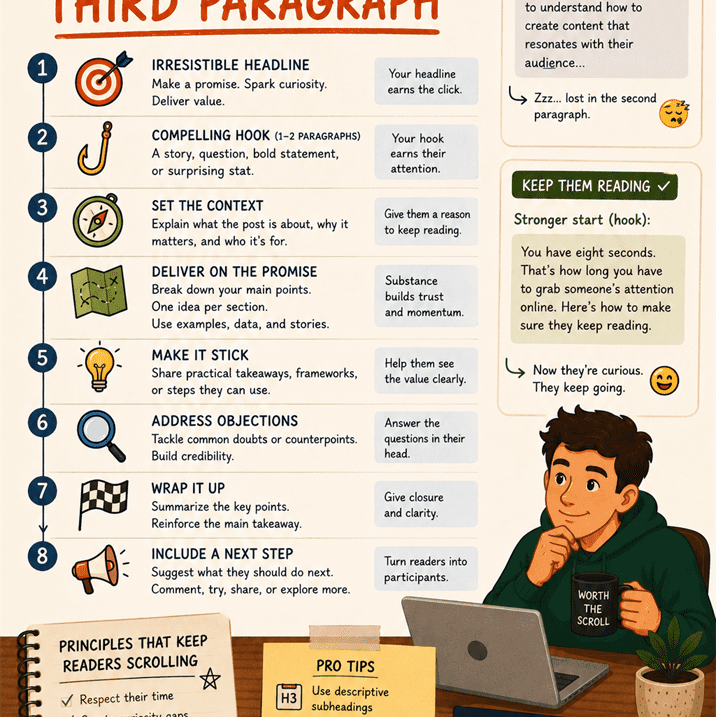
People often stop reading blog posts somewhere around the third paragraph. Not because the reader lost interest in the topic. Because the post gave them a reason to leave before it gave them a reason to stay.
This happens constantly, even to writers who genuinely know what they’re talking about.
A blog post that isn’t structured well makes the reader do the work, hunting for the point, wading through context they didn’t ask for, trying to work out whether the thing they came to find is actually in there somewhere.
Most readers won’t do that work. They’ll just leave.
Good structure signals to the reader early and clearly that this piece knows where it’s going and is worth the trip.
Why structure matters more than you think
There’s a tempting assumption that good writing is enough. That if the prose is strong and the ideas are solid, people will read to the end.
Sometimes that’s true. But most readers aren’t settling in with a cup of tea and forty minutes to spare.
They’re scanning. They’re deciding, continuously and mostly unconsciously, whether to keep going or click away.
Structure is how you keep winning that decision.
It also affects how your content performs in search.
Google’s understanding of a page is partly built on how well it’s organised, whether the headings signal what the sections deliver, whether the piece answers the question it promises to answer, whether a reader who lands on it leaves satisfied or immediately bounces back to the results page.
The parts of a blog post and what each one has to do
Here’s a quick overview of everything you need to know about structuring a blog post:
The headline
The headline has one job, get the reader to read the first line. That’s it.
It doesn’t need to be clever. It doesn’t need to be a complete summary of the piece. It needs to make someone think “yes, that’s the thing I want to know about” and click.
The most reliable headlines are specific and useful.
“How to structure a blog post” is fine. “How to structure a blog post so people read past the third paragraph” is better, because it names a problem the reader recognises and implies a solution.
“10 blogging tips” is neither, because it promises very little to a very broad audience.
A useful test is to read your headline and ask whether a stranger could tell, from those words alone, what they’ll know or be able to do after reading the piece.
If the answer is “not really,” the headline needs more work.
The introduction
The introduction’s job is not to introduce itself. It’s to make the reader feel immediately that they’re in the right place.
The single most common mistake in blog introductions is warming up.
The writer eases in, a broad observation, some scene-setting, a rhetorical question or two and then, eventually, the actual point.
By which time a significant portion of readers have already left.
Here’s what warming up looks like:
“Content marketing has become an increasingly important part of business strategy in recent years. More and more companies are investing in blogs, social media and other forms of digital content to reach their audiences.
But creating content that actually engages readers is a challenge many businesses face. So how do you write a blog post that people will actually read?”
And here’s what committing looks like:
“People often stop reading blog posts somewhere around the third paragraph. Not because the reader lost interest in the topic. Because the post gave them a reason to leave before it gave them a reason to stay.”
The second version opens on the problem. It’s specific, it’s a little uncomfortable if you’ve written blog posts before and makes the reader want to know what comes next.
A good introduction does three things quickly:
- Establishes the problem or question.
- Signals that this piece has something real to say about it.
- Earns the next click of the scroll.
Subheadings
A reader scanning a post before committing to it is reading the subheadings first, making a judgement about whether the piece delivers what the headline promised.
Which means subheadings need to do some work.
“Introduction,” “Main body,” and “Conclusion” are technically subheadings. They’re also completely useless because they tell the reader nothing about what’s in the section.
Compare:
- Useless: “Things to consider”
- Useful: “Why your introduction is where most readers leave”
- Useless: “Tips for writing”
- Useful: “The one structural mistake that kills reader retention”
Every subheading should be specific enough that a reader skimming the page could reconstruct the argument of the post just from reading them in sequence.
If your subheadings could belong to any blog post on any topic, they’re not doing their job.
The body
The body of a blog post should deliver on every promise the headline and introduction made, in an order that feels logical rather than arbitrary.
The most common structural failure in the body is the information dump.
Everything the writer knows about the topic, in roughly the order it occurred to them, with transitions that are doing heroic work to make it feel connected.
The reader can feel this. It reads like someone thinking out loud rather than someone who has prepared.
A useful discipline before writing the body is to ask what the reader needs to know first, for the next section to make sense. Then work forward from there.
Each section should earn the next one.
Paragraphs should be short, especially online. Three to four sentences is a useful working length.
A wall of text signals effort to the writer and difficulty to the reader.
White space is not wasted space, it’s breathing room that keeps people moving through the piece.
Examples belong in the body and they belong early.
Abstract claims are easy to scroll past. A concrete example anchors the point in something real.
Telling someone that “paragraphs should be short” is a claim.
Showing them a paragraph that runs to twelve lines with no break, covering three separate ideas in a single block, no air, no pause, just words arriving continuously until the reader’s eyes start to slide down the page looking for somewhere to land, is the same claim made undeniable.
The conclusion
A good conclusion does two things.
First, it lands the piece, a sentence or two that gives the reader the feeling of having arrived somewhere, rather than just running out of post.
Second, it tells them what to do next, whether that’s applying what they’ve just read, exploring a related piece of content, or getting in touch.
The CTA doesn’t have to be heavy-handed. “If this is something you’re working through, I’m available for a conversation” is a softer invitation than “Book a call now” but it still plants the flag.
Match the pressure of the CTA to the temperature of the content.
The structural shape of a well-built post
If you stripped a good blog post back to its skeleton, it would look something like this.
- Open with the problem, stated specifically.
- Establish why it matters and why now.
- Walk through the solution in logical sequence, with each section earning the next.
- Close with a landing point and a next step.
Every element is doing something. Nothing is there because it felt like the kind of thing a blog post should include.
That last part is worth lingering on.
The “did you know” opening. The list of statistics in paragraph two. The subheading that says “let’s dive in.”
These are the structural equivalents of filler words, habits that create the shape of a blog post without doing the work of one.
One test worth running before you publish
Read just the headline, the first two sentences of the introduction and the subheadings.
If that reading gives a clear picture of what the post argues and why it matters, the structure is working.
If it feels vague, repetitive, or like the subheadings could have come from a different post entirely, something needs adjusting before the piece goes live.
This takes about ninety seconds and catches most structural problems before a reader does.
The honest version
I’ve edited thousands of blog posts in almost every sector you can think of and the ones that underperform rarely do so because the writer didn’t know enough about the topic.
They underperform because the structure made the reader work too hard, too early, for a payoff that arrived too late.
Fix the structure and the writing almost always improves with it, because good structure forces clarity of thinking.
You can’t write a useful subheading for a section you haven’t properly worked out yet.
You can’t write an introduction that commits to a point if you don’t know what the point is.
The structure is the thinking made visible.
If your blog posts are technically fine but not quite landing, structure is usually where to look first.
And if you’d like a second pair of eyes on yours, or help building a content process that produces well-structured posts from the brief stage onwards, get in touch.
I find this sort of thing genuinely enjoyable, which is either a selling point or a red flag depending on your perspective.

 Oct 27, 2026

