


The real skill gap in the AI era is judgment
 By Jamiek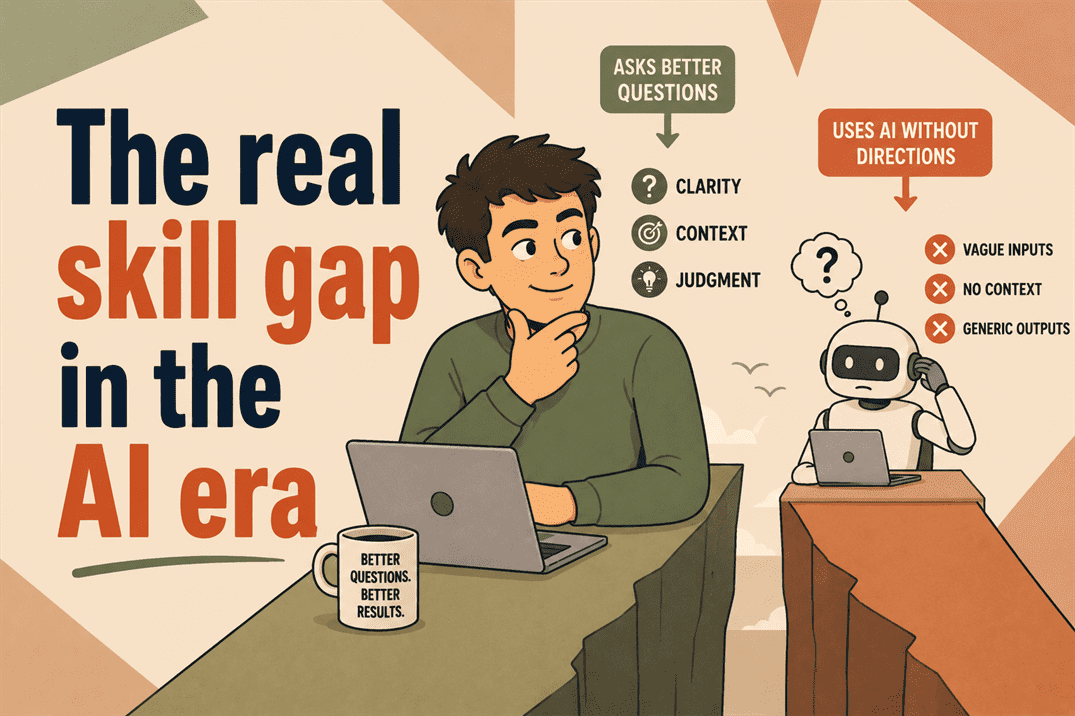
Let me tell you about a folder on my desktop called “Published.”
It’s gloriously tidy. A curated archive of ideas that survived contact with my better instincts. A highlight reel. A source of mild professional pride.
Now let me tell you about a folder called “Drafts.”
It contains 47 documents. Seventeen of them are titled some variation of “good idea maybe.docx.”
Three of them are just the word “no” in a 48pt font, which I apparently found very decisive at the time.
One is a 3,000-word argument that content writers are the unsung architects of civilisation, written during a particularly caffeinated Tuesday and never, mercifully, published.
One appears to be a dissertation on the merits of metadata. I have no memory of writing it. I choose not to investigate.
That folder is where I do my best work. And ironically, it’s the folder nobody ever asks about.
Here’s the thing we’re all tiptoeing around in the AI skills conversation.
The ability to generate content has basically been solved.
You can prompt your way to a passable 1,500-word article in the time it takes to make a coffee, drink the coffee and then make a second coffee because the first one went cold while you were staring at the output wondering if something felt a bit off.
The tools are genuinely remarkable. I use them every day.
They’re part of how I work, not a threat to how I work. But generation isn’t the skill anymore. It never really was.
The skill is everything that happens around it.
And right now, a concerning number of people are skipping straight past “everything that happens around it” into “publish” like they’ve won something.
Taste: The thing that can’t be prompted
Ask any writer worth reading what separates good content from content that technically exists, and they’ll eventually say something like “knowing what works.”
Which sounds irritatingly vague until you’ve spent years developing a sense of it, at which point it sounds irritatingly obvious, and then about ten years after that it starts to sound like the most important professional skill you have.
Taste isn’t preference. It’s not “I like this” or “my client’s CEO really liked this paragraph, it was his idea.”
It’s a calibrated, sometimes uncomfortable ability to assess whether something is earning its place.
- Does this opening sentence deserve the next thirty seconds of a stranger’s attention?
- Is this metaphor doing actual work, or is it just standing around looking atmospheric?
- Is this section here because it adds something to the argument, or because I spent two hours on it and couldn’t emotionally commit to the bin?
That last one. That last one is where so much published content breaks down.
It’s the paragraphs that survive not because they belong but because the writer worked hard on them, felt attached to them, and rationalised keeping them by adding a subheading.
AI doesn’t have this problem, obviously.
You can delete a generated section with zero emotional weight. But you can also publish a generated section with zero editorial discernment.
And that’s how you end up with a 2,400-word blog post that circles the same point four times in slightly different fonts and calls itself a comprehensive guide.
The writer’s job, increasingly, is to be the person in the room with taste. Not just the person doing all the typing.
If you’re a business buying content, that’s precisely what you should be paying for. Not output volume, but the judgment applied to it.
More on that in a moment.
Curation as a superpower (that sounds fancier than it is)
Curation is selection. It’s the editorial instinct that says, out of everything that could be said about this topic, here’s what matters, here’s the order it goes in and here’s what we’re deliberately leaving out because it muddies the point and the reader doesn’t need it and frankly neither do you.
That last part, especially.
Good curators know that every “here’s the definitive guide to X” post is secretly a set of opinions dressed up as completeness.
The writer who can own that clearly, who can say “I’m not covering Y because it’s a sideshow,” is doing something genuinely difficult.
They’re taking a stance.
And stance, in a world of generated content that optimises for covering everything neutrally and exhaustively and therefore memorably for nobody, is worth actual money.
Joan Didion wrote that we tell ourselves stories in order to live.
She meant something more existential than content strategy, obviously, but the principle holds.
Narrative is how human beings make sense of information.
The AI gives you the information. Curation decides what story it tells.
The writer who understands both sides of that equation is not a content machine. They’re an editorial strategist.
Which is, not coincidentally, a significantly more profitable thing to be.
Narrative control: The bit everyone skips
Early in my writing life, I thought narrative control was something novelists worried about.
Plot structure, character arcs, whether the third act earned its resolution. Definitely not something relevant to a blog post about, I don’t know, form builder plugins.
Turns out it has everything to do with it.
Narrative control in content writing is knowing the journey you’re taking the reader on, and refusing to let them wander off into a different story than the one you’re telling.
It means the hook promises something specific and the body delivers exactly that.
It means every section is a step, not a detour.
It means the ending lands on the same emotional register the opening established, even if a thousand words have passed and someone on your team has added a section called “related considerations” that doesn’t relate to anything.
When content is produced without narrative control, you can feel it.
The tone shifts midway through. The post opens confidently and ends hedging. The introduction asks a big, compelling question and the body answers four completely different, smaller questions, none of which are the original one.
It’s technically content. It goes nowhere. It converts nobody. It exits the reader’s memory approximately fourteen seconds after they close the tab.
This is the part that requires a human who actually cares about the outcome. Not a human who technically exists in the process.
The writer who can take a raw output, feel where the thread goes slack and pull it tight without losing the voice is not doing a clean-up job.
They’re doing the most strategically valuable editorial work available right now, and most briefs don’t even account for it.
The delete key as editorial philosophy and business case
Here’s the section I most want businesses to read, printed out and stuck to something.
Knowing what not to publish is a skill. It might be the skill. And it’s being catastrophically undervalued by anyone optimising purely for content volume.
There’s a principle I’ve been applying that I call the publication threshold, which sounds more official than it is, but bear with me.
The question isn’t “is this good enough to go out?”
The question is “does publishing this make the overall body of work stronger?”
Sometimes the answer is yes to both. Sometimes it’s yes to the first and no to the second.
That gap is where editorial judgment lives and that gap is currently enormous.
Twenty average posts actively compete with five excellent ones for the same search intent.
They dilute topical authority. They signal to both search engines and actual human readers that volume, not quality, is the operating value here.
And once a site acquires a reputation, in the algorithmic sense or the human sense, for producing content that broadly exists rather than content that actually helps, recovering from that takes significantly longer than the time saved publishing faster.
I’ve had this conversation with clients. It’s a good conversation to have early.
The ones who get it tend to end up with tighter sites, stronger organic performance, and content that does identifiable things for their business rather than just sitting there contributing to the internet’s general girth.
The delete key is a business decision as much as it’s an editorial one.
Use it deliberately. Use it often. Use it especially on whatever you wrote before your second coffee and then titled “just some thoughts.”
So what’s the actual skill gap?
Here’s what I’d put on the whiteboard if someone handed me a whiteboard:
The people who’ll thrive in the current setup aren’t the ones who prompt most efficiently or produce most prolifically.
They’re the ones who can read an output, know what’s missing, shape it into something with a genuine point of view, decide whether to publish it at all, and explain all of that clearly to the person paying for it.
That’s taste, curation, narrative control, editorial judgment and the professional confidence to say “this one’s not ready.”
None of those are soft skills in the hand-wavy sense.
They’re hard skills that are genuinely difficult to develop, difficult to delegate, and, crucially, impossible to fully automate.
Which makes them worth quite a lot right now. Probably more next year.
The folder called “Drafts” is where the work happens. The folder called “Published” is where the judgment shows.
If you’re looking for a content writer who treats the delete key as seriously as the publish button, and who brings an actual editorial perspective rather than just a word count, take a look at what I do at Coastal Content.
The “Drafts” folder is large. The published work is deliberately not.

 Oct 06, 2026
