


How to add depth to content without adding word count
 By Jamiek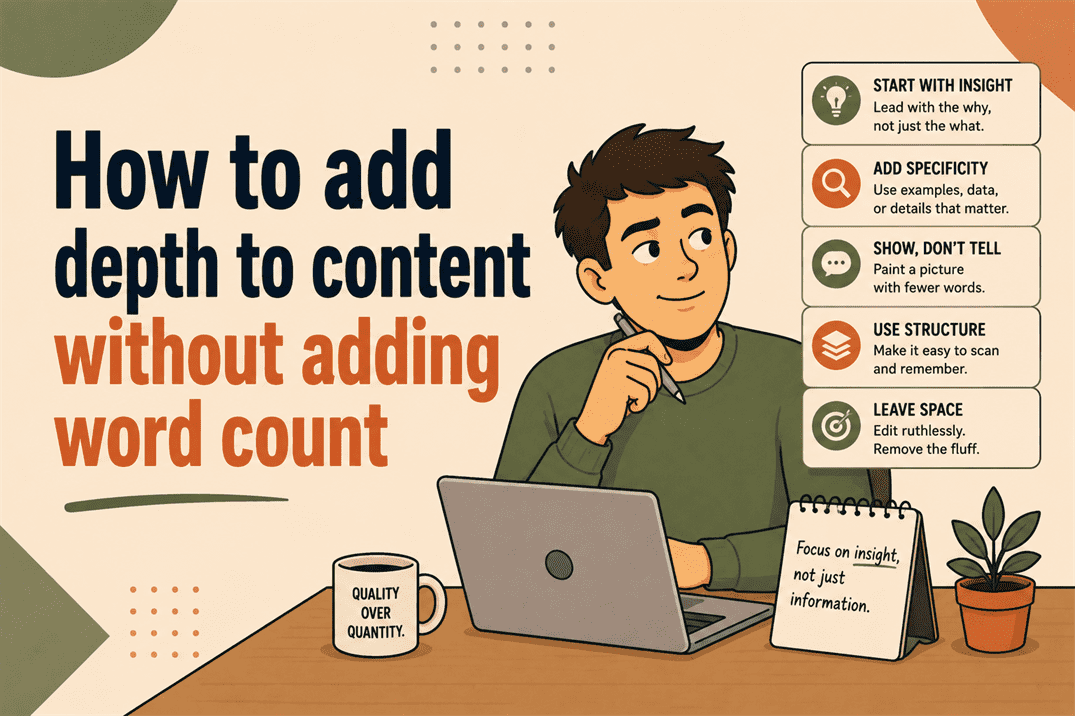
Let me tell you about a thing I used to do.
I’d finish a blog post, read it back, and think: “This is good. This is actually good.” Then I’d count the words, see 1,100 staring back at me, and immediately start padding.
A sentence here. A quick recap there. Maybe a transitional paragraph explaining what I was about to explain.
And before I knew it, I had 1,600 words of slightly-worse content that felt inexplicably longer than it read.
I was adding width when I thought I was adding depth.
They are not the same thing. They are, in fact, enemies.
Depth isn’t about length. It’s about pressure.
Think about the difference between a documentary that makes you rethink something you’ve believed for years, and a documentary that’s three hours long.
Length and impact are unrelated.
The same goes for writing.
A 600-word piece that shifts a reader’s thinking does more work than a 2,000-word piece that confirms what they already knew while gently putting them to sleep.
Depth is pressure. It’s the feeling that the writing is pushing on something real, not just filling space between headings.
The question isn’t “how do I write more?” It’s “how do I make every sentence do more?”
Which, yes, sounds obvious. But then why are people still writing the content equivalent of a thin supermarket duvet?
The content arms race nobody asked for
AI can now produce 2,000 words on any topic in about forty seconds. Much of it will be accurate. Most of it will be readable.
All of it will feel like it was written by someone who has read about the topic but has never actually cared about it.
That’s the gap. Not quality, not accuracy. Care.
AI content doesn’t have a perspective. It doesn’t have a weird specific experience that reframes the whole thing. It doesn’t notice the thing nobody else has mentioned. It doesn’t write a sentence that makes you stop scrolling and think “yes, exactly that.”
The reader doesn’t consciously register any of this, but they feel it. It’s the difference between shaking someone’s hand and getting a handshake from a robot with warm rubber fingers.
Technically correct. Quietly wrong.
So if you’re trying to compete by writing more words, you’re competing on the one dimension where AI will always, always win.
Four ways to add depth without adding bulk
Here’s what actually works. These aren’t content tips. They are pressure tests.
Run your draft through them.
1. Specifics do the heavy lifting
Vague language is content filler with good PR.
“Many businesses struggle with X” is word count.
“The average SaaS company spends roughly eleven months realising that onboarding emails aren’t the problem” is depth.
It’s the same real estate, but the second one lands somewhere.
The rule I’ve started using is, if a sentence could appear in any article on the topic, it probably shouldn’t appear in mine.
Generic sentences are placeholders. You can replace them with one specific, concrete, experienced thing and suddenly the whole paragraph has more weight.
2. Tension keeps reading alive
Most content is relentlessly agreeable. Every paragraph says yes. Every point flows neatly into the next.
By the end, the reader has been moved absolutely nowhere.
Depth comes from tension. Introduce a complication. Acknowledge a thing that doesn’t quite fit.
Say “and yet.” Write a sentence that makes the previous point seem less settled than it did.
This isn’t being negative, it’s being honest about the texture of the thing you’re writing about.
Topics aren’t smooth. Pretending they are makes content flat.
A useful trick I use is to find the “but actually” in your topic. The thing that complicates the advice, qualifies the claim, or makes the reader sit up slightly.
That’s usually where the depth lives.
3. Point of view is a feature, not a flaw
There’s a version of professional writing that’s been systematically drained of opinion in case someone disagrees.
It hedges. It says “some people think” and “others argue” and “it depends.” It reads like it was written by a committee of people who were all slightly nervous of offending someone.
Your perspective is not a liability. It’s the entire reason someone should read you rather than a summary.
I’m not saying every post needs a polemic. I’m saying that if you have a take, put it in.
If you think the prevailing advice on something is slightly wrong, say so.
If you’ve noticed something that other pieces about this topic consistently miss, name it.
That’s not ego. That’s the writing doing its job.
4. Earned resonance vs manufactured relatability
“We’ve all been there” is the content version of a laugh track. It tells you to feel something rather than actually creating the conditions for you to feel it.
Earned resonance comes from being specific about a thing that other people also experience but haven’t seen named before.
The moment the reader thinks “I’ve never seen that written down but that’s exactly it” is worth about four paragraphs of technically correct explanation.
The way to write that sentence is not to aim for relatability. It’s to be honest about your own specific, slightly embarrassing experience with the topic.
(See: the opening of this post. That padding thing? I have done that hundreds of times. Probably still do it sometimes. I’m not proud.)
The DEPTH test (which I just invented and am very pleased with)
Run your next draft through this before you add a single word for length.
D: Does it say something distinct that another writer wouldn’t say?
E: Is there at least one moment of earned resonance, a specific detail or named experience?
P: Is there a point of view, not just a summary of positions?
T: Is there some tension somewhere, something complicated or qualified?
H: Does the headline sell the specific thing the piece actually delivers?
Five questions. No minimum word count. That’s the whole test.
If the answer to all five is yes, you don’t need more words. You need to stop.
One last thing
The best piece of writing advice I ever got came from an editor who cut a 900-word piece I’d written down to 450 and made it twice as good.
When I asked how, she said: “You kept explaining the point after you’d already made it.”
That’s it. That’s the whole thing.
Most content isn’t too short. It’s too long because we don’t trust ourselves to have made the point, so we make it again, slightly differently, just to be safe.
Trust the sentence. Make it a good one. And then stop. Or contact me and I’ll do it for you.

 Sep 17, 2026
