


What I’m actually doing when I say I’m thinking
 By Jamiek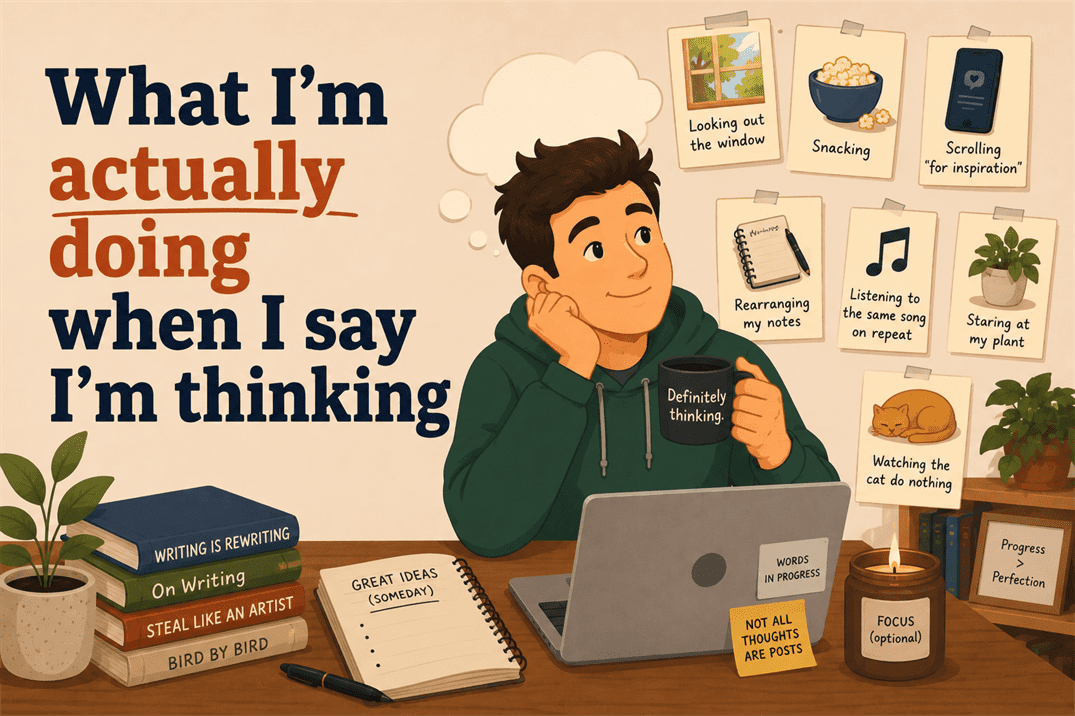
There’s a part of my working day that produces nothing. No words appear. No draft moves forward.
To an outside observer, and occasionally to me, it looks indistinguishable from not working.
I’m making coffee I don’t especially need. I’m looking out of the window at something that isn’t interesting. I’m walking around for reasons I couldn’t articulate if someone stopped me and asked.
This is, I have come to accept, the job.
The structure problem
Writing has a visible phase and an invisible one.
The visible phase is when the words go down.
The invisible one is everything that has to happen before that’s possible.
Most of the structural problems in a piece of writing don’t get solved at the keyboard. They get solved in the shower, or on the walk, or in that specific semi-conscious gap between deciding to start and actually starting, where your brain is apparently doing nothing and is in fact sorting the whole thing out without your conscious involvement.
You sit down to write and the piece either comes or it doesn’t.
Whether it comes depends almost entirely on what happened in the period where it looked like nothing was happening.
I’ve tried skipping this phase. I’ve sat down cold and written on deadline with no incubation time, and the work was fine, and it was also noticeably worse.
The structure was technically present and slightly wrong in ways that are hard to explain but easy to feel when you read it back.
Something hadn’t resolved. Usually several things.
Why it’s not procrastination
Procrastination is avoidance with a bad conscience. You know you’re not doing the thing and you feel bad about it.
The thinking phase is different. You’re not avoiding the work. You are doing the work. The discomfort, when it exists, is the productive kind, something is being worked out and it isn’t finished yet.
The practical difference is in what follows.
Procrastination ends when you finally make yourself start and the starting is hard.
The thinking phase ends when something clicks and the starting after that is almost easy.
You sit down and the first paragraph is already there, not word for word, but in shape. You know what it’s doing. You just have to write it.
The wall-staring and the walk aren’t delays before that moment. They are how that moment gets produced.
The billable hour problem
Creative work has never mapped well onto time-as-output. The billable hour is a reasonable proxy for a lot of professional services because there’s a legible relationship between time spent and value delivered.
An hour of legal advice takes an hour to give. An hour of accounting takes an hour to do.
An hour of writing might produce two thousand words or two sentences and the two sentences might be worth more.
The thinking that makes the two sentences possible might have happened on a Tuesday walk that nobody invoiced for.
The structural breakthrough that unlocked the whole piece might have occurred during what looked, from the outside, like a man making unnecessary coffee.
This is the slightly imperfect fit. The work doesn’t happen at a consistent rate and some of the most important parts of it don’t happen in a way that’s visible at all.
Charging for time is a reasonable convention and it doesn’t quite capture what’s actually being sold, which is the accumulated capacity to resolve structural problems in the invisible phase, quickly enough that they’re done before the client notices there was ever a problem to resolve.
What you’re actually paying for, in other words, is the walk. The wall. The third coffee. And knowing which problems resolve themselves and which ones need a fourth.
What experienced looks like
The other thing that changes over time is that the invisible phase gets faster. Not because thinking speeds up, but because pattern recognition does.
A lot of structural problems in writing are versions of problems I’ve seen before. The angle that isn’t quite right, the intro that’s actually the conclusion, the section that’s trying to do two things and doing neither.
I recognise them now before I’ve consciously identified them, which means the resolution comes sooner and sometimes I don’t even notice it happened.
This is what experienced looks like from the inside. Not faster typing. Not more ideas. Just a shorter walk.
If the thinking-to-output ratio here sounds familiar and you want someone who’s made peace with it working on your content, you know where I am.

 Sep 17, 2026
