


Finding work when the market is being weird about it
 By Jamiek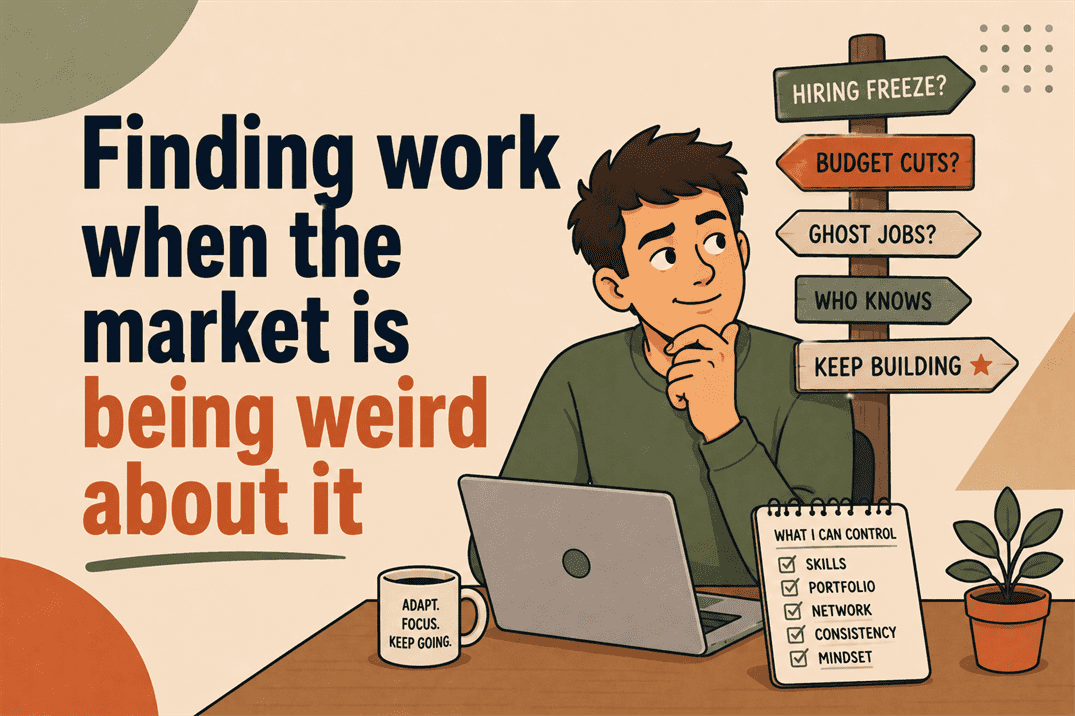
Right now, finding writing and editing work is a bit like applying for a job at a restaurant where they’ve replaced half the kitchen with a microwave, aren’t sure they need a head chef anymore and will interview you four times before ghosting you the week before Christmas.
Fun, right? Absolutely love it.
The good news is that writers and editors are actually well-positioned here, as long as you’re willing to update how you think about the search itself.
What worked three years ago probably needs a tweak.
What the internet keeps telling you to do is largely performative nonsense.
And what actually works? That’s what we’re getting into.
The market isn’t broken, it’s just rude
The freelance and content job market isn’t some apocalyptic wasteland.
It’s tighter, yes. It’s more competitive, yes. There’s an AI-shaped elephant in every room, yes.
But there is still a very large pile of money being spent on content and not all of it is being shovelled towards a large language model.
What’s changed is the buyer’s attitude.
Budgets have been squeezed. Risk tolerance has shrunk. Decision-making has slowed to a pace that makes continental drift look decisive.
And a worrying number of companies would sooner fire three people and rehire one at a lower rate than give an existing, trusted team member a 5% raise that would cost less than the recruitment process.
That’s not cynicism. That’s the market as it currently behaves.
The correct response isn’t despair. It’s strategy.
The ATS problem (Or your CV is probably being judged by a robot who has never read anything good)
Most larger companies now run applications through an Applicant Tracking System before a human ever sees them.
The ATS scans for keywords, formats and signals that loosely correspond to what was in the job description.
It has no taste, no sense of voice and no appreciation for a well-turned sentence.
This is annoying if you’re a writer, because writers are naturally tempted to write CVs that are interesting.
The ATS doesn’t want interesting. It wants the word “content strategy” in the top third of the document.
The move here is a two-document approach.
Write one CV that’s genuinely you, your voice, your personality, your range. This is your pitch document, the thing you send to a person who’s going to read it.
Then write a parallel version that’s heavily mirrored to the language in job descriptions.
Same experience, same achievements, but framed in the kind of language the job posting uses.
If they say “cross-functional collaboration”, you say cross-functional collaboration. It feels slightly soulless and you’ll probably cringe while doing it, but it works.
For freelance gigs, this doesn’t really apply because you’re usually pitching directly to a human.
That’s where you can use your own voice CV.
If you’re applying to companies or larger outfits, it’s worth knowing the game before you decide whether to play it.
Why the interview process has become an endurance sport
Four rounds. Skills test. “Meet the team” call. Final presentation. Sound familiar?
The modern interview process for content roles has ballooned into something that would have been reserved for a senior VP a decade ago.
There’s a practical reason for this.
Companies are nervous about bad hires. Remote working means less organic vetting. And honestly, some hiring managers just don’t trust their own judgment without committee cover.
The result is a process that can stretch to six or eight weeks and leave you feeling like you’ve been investing in a relationship that was always going to end badly.
A few things that help here.
First, treat every round as billable thinking time.
The skills test that asks you to write sample content?
You’re now producing spec work, and you should treat it with the same quality control you’d apply to paid work, because it might end up being used whether you get the job or not.
(Yes, this happens. Protect your work accordingly by including a visible watermark or draft-only disclaimer on anything substantial.)
Second, set your own timeline.
After two rounds, it’s entirely reasonable to say you’re progressing with other conversations and ask whether they’re able to move to a decision in the next fortnight.
This doesn’t sound demanding. It sounds like someone with options, which is exactly the impression you want to give.
Third, be genuinely willing to walk away.
A company that needs seven rounds to decide whether they trust you probably isn’t going to be a great place to work.
The case for a narrow niche
Generalist writers face real headwinds right now.
Not because generalism is bad, but because the phrase “I write across multiple industries” makes it harder for a hiring manager or potential client to picture you solving their specific problem.
The writers and editors getting consistent work tend to be identifiable as something.
B2B SaaS content. Technical writing with an SEO layer. Long-form feature writing for finance. Email sequences for consumer brands.
Whatever it is, having a clear lane makes word-of-mouth work better, makes LinkedIn positioning easier and means you tend to show up in the right searches.
If you’re a generalist who doesn’t want to give that up (fair), the answer isn’t to lie about having a niche.
It’s to lead with the niche that’s most commercially interesting and let the breadth show in your portfolio without making it the pitch.
LinkedIn is doing a lot of work and you might be making it do none
LinkedIn is a deeply strange place that seems to exist somewhere between a job board and a motivational speaker convention.
But it also has the highest concentration of people who commission content of any platform, and ignoring it is leaving connection potential on the table.
You don’t need to post daily. You don’t need to share thoughts about resilience or your morning routine.
You need a profile that clearly says who you are, what you do, who you help and provide occasional evidence that you exist and think.
A post or two a week is enough.
It can be a short take on a content trend. A brief behind-the-scenes note on a project. A recommendation for a tool or technique you’ve been using.
The goal is to stay in the peripheral vision of people who might need you, so that when they do need you, they think of you first.
The other underused move is commenting genuinely on posts from people in your niche.
Not “great post!” but an actual perspective.
This is one of the fastest ways to become recognisable to an audience that isn’t following you yet.
Cold pitching still works and still requires most people to do it better
The reaction most writers have to cold pitching is the same reaction most people have to doing their tax return.
It’s there, it’s necessary and something about it makes you want to reorganise your desk instead.
But cold pitching to the right person, done well, works.
The key is specificity. A pitch that says “I’m a content writer with ten years of experience” is going straight to the archive.
A pitch that says “I’ve been writing about FCA-regulated financial products for eight years, I noticed your last three blog posts don’t have internal links to your comparison pages, and I have a specific idea for fixing that” is something a content manager might actually read twice.
Research before you pitch. Know what they publish. Find the gap. Offer a solution, not just your credentials.
And pitch to the person who actually commissions content, not the generic contact address in the footer.
On referrals: Your existing network is probably warmer than you think
Somewhere in your contact list right now, there is a person who would happily recommend you to their colleague if you just reminded them that you exist and are available.
This is the single highest-conversion source of new work most established writers have and most writers are not actively using it.
Send a genuine catch-up message.
Not a template. Not “I hope this email finds you well” (it never does). Just a real note to someone you’ve worked with before, asking how things are going and mentioning that you have capacity for new projects.
You don’t have to pretend the context doesn’t exist. “Freelance work has slowed down a bit across the board lately, so I’m actively looking for new clients” is completely fine to say.
People respect directness and a little honesty about where you’re at usually gets a warmer response than a carefully constructed pitch that pretends you’re turning work down.
How to talk about AI without sounding defensive
Right now, any writer or editor who doesn’t acknowledge AI in their positioning is leaving an objection unaddressed.
Clients and employers are thinking about it whether you bring it up or not.
The most effective frame isn’t “I don’t use AI” (increasingly implausible and also a bit of a missed opportunity) and it isn’t “I use AI to do everything faster” (a race to the bottom on rates you probably don’t want to win).
It’s somewhere in the middle.
You understand what AI can and can’t do, you use it strategically where it adds genuine value and your actual skill as a writer or editor is what gives the output its quality and integrity.
Editors in particular are in a strong position here.
If AI is generating more content than ever, the bottleneck shifts toward quality control, voice consistency and judgment.
Those are the things a good editor provides. That’s the pitch.
A small framework nobody asked for, presented anyway: The WARM method
Writers and editors finding steady work in a tough market are generally doing four things consistently.
Work: They’re producing visible evidence of their skill, whether that’s a blog, a newsletter, a public portfolio, or regular social content. Not to feed an algorithm, but because it keeps the muscle working and shows people what they can do.
Ask: They’re actively asking for work, referrals and introductions, not waiting for inbound to find them.
Refine: They’re regularly updating their positioning based on what’s getting traction. If the pitches for one type of work are converting and another isn’t, they’re adjusting the emphasis.
Meet: They’re staying in genuine contact with their network, showing up in professional spaces and building new connections with people who commission their type of work.
None of this is glamorous. It’s just consistent. And consistency in a market that’s being a bit weird is, it turns out, the edge.
The only honest closing thought
If you’re a writer or editor reading this because work feels slower than it should, you’re not imagining it and you’re not failing.
The conditions are tighter. The process is often bizarre. The competition is real.
But the need for people who can think clearly, write well and make content that actually serves its audience hasn’t gone away.
It’s just wearing a slightly harder hat right now.
Work the process. Stay visible. Be specific about who you help and how.
And if a company puts you through five rounds of interviews and then decides to “go in a different direction,” delete the email, make a coffee and send three new pitches.

 Sep 17, 2026
