


How to sound confident without sounding arrogant
 By Jamiek
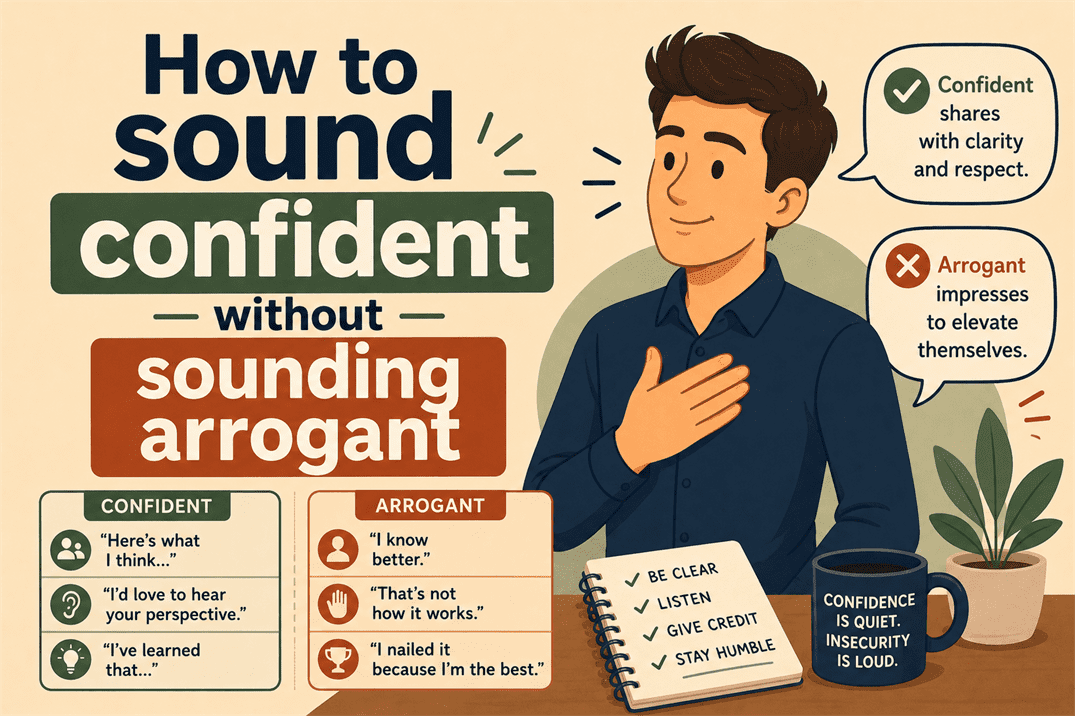
There is a very particular way a piece of writing can make you feel like the author is doing you a favour by existing.
Every sentence slightly too well-assembled. Every point landed with the energy of someone expecting a response card.
Somewhere in the subhead, a faint implication that the author has transcended the limitations that hold lesser writers back.
Some of us have read that content. Some of us have written it. We don’t need to dwell on that.
So. Confidence in writing. Specifically, how to project it without becoming the person at the content industry dinner who keeps steering the conversation back to their niche expertise in thought leadership.
The thing about confidence is that it’s mostly implied
Real confidence in writing almost never announces itself. It doesn’t need to.
A writer who keeps reminding you they know what they’re talking about tends to produce the opposite effect, in much the same way that someone who describes themselves as easy-going usually isn’t.
What actually communicates authority is harder to define, so I’ll give it a name: declarative consistency.
I made that up, but it maps to something real.
It’s what happens when a writer makes a claim and then moves on. No hedging. No five-sentence caveat. No pre-emptive apology for having an opinion.
Just a clear point, followed by the next one.
Compare:
“Some might argue that shorter content can be effective, though it’s worth considering that longer content might, in certain contexts, perform better.”
With:
“Longer content earns authority. Shorter content earns clicks. You need both.”
The second version makes an actual claim. The first is the written equivalent of standing in a doorway. At some point you have to pick a side of the threshold.
How to seem important without announcing it
There’s a field writers stumble into without realising, positioning psychology.
In the context of writing, it’s about how the structure and framing of your sentences signals your relationship to the reader before they’ve consciously registered what you said.
One expression of this is what I’d call the reference ladder. (Also made up. Still real.)
When you position yourself as someone who interprets the work of others rather than just cites it, you implicitly place yourself in conversation with the source rather than beneath it.
“Ann Handley writes about empathy in content, and she’s right, but empathy without precision is just warmth, and warmth doesn’t convert” does something different to “Ann Handley wrote in Everybody Writes that…”
The first treats Handley as a peer. The second treats her as a teacher whose homework you’re reading back to the class.
This isn’t about dismissing sources. It’s about engaging with them. Citation says you read something. Engagement says you had a view about it.
The arrogance trap is when this gets misapplied. “Look, some people still believe X, but honestly…” is positioning yourself above the idea without doing the work to justify it.
Readers notice this even when they can’t name it.
Tone calibration: the difference between confident and closed
Confident writing makes a strong claim and invites the reader to think about it. Arrogant writing makes a strong claim and then closes the conversation.
The mechanics are smaller than you’d expect. Watch your modal verbs. “This will work” is often weaker than “this works,” because the extra word creates a faint sense of the author reassuring themselves.
“You should consider” is weaker than “consider” for the same reason. Every word that pre-empts possible disagreement is a small step away from the reader.
Watch your scope, too. “Most content marketers don’t understand SEO” implicates the reader without evidence.
“The SEO checklist most content marketers use is missing a step” is specific enough to be interesting.
One invites defensiveness. The other invites curiosity.
The test I use is what I’d call the Dinner Party Rule. Would this sentence make someone lean in or start composing their rebuttal?
Confident sentences make people want the next one. Arrogant sentences make people want to say something.
Authority signals: The structural work that nobody talks about
Most of the heavy lifting in confident writing is structural. Unglamorous, but it’s doing real work.
Specificity is authority. “Studies show that…” is the weakest possible use of research.
“A 2023 Edelman trust survey found that…” signals that you found the source, read it and formed a view.
Even if the reader doesn’t verify it, they feel the specificity and it reads as confidence rather than vagueness dressed up as rigour.
The first sentence of every paragraph is doing interview work. Editors used to call this the ticket line, the sentence that earns the reader’s permission to continue.
“There are a few ways to approach this” is not a ticket line. “The first draft is always a negotiation with your worst instincts” is.
And then there’s the quality of your acknowledgements, which is very underrated.
A confident writer addresses the counterargument before someone else raises it. “You could argue this approach is slower, and you’d be right” is authority. It signals that you’ve thought about this carefully enough to see the objection coming.
Ignoring the counterargument, or handling it defensively, suggests someone less sure of their position than they’re letting on.
The failure mode that catches experienced writers
The one I see most in writers who’ve been doing this a while is credential overload.
You have the experience, the clients, the results, and you’ve decided the reader needs to know this before they’ll trust you.
So every few paragraphs you remind them. Every claim comes with a small “having worked with X and Y, I’ve found that…”
The intention is confidence. The effect is anxiety.
It reads like someone over-explaining their CV in a job interview they’re worried about.
Credentials earn trust once, briefly, early. After that, re-citing them doesn’t add to your authority. It quietly suggests you’re still not sure you have enough of it.
The writers who genuinely project confidence, Seth Godin being the obvious example, along with Morgan Housel, Paul Graham in his earlier essays, Roxane Gay in her criticism, all share the quality of letting the claim carry its own weight.
They don’t establish the right to say the thing. The saying of it is the demonstration.
A brief note on warmth
Arrogance, in writing as in person, is usually just confidence with the warmth taken out.
Confident writing trusts the reader. It assumes they’re smart enough to follow the argument and honest enough to update their view when the argument is good.
Arrogant writing performs competence for the reader rather than sharing it with them.
You feel the difference before you can articulate it, and once you’ve felt it, you start seeing the mechanics.
This doesn’t mean every piece needs to be chatty. Formal authority has its place.
But formal authority and condescension are not the same thing, and the distance between them usually comes down to whether the writer thinks the reader is capable of meeting them where they are.
Confident, not arrogant
Make claims. Real ones, with a direction. Don’t negotiate the point into a corner.
- Position yourself in conversation with ideas, not above them.
- Be specific. Name things. Dates, people, numbers, titles.
- Acknowledge the objection before someone else does.
- Remove every word whose job is to protect you from being wrong.
- Trust the reader.
None of this requires you to be an expert on everything. It requires you to be honest about what you actually think and to write it without flinching.
The writers who do this well don’t come across as arrogant. They come across as someone worth reading.
Which is, ultimately, the job.
If you need a sanity check on how your content portrays you or your business, get in touch.

 Nov 07, 2026

