


How often should a startup actually publish content?
 By Jamiek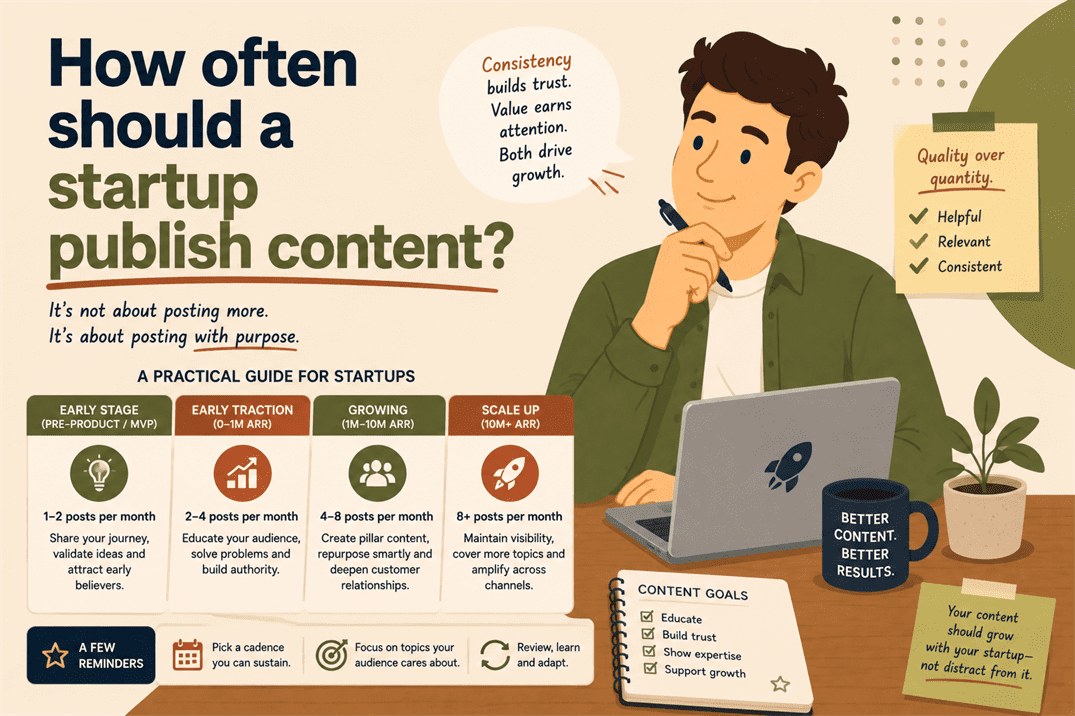
Ask this question in most marketing circles and you’ll get “consistency is key” within about four seconds, usually from someone who has never once had to write the thing they’re recommending you publish weekly.
It’s not wrong, exactly. It’s also not an answer.
Here’s an actual answer: Publish as often as you can produce something worth reading and no more.
For most startups, that’s less often than you might think, and considerably less often than whatever content calendar template you downloaded is telling you.
The made-up number problem
“Two blog posts a week” isn’t a strategy, it’s a number someone picked because it sounded productive.
It doesn’t account for who’s writing them, whether that person has anything left to say by week six, or whether anyone’s actually reading the first four before you’ve published number five.
A frequency target set without reference to capacity or substance isn’t a plan. It’s a countdown to burnout or filler, and it’s usually filler that arrives first.
I’d argue most startups should publish less than the generic advice suggests and mean every word.
Time is the first constraint and it’s not negotiable
A genuinely good piece of content, the kind that changes someone’s mind, or gets forwarded around a Slack channel, takes real hours to produce.
Research, a proper interview or two, a draft, a look at it again after a night’s sleep.
That’s not a process you can compress just because the content calendar says Thursday.
Startups routinely underestimate this because writing looks like typing and typing looks fast. It isn’t.
If your team, or your one very stretched marketing hire, has four hours a week for content, that’s roughly one solid piece a fortnight once you factor in everything else on their plate.
Committing to two posts a week on that budget doesn’t produce twice the content. It produces two thin pieces instead of one good one, and thin content doesn’t compound the way people assume it will.
Resource is the second constraint and it’s usually the real one
This isn’t just about the writer’s time. It’s about everyone the content depends on.
The founder who needs to be interviewed, the engineer who has to check a technical claim, the customer who agreed to a case study call and then went quiet for three weeks.
Every one of those dependencies caps your realistic frequency and no publishing schedule survives contact with a founder who’s too busy fundraising to answer follow-up questions.
Startups with lean teams should treat content frequency the same way they’d treat any other resourcing decision. What can we actually sustain without something else breaking?
The honest answer is usually monthly or fortnightly, not weekly and that’s fine.
Having something to say is the constraint everyone skips
Most importantly, publishing frequency should be limited by how often you genuinely have something worth saying, not by how often the calendar has a slot open.
A startup with one sharp insight a month and the discipline to only publish that insight will outperform a startup publishing three generic posts a week, every time.
Why? Because readers can tell the difference between a piece written from conviction and a piece written to fill a gap.
If you don’t have anything to say this week, the correct move is to not publish this week.
That’s a harder thing to accept than it sounds, especially with a content plan sitting in a spreadsheet somewhere insisting otherwise.
But it’s the difference between a blog people trust and a blog people learn to scroll past.
So what’s the answer?
However often you can produce something genuinely useful, without burning out the people who make it and without publishing just to hit a number.
For most early-stage startups that’s realistically once or twice a month.
That might sound underwhelming next to “post daily for maximum visibility,” but a startup with four excellent posts a quarter will do more for its reputation than one with fifty forgettable ones, and it’ll cost a lot less in hours nobody had spare.
If you’re trying to work out what’s sustainable for your team, get in touch and we’ll figure out a frequency that fits your resourcing rather than someone else’s spreadsheet.

 Sep 22, 2026
