


What AI thinks “conversational tone” means
 By Jamiek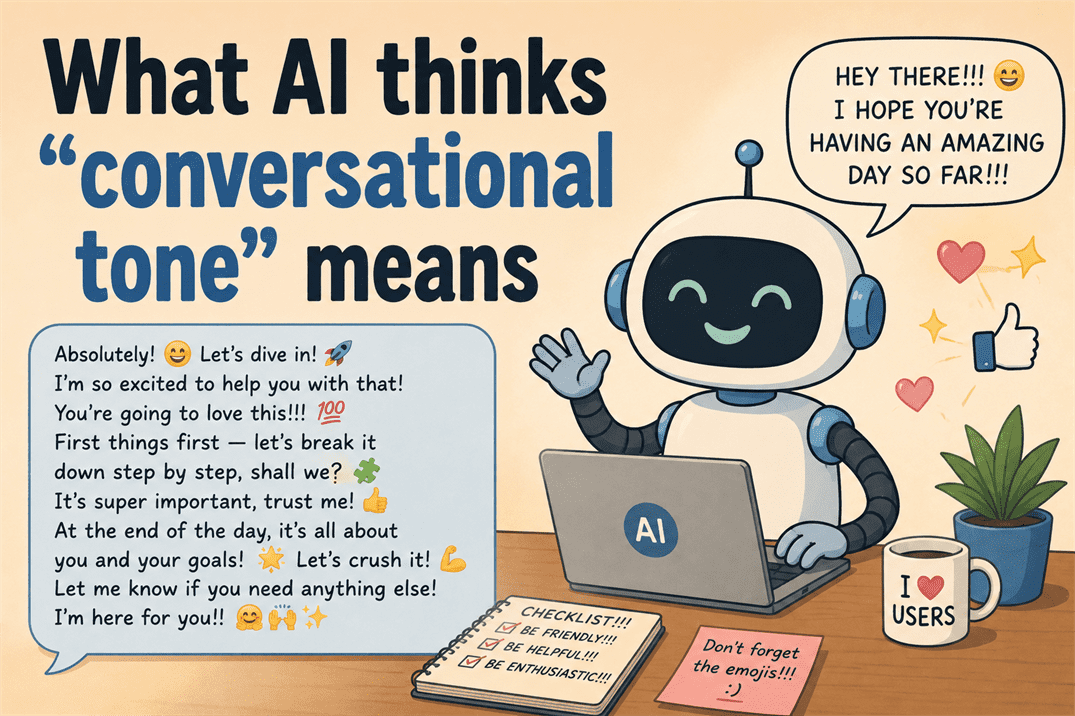
Imagine you’ve just asked a question. Nothing complicated. Something like “what should I include in a company blog post?”
And the response begins: “Great question! When it comes to crafting compelling blog content that truly resonates with your audience, there are several key considerations to keep in mind.”
You’ve just been talked at by something that has read every piece of content on the internet and concluded that this is what warm, approachable communication sounds like.
The exclamation mark. The affirmation. The pivot phrase. The word “truly.” The arrival at “key considerations” as though the sentence needed somewhere to land and that was the nearest available surface.
This is AI’s working model of conversational tone.
It’s worth taking apart, because understanding why it doesn’t work is also, handily, a masterclass in what actually does.
The tell-tale opener
“Great question!” is the most thoroughly documented AI verbal tic at this point, which means most models have been trained out of leading with it directly.
It now appears in subtler forms. “That’s a really interesting point.” “Absolutely.” “Of course!” The affirmation reflex is still there, it’s just learned to vary its entrance.
The problem with affirmations as openers isn’t that they’re warm. It’s that they’re structurally empty.
They add no information. They exist purely to signal enthusiasm before the actual response begins, and because they’re reflexive rather than genuine, they read as exactly that.
A real person affirms you when something genuinely strikes them.
An AI affirms you because it learned that affirming people reads as friendly and friendly was the instruction.
Real conversational openers don’t affirm. They engage.
They pick up a thread and pull on it. They assume the other person doesn’t need to be told their question was good before being handed the answer.
The pivot phrase problem
“When it comes to” is doing a specific kind of work in AI writing, and once you see it you can’t stop seeing it.
It’s a throat-clearing device. A way of beginning a sentence that defers the actual point by one beat.
“When it comes to writing good copy, clarity matters.” You could have just written “clarity matters in good copy.”
The opener adds nothing except the impression of a measured, thoughtful approach, which is presumably why it got reinforced.
Its siblings are everywhere. “In terms of.” “With regard to.” “As far as X is concerned.”
These phrases exist in human writing too, but in human writing they appear occasionally, when genuine nuance requires them.
In AI writing they appear as sentence starters, reflexively, because they pattern-match to a register that sounds considered and professional.
They produce the opposite effect. A sentence that begins “when it comes to” is a sentence that hasn’t quite decided to start yet.
“Truly,” “really,” and the intensifier that doesn’t intensify
Here’s a simple test. Read these two sentences.
“This approach can improve your writing.”
“This approach can truly transform your writing in a really meaningful way.”
The second sentence is trying harder. It’s deploying intensifiers to signal conviction. And because those intensifiers are applied uniformly, to everything, they intensify nothing.
“Truly” is supposed to mean “I mean this with particular sincerity.”
When it appears in every third sentence, it means “I’ve added truly here.” Same with “really.” Same with “incredibly,” “highly,” and “genuinely,” which has become so thoroughly colonised by AI writing that it now reads as a red flag in any context.
Human writers use intensifiers sparingly, because the value of an intensifier is its rarity.
If everything is remarkable, nothing is. AI writing hasn’t quite learned this because it optimises for enthusiasm rather than calibration.
The list that didn’t need to be a list
Ask an AI for a conversational piece and there’s a reasonable chance it’ll come back with a paragraph followed by a bulleted list followed by another paragraph followed by another bulleted list.
This isn’t because lists are wrong.
It’s because lists are a structural shortcut that feels organised and clear and reads, at scale, as a refusal to write prose.
Real conversational writing moves. It has rhythm. It transitions between ideas in a way that shows the relationship between them.
A bullet point can tell you that two things exist. A sentence can tell you how they connect, which one matters more, and what you’re supposed to feel about the whole situation.
That’s not a small difference.
The list-heavy AI document doesn’t look conversational. It looks like a presentation somebody turned into a blog post.
The information is technically there. The voice isn’t.
“It’s important to note that”
This one deserves its own section.
“It’s important to note that” is a phrase that exists to signal significance without committing to why something is significant.
A human writer who finds something genuinely important says what it is and then explains why it matters.
“It’s important to note that” is the signpost without the road. It tells you to pay attention without giving you anything to pay attention to.
Its cousins are “it’s worth mentioning that,” “it should be noted that,” and “keep in mind that.”
All of them have the same structure, a preamble about noteworthiness, followed by the note.
You could remove every single one of these phrases from a piece of writing and lose nothing except three hundred empty calories per thousand words.
What conversational tone actually is
Here’s the thing that AI writing gets structurally wrong about conversational tone.
It treats it as a register rather than a relationship.
Conversational tone isn’t a set of lexical choices. It’s not contractions and short sentences and the occasional “you.”
It’s the sense that a specific person, with a specific perspective, is talking to another specific person about something they both have a reason to care about.
It has opinions. It has texture. It notices things. It makes choices about what to say and what to leave out, and those choices are visible in the writing.
The reason AI writing produces a convincing simulation of conversational tone rather than the thing itself is that it optimises for the surface features of the register rather than its underlying cause.
Conversational writing sounds like a person because a person wrote it, and a person has a point of view that shapes every sentence.
The intensifiers, the affirmations, the pivot phrases: these all appear because they pattern-matched to something that looked like the right register.
But register without voice is a costume. It fits. It just doesn’t look like anyone.
This matters practically because readers feel it, even when they can’t name it. Content that reads as AI-assisted tends to produce a mild, background sense of nobody-home.
The information is correct. The tone is technically fine. Something is missing and that something is the sense that a human being made a series of deliberate choices and those choices add up to a perspective.
That’s what conversational tone is. Not the absence of formality. The presence of someone.
A note on working with AI as a writer
None of this is an argument against using AI in a content workflow. It’s an argument for knowing what it produces by default and treating that output as a first pass rather than a finished piece.
The tics are consistent enough to edit out systematically. The structure is fixable.
What you’re putting back in, when you revise AI-assisted content, is the specificity and the point of view and the small choices that make writing feel like it came from somewhere.
The writers who do this well aren’t using AI less. They’re editing it harder and they know exactly what they’re looking for.
If you’d like content that sounds like a person wrote it, because a person did, you know where to find me.

 Sep 24, 2026
