


Writing for an internet that’s already annoyed before you’ve finished the sentence
 By Jamiek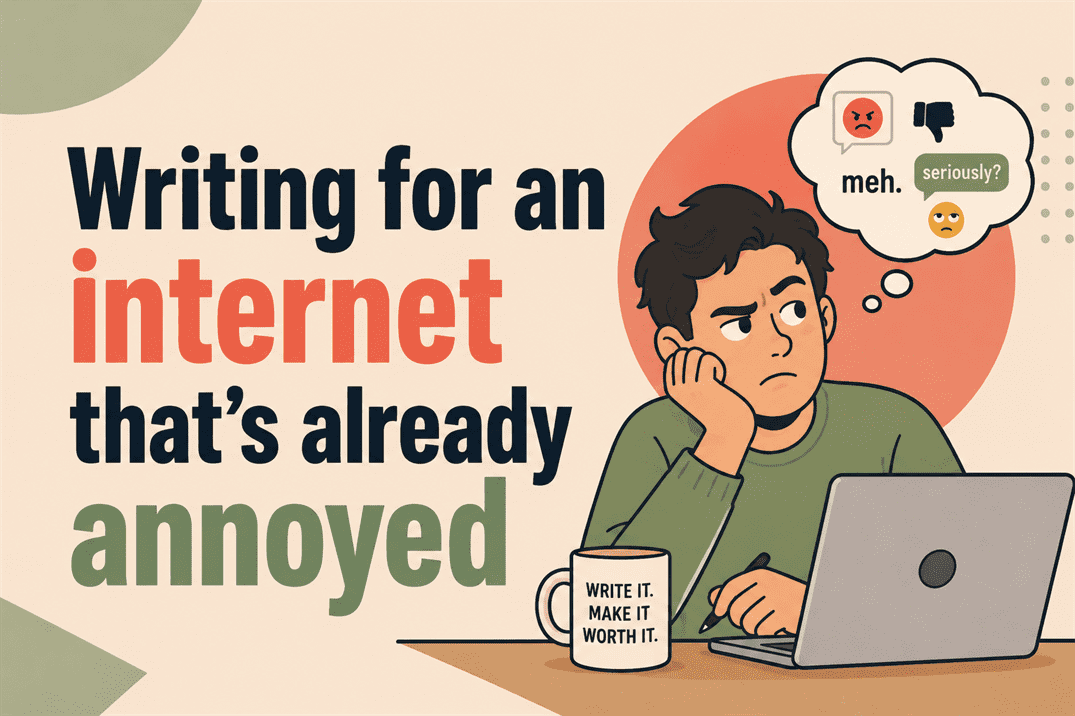
Let me set the scene.
You’ve written something. It’s good. Balanced, considered, reasonably well-punctuated.
You’ve made a point without being aggressive about it. You’ve acknowledged nuance exists. You’ve even, at one stage, written a sentence that starts with “to be fair,” which is practically a peace offering.
You publish it.
Within four hours, someone in a replies section you didn’t know existed has described it as either deeply offensive or suspiciously safe, depending on which corner of the internet found it first.
Welcome to writing in public in the mid-2020s. Population: everyone.
How we got here, briefly, because I don’t want to write a thesis
The internet used to be a place where you could publish an opinion and the worst that happened was a strongly worded comment from someone called DaveFromLeeds who disagreed about broadband providers.
Dave was manageable. Dave had a single, specific grievance and he left after making it.
The current internet is not Dave.
The current internet is a vast, hyperconnected, permanently caffeinated ecosystem that has somehow made outrage the most efficient form of engagement.
Algorithms reward it. Platforms amplify it.
And somewhere along the way, a significant portion of the population got very, very good at finding the most uncharitable possible interpretation of any given sentence and then being publicly furious about it.
This is not a political point, by the way. This is a writing observation. Every quadrant of the internet does this. It is a universal and deeply human sport.
I just have to write in it. And so, probably, does your brand.
The three types of reader you’re writing for now
In the interest of having a framework, because I find frameworks soothing and also they make posts easier to skim, I’ve developed what I’m calling the Audience Tension Spectrum, or ATS, because again, acronyms are load-bearing.
ATS Type One: The reasonable majority. They read the thing. They form a view. They move on with their lives. They are the reason writing still works and they are tragically underrepresented in comment sections.
Write for these people. Always. They are the whole point.
ATS Type Two: The primed reader. They arrived with a position. They’re not looking to be informed, they’re looking for confirmation or ammunition, whichever comes first. They will find something to object to in almost anything because that’s not really about the writing.
You cannot fully write around this person without producing content so aggressively neutral it makes a blank page look opinionated. Don’t try.
ATS Type Three: The offence archaeologist. This is the specialist. Patient, thorough, genuinely committed to the dig. They will find the one sentence in a 1,200-word piece that, when read in a specific context you never intended, by someone in a specific situation you couldn’t have anticipated, could theoretically be interpreted as problematic.
Then they will post about it as though you opened the piece with a villain monologue.
You cannot write for the offence archaeologist without writing nothing. So you don’t.
You write well, you write clearly and you make your peace with the possibility that someone will one day screenshot your most innocuous paragraph.
What this actually means for the writing
Here’s the gear change. The practical bit. The part where I stop being lightly satirical and say something I actually mean, which is that writing well in this environment isn’t about being bland.
Bland doesn’t work. It never did. It just used to be safer.
What works now is the same thing that’s always worked: clarity of intent. Knowing exactly what you’re saying and why, and saying it without wobbling.
Readers, even difficult ones, can sense when a writer is genuinely confident in their position versus when they’re hedging so hard the piece has no centre of gravity.
The posts and campaigns that get torn apart are often not the bold ones.
They’re the ones that tried to say something and then flinched halfway through and ended up saying nothing while gesturing awkwardly at several things.
Pick a lane. Drive in it. Don’t apologise for being in it.
This doesn’t mean be needlessly provocative. Provocation for its own sake is its own kind of cowardice, it’s just cowardice wearing a leather jacket.
It means be honest. Be specific. Have an actual point and follow it to its conclusion like you mean it.
The bit about brands, since I know you’re reading this too
If you’re a business owner or a marketing lead reading this while slightly worried about your next campaign, here’s the version for you.
The instinct when the internet feels hair-trigger is to sand down every edge until the content is perfectly smooth and perfectly meaningless.
I understand that instinct. I’ve watched it happen in real time in briefing documents where sentences start life as opinions and arrive in the final draft as abstract suggestions.
It doesn’t protect you. It just makes the content worse while also failing to protect you, which is a fairly grim combination.
What actually reduces risk?
Say what you mean, mean what you say, don’t punch at groups of people and don’t let your copy make promises your brand can’t keep.
That last one causes more problems than anything I’ve mentioned so far and it rarely gets talked about in the same breath as online sensitivity, but it absolutely should.
The content that genuinely offends people, in a way that’s worth worrying about, is usually content that’s lazy, careless, or written without thinking about who’s on the receiving end.
That’s an editing problem. An experienced editor catches it before it goes anywhere near publish.
The content that merely annoys the offence archaeologist is mostly just content that exists.
There’s not much to be done about that except write it well and move on.
A small, sincere conclusion
Writing has always required a degree of courage. Not dramatic, manifesto-nailing-to-a-door courage. Just the quiet kind.
The kind that lets you finish a sentence without checking over your shoulder.
The internet being what it is right now makes that harder. I won’t pretend otherwise. But the answer isn’t silence and it isn’t beige.
It’s good writing. Specific, honest, carefully edited and aimed squarely at the reasonable majority who just want to read something that says something.
Dave from Leeds is still out there, by the way. He’s got more tabs open now. But he’s still basically fine.
If you want content that says something real without setting anything on fire, I’ve been doing exactly that for twenty years. Come and talk to me.

 Sep 17, 2026
