


Agency vs solo specialist: Who should edit your content?
 By Jamiek
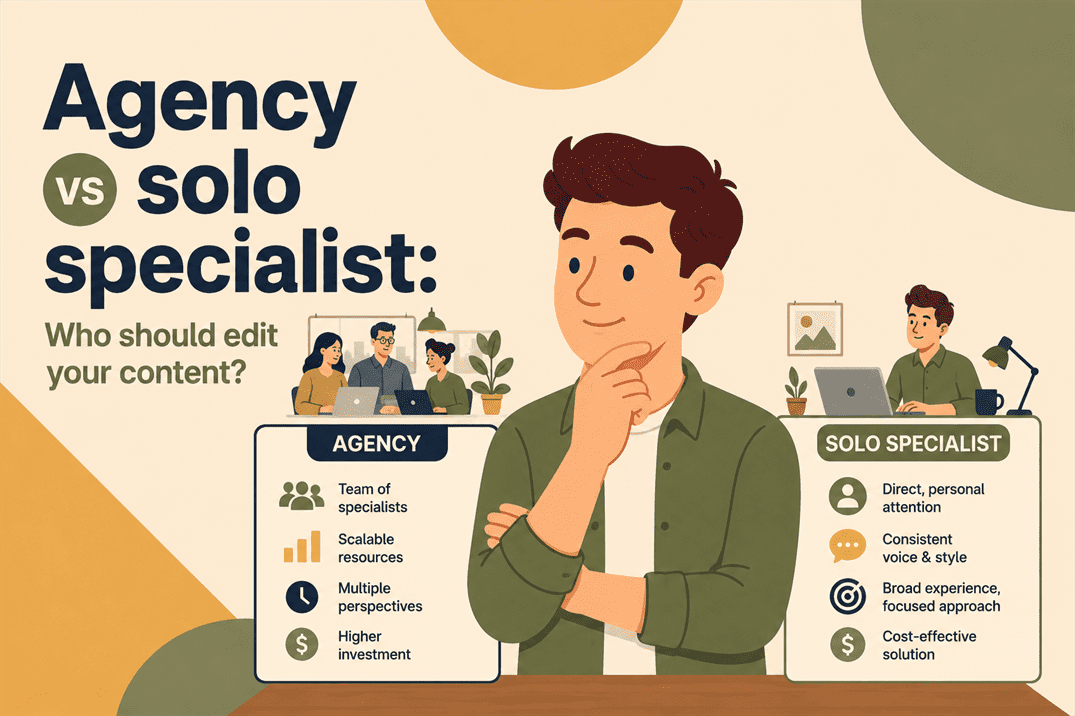
A small or medium business looking for editorial help usually starts in the same place, a Google search for “content editing agency,” because that’s the phrase that comes to mind first and agencies have spent a long time making sure it’s the phrase that ranks.
What often gets missed further down that search is the other genuinely viable option, a solo specialist working directly with you rather than through a team structure.
Both can do the job well but they do it in fairly different ways.
For a smaller business, the difference matters more than the marketing on either side tends to let on.
What an agency offers
Redundancy, mostly. If your usual editor is on holiday or leaves the company, someone else at the agency picks up the account and the work continues without you having to find a replacement yourself.
For a business with heavy, unpredictable volume, that continuity is worth something.
Agencies also bring a range of disciplines under one roof, strategy, design, sometimes paid media, all coordinated through a single point of contact.
If you need editing as one piece of a much larger, multi-service engagement, that coordination has genuine value and building the equivalent yourself from several freelancers takes real effort.
The trade-off is the layer of management sitting between you and the person actually doing the editing.
Most agencies work through an account manager who relays your feedback to the editor rather than you speaking to them directly.
Instructions travel through a middleman, which means nuance gets lost and the person with the clearest sense of what you actually meant, you, isn’t the person having the conversation with the editor.
I’ve watched simple feedback take three rounds to land properly this way, purely because it kept getting paraphrased on its way through.
There’s also a cost to be aware of.
Agency rates include the account management, the office overhead and often a junior team member doing a first pass before a senior editor reviews it, if a senior editor reviews it at all.
You’re not just paying for editing time. You’re paying for the structure the editing sits inside.
What a solo specialist offers
Direct access, mostly. When you work with a solo editor, your feedback goes to the person doing the work, not through anyone relaying it on your behalf.
If a piece isn’t landing the way you expected, you can say so directly and get an answer that reflects genuine judgement rather than a summary of a summary.
You also get consistency of person, which matters more than it sounds like it should.
The same editor learns your voice, your industry’s specific sensitivities and the small preferences that never quite make it into a written brief.
That knowledge compounds over successive projects in a way it can’t when your work rotates between whichever team member the agency has available.
Cost tends to be more transparent too, since you’re paying for one person’s time rather than an overhead structure sitting on top of it.
This is the positioning I’ve built Coastal Content around.
No account managers, no junior writers doing a first pass before someone more senior actually reviews it.
When you brief me, I’m the one writing and editing it. When you give feedback, I’m the one hearing it.
The trade-off is real and worth naming honestly. There’s no built-in redundancy.
If I’m unavailable for a period, there’s no one else stepping in on your account, which is a genuine consideration if you need guaranteed year-round coverage with zero gaps.
And a solo specialist has natural capacity limits, so a business that needs a very large volume of editing every single month may find an agency’s structure a better practical fit, purely on volume.
Two scenarios where the answer differs
A fast-growing company launching content across five channels simultaneously, with three different internal stakeholders each needing sign-off.
This is closer to agency territory, or at minimum a case for a solo specialist who’s explicitly built a workflow for handling multiple stakeholders cleanly, because the coordination overhead is real and someone needs to own it.
A ten-person B2B consultancy publishing 10 pieces a month, where the founder has a clear voice and just needs someone sharp enough to catch when a draft doesn’t sound like them.
This is exactly where a solo specialist tends to outperform an agency.
The relationship is close, the volume doesn’t need a team’s worth of capacity and direct access to one experienced editor solves the problem faster than routing it through account management.
Most small and medium businesses sit closer to the second example than the first, which is worth knowing before you default to “agency” purely because it’s the more familiar search term.
Questions worth asking either option
- Who specifically will be editing my content and will that be the same person each time?
- Will I be speaking to them directly, or through an account manager?
- What happens if that person is unavailable?
And, sharpest of all, what does the pricing actually cover, editing time alone, or editing time plus a layer of management and coordination you may not need for the scale you’re working at?
Ask an agency these questions directly and you’ll usually get a clear picture fast.
Some genuinely do offer direct access to the editor, in which case a lot of the trade-off above narrows considerably.
Others are structured exactly the way the stereotype suggests and it’s better to find that out at the enquiry stage than three projects in.
My honest recommendation
If your business needs coordinated, high-volume, multi-service output with guaranteed redundancy, an agency structure is the logical choice.
If what you need is a sharp, consistent editorial eye that understands your business and speaks to you directly without a management layer in between, a solo specialist, done properly, tends to deliver more for less.
Neither option is a trap. The trap is picking one out of habit rather than matching the structure to what you genuinely need.
If you want to talk through which shape fits your business, get in touch and I’ll give you a straight answer, including telling you if an agency would genuinely suit you better.
That’s not a sentence you’ll hear from many agencies about a solo specialist!

 Oct 22, 2026

