


What it costs you when nobody’s editing your content properly
 By Jamiek
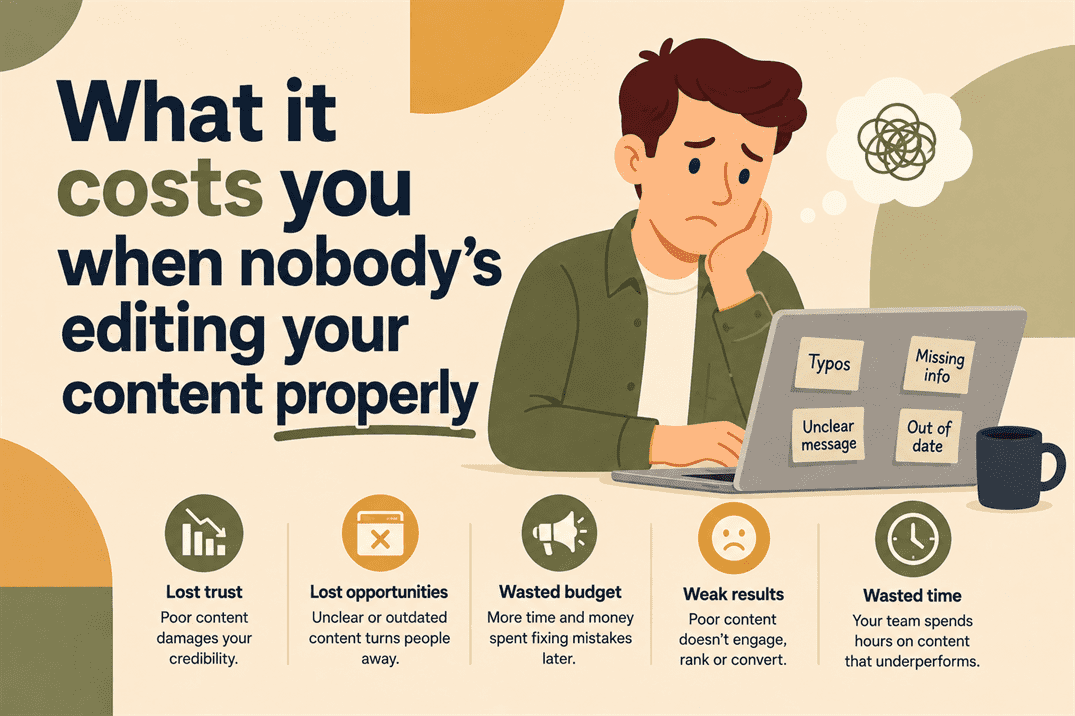
Editing looks like the expense you can trim when budgets get tight. It’s the step at the end, the polish, the thing that happens after the real work of writing is already done.
Cut it and nothing visibly breaks. The blog post still publishes. The email still sends. Nobody’s phone rings to tell you a piece went out unedited.
That’s exactly what makes it dangerous to cut.
The cost of skipping editing doesn’t show up as a single obvious bill.
It shows up slowly, spread across trust, consistency and a hundred small moments where a reader decided your brand wasn’t quite as sharp as it claimed to be, and you never found out it happened.
The trust cost
Readers extend a small amount of credit to any piece of content they start reading.
They’re willing to assume, for the first paragraph or two, that whoever wrote this knows what they’re talking about.
Every inconsistency, every claim that doesn’t quite hold together, every sentence that contradicts something said two paragraphs earlier spends a bit of that credit.
Enough small withdrawals and the reader stops extending it at all, not just for this piece but for the next one too.
I’ve seen this play out with a client whose blog made a specific statistic claim in one post and a materially different version of the same statistic in another, published four months apart.
Neither number was wrong exactly, they’d just pulled from different sources without anyone checking for consistency.
A reader who happened across both, which is more likely than most teams assume given how search results show older content, would reasonably wonder what else on the site wasn’t being checked.
That’s not a dramatic failure. It’s a subtle one nobody catches until the damage is already done.
The inconsistent voice cost
If multiple people are producing content, whether that’s several writers, several departments, or a mix of human drafts and AI-assisted ones, voice drifts unless something is actively holding it together.
One piece is warm and conversational. The next is stiff and corporate, because whoever wrote it defaulted to what “professional” sounds like in their head rather than what your brand sounds like.
A reader encountering both in the same week gets a confusing signal about who they’re dealing with.
This matters more for smaller businesses than people expect, because a smaller brand’s voice is often doing more of the trust-building work.
A huge, established company can survive inconsistent tone because its size alone signals legitimacy.
A growing business without that size behind it is relying on its content to feel like it’s coming from one coherent, credible source.
Inconsistency undermines exactly the thing a smaller brand most needs its content to do.
The AI slop cost
This is the newest version of an old problem and it’s becoming the most common one I see.
AI drafting tools are genuinely useful and genuinely fast, and that speed creates its own risk.
- Content that reads well enough to sail past a glance while saying very little.
- A paragraph that sounds confident but hedges every real claim.
- A conclusion that promises something the body never quite delivers.
- A statistic that sounds plausible and was never checked.
None of this looks obviously broken on a first read, which is precisely the danger.
Content like this gets approved because it passes a surface check, no typos, roughly the right length, technically on topic.
It goes out under your brand’s name, and the readers who notice, and a meaningful number will, recalibrate how much they trust the next thing you publish.
I’ve written before about why the theory that AI drafts only need a quick proofread falls apart under any real scrutiny.
The cost you can’t see on a dashboard
None of this shows up cleanly in analytics.
Pageviews don’t drop the week a piece with an inconsistent claim goes out. There’s no line item for “readers who quietly stopped trusting us.”
The damage accumulates below the metrics most teams are watching, which is exactly why it gets deprioritised in budget conversations.
It’s very hard to argue for spending on a problem you can’t point to a number for, even when the problem is real and compounding.
This is close to the same blind spot that shows up when nobody in the approval process is checking for substance rather than surface correctness.
A team can be doing everything that looks like due diligence, spellcheck, brand compliance, a read-through and still be missing the layer of scrutiny that catches the problems that cost you readers over time.
What proper editing catches
A good edit isn’t about fixing commas.
It’s checking whether a claim is genuinely supported, whether this piece says the same thing your last piece said about the same topic, whether the voice sounds like you rather than like a generic version of professional writing, and whether an AI-assisted draft’s fluency is hiding a gap in substance underneath it.
That’s a different skill to writing and it’s the layer most content operations skip once deadlines get tight, exactly the point where skipping it does the most damage.
The real comparison
Editing has a visible cost. You can see the day rate, the project fee, the line item.
Skipping it has an invisible one. Trust eroded a little at a time, voice that drifts until your brand doesn’t sound like one coherent thing anymore and content going out that reads fine on a fast read and falls apart on a careful one.
The visible cost is the one that’s easy to cut in a budget meeting.
The invisible one is the one that costs more in the long run. By the time it’s obvious enough to point to, you’re not looking at a quick fix. You’re looking at a rebuild.
If you’re not sure whether your current content would hold up to a genuinely careful read, that’s worth finding out before a reader finds out for you.
Get in touch and I’ll give you a straight assessment of where the gaps are.

 Oct 22, 2026

