


What I’d tell myself if I could go back 20 years
 By Jamiek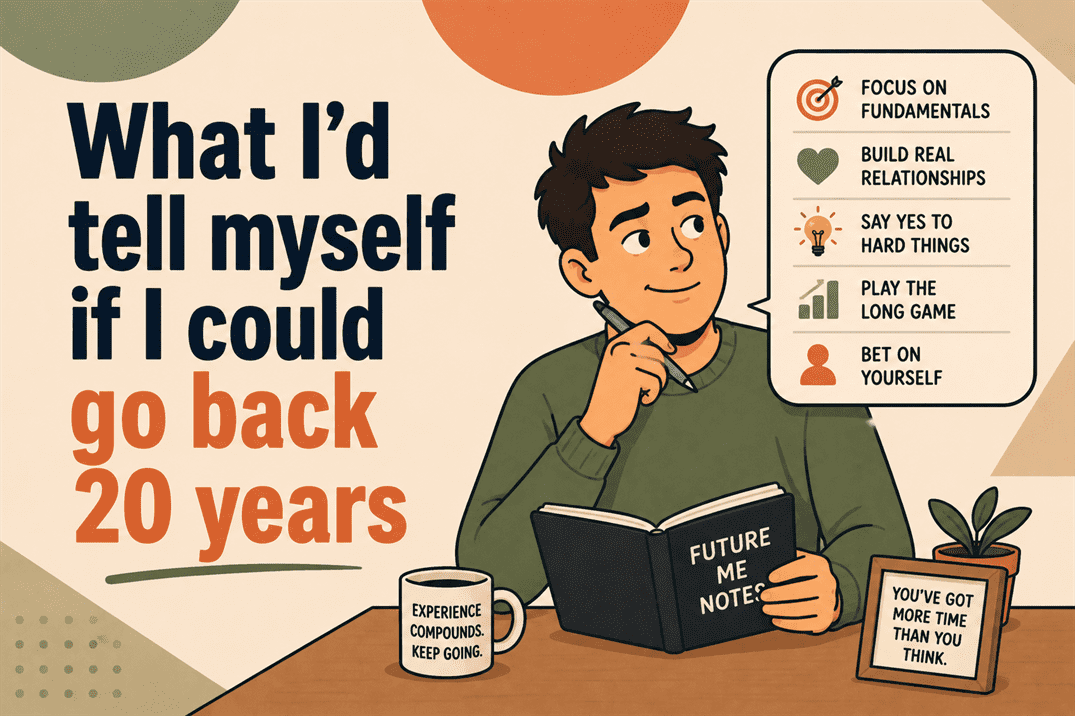
Or: What advice would you give your younger self when planning to move into writing and editing.
Here’s a fun thought experiment that I’ve been turning over for a few weeks now, which tells you everything you need to know about how I spend my time.
Imagine you could sit down with yourself, circa 2006.
Your past self is probably hunched over a beige desktop computer typing something with a confidence that isn’t fully warranted, absolutely certain they’re doing it right.
What would you say to them?
I’ve been writing and editing for long enough that this question hits differently than it might for someone who just picked up a keyboard.
There are real things I’d say. Not vague stuff like “believe in yourself” or the sort of advice that belongs on a fridge magnet nobody asked for.
Actual, specific, occasionally embarrassing things.
So. Let’s have the conversation.
Stop writing to sound clever
Twenty-years-ago me was doing something I now spend half my editing time fixing in other people’s work.
He was writing to impress.
Long words where short ones worked perfectly well. Passive voice dressed up as authority. Sentences that felt like they were wearing a tie to a barbecue.
The humbling truth is that nobody reading your work thinks “wow, this person must be really intelligent.”
They’re thinking “get to the point” while scrolling past at a speed that would make your younger self weep.
Clear writing isn’t a consolation prize for people who can’t do clever writing. It is clever writing.
It took me years to understand that.
You could argue it’s the central insight of the whole craft and the fact that it sounds obvious doesn’t mean anyone actually acts on it.
George Orwell knew it. Anne Lamott knew it. Your client who asked you to “just make it punchy” also knew it, and they weren’t even trying to be wise.
Learn to edit yourself before someone else has to
My early drafts were, let’s say, enthusiastic.
There was a period where I genuinely believed that more words meant more value, and I was charging by the word, which probably explains it.
Self-editing is a different skill from writing.
It requires you to read what you actually wrote rather than what you intended to write, which sounds simple and is absolutely not.
The version of a sentence in your head is always better than the one on the page. Your job is to close that gap.
The single best thing I ever did for my editing was to stop editing immediately after writing.
Distance is everything. Come back after a coffee, a walk, a sleep, whatever works.
You’ll catch things you’d have sworn weren’t there.
The internet changed what writing is
Here’s where it gets interesting. And by interesting, I mean slightly uncomfortable if you’ve spent years building one particular set of skills.
Writing for the web isn’t just print writing that happens to live online. It never was.
The way people read on a screen is different. The context is different. The competition for attention is different. I didn’t fully accept this for longer than I should admit.
Twenty-years-ago me was writing long, unbroken paragraphs for websites like they were magazine features.
That’s not entirely wrong, but it’s not entirely right either.
Structure matters more online. Entry points into the text matter. People scan before they commit.
That’s not a character flaw in your readers. That’s just how human attention works when there are seventeen other tabs open.
The writers who thrived in the shift from print-first to digital-first thinking were the ones who stopped seeing web conventions as dumbing down and started seeing them as a different kind of craft.
Which they are.
Learn what you’re actually selling
This one stings a little.
For a long time, I thought I was selling words. Sentences. Beautifully constructed paragraphs with good bones.
I wasn’t. I was selling outcomes. Rankings, conversions, authority, trust, subscriptions, enquiries.
The words are the mechanism, not the product.
Understanding that changes how you approach a brief, how you talk to clients, how you price your work, and how you evaluate whether something is actually good.
Good isn’t “I’m happy with how that reads.”
Good is “did it do the job it was supposed to do?”
This doesn’t make writing transactional. It makes it purposeful. There’s a difference, and it matters.
Now the part where I look at where this is all going
Here’s the bit where I have to stop being glib, because the next ten years of written content are genuinely interesting and I don’t want to be the person who buries the lead under my wittering.
AI is already writing. You know this. You might be slightly worried about it, or very worried about it, or pretending not to think about it, which is also a valid coping strategy.
But the writing that AI produces is competent in the way that a competent content farm is competent.
It covers the ground. It doesn’t miss things out. It’s also, quite often, exactly what the brief asked for and nothing more.
The writing that survives the next decade is the writing that has a point of view.
Specificity. Evidence of an actual human having actually thought about something.
The pieces that feel like they came from somewhere rather than being assembled from statistically likely sentences.
That’s not wishful thinking. That’s where the attention is already migrating.
The commodity content market is going to get harder because supply is about to become effectively infinite.
The market for writing that does something the algorithm can’t replicate is going to get more valuable, not less.
If you’re a writer or editor reading this, the thing to invest in isn’t a tool or a technique. It’s your judgment.
Your ability to know when something is good and why. Your voice. Your point of view on things.
Those are the attributes that compound over time and can’t be summarised into a training data set.
What I’d actually say
So, if I’m sitting across from myself in 2006, coffee going cold, beige computer humming away, here’s the honest version:
Write clearly. Edit ruthlessly. Understand why you’re writing before you write a word.
Read more than you think you need to, including things that have nothing to do with your niche, because that’s where the interesting thinking actually comes from.
Be curious about the industry you’re writing in, not just the craft of writing itself.
And maybe the most important thing, the one that took longest to properly land, don’t confuse your work with your worth.
A piece of writing is a version of a thing, not the final word on whether you’re any good. The next draft is always possible.
Twenty-years-ago me would probably nod along, go back to his desk and write something overly clever in the passive voice.
But maybe a little less so. And that’s how it works, really. You don’t learn this stuff all at once. You just keep getting slightly better at catching yourself.
That’s the job.
If you would like to use my experience for your benefit, get in touch!

 Oct 15, 2026
