


The AI content discourse ranked by how many times I’ve read it
 By Jamiek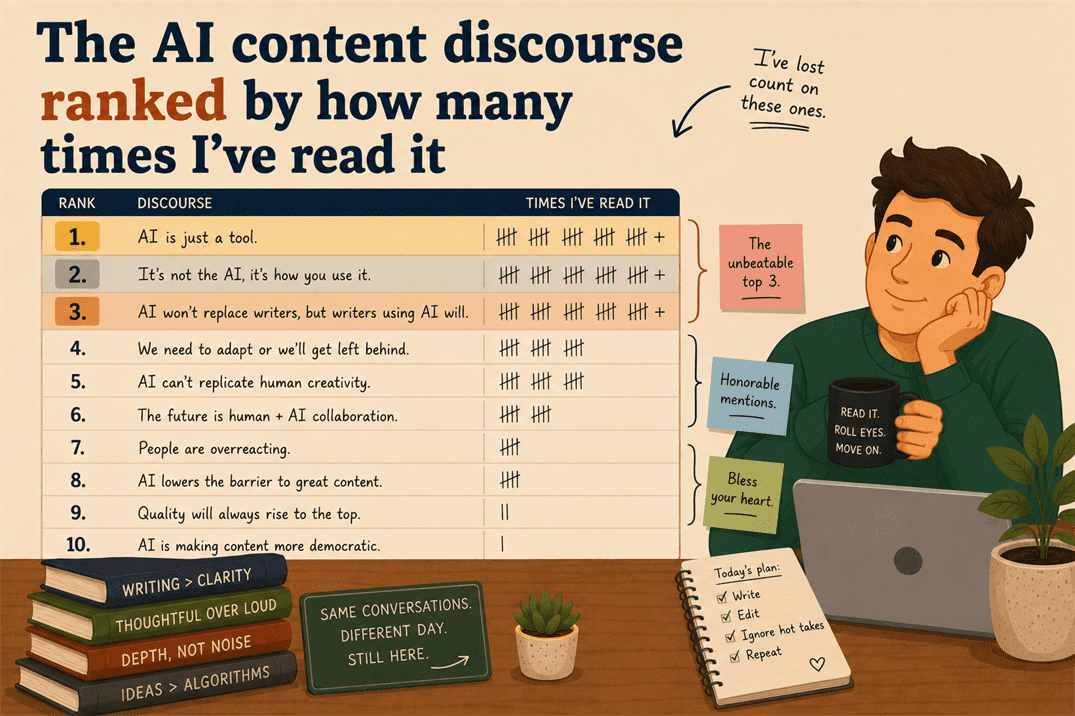
I’ve been writing about AI and content for long enough now to have seen the full ecosystem of takes cycle through multiple times.
The same arguments, the same framings, the same conclusions, occasionally wearing a different hat.
This is a field guide. It is written with affection, exhaustion and the specific weariness of someone who has read all of these more than once.
Tier one: I have read this ten thousand times
“AI will replace writers.”
The original. Still going. Has been definitively answered, partially answered, complicated, nuanced, reversed and re-complicated so many times that it now exists outside the normal rules of argument.
Nobody is convinced by a new version of this piece. Everyone writes one anyway.
Including, in a roundabout way, me, which I’m aware of.
“AI won’t replace writers, it will change what writers do.”
The corrective to the above, which arrived approximately forty-eight hours after the above and has been published continuously since.
Usually contains a section about how writers will become “orchestrators” or “prompt engineers” or “quality controllers,” which is sometimes true and is also a way of describing the same job with more anxiety about it.
“The problem with AI content is that it lacks a human voice.”
Correct. Also now the first thing everyone says, which means it’s been absorbed into the conventional wisdom without producing much change in what people actually commission.
Knowing the problem and solving the problem remain two separate activities.
Tier two: I have read this several hundred times
“Here’s my prompt for writing blog posts.”
Usually involves a system prompt of considerable length that instructs the model to be an expert SEO content writer who writes in a clear, engaging, conversational tone.
The resulting output is then presented as evidence that the prompt works, without a control condition and without asking whether the piece is actually any good.
The prompt is the product. The content is incidental.
“We tested AI against human writers and here’s what happened.”
The methodology is almost always under-specified in ways that determine the outcome.
What counts as good? Who’s judging? Is the human writer working to a brief or working freely? Is the AI output first draft or edited?
These questions are usually absent, which means the conclusion was chosen before the test was designed.
I’ve seen this piece conclude in both directions with equal confidence.
“Google says it doesn’t penalise AI content.”
True, technically, and deployed as an argument that AI content is therefore fine, which doesn’t follow.
Google doesn’t penalise bad photography either. That doesn’t make bad photography good.
What Google actually says, if you read past the headline, is that it evaluates quality, which is exactly the thing the piece is trying to avoid discussing.
Tier three: Appears regularly, still produces a reaction
“I used AI for a month and here’s what I learned.”
Genuinely interesting in format, variable in execution. The good versions of this piece are specific about workflow, honest about what didn’t work and contain at least one conclusion that surprised the writer.
The bad versions are a month-long validation exercise that confirms the writer’s prior position with added anecdotes.
You can usually tell which one you’re reading by the end of the second paragraph.
“The real problem is that clients can’t tell the difference.”
This one bothers me more than it should because it’s framed as a criticism of clients when it’s actually a description of a quality threshold.
If clients genuinely can’t tell the difference between two pieces of writing, one of them wasn’t good enough to be worth the difference.
The correct response is to be better, not to be frustrated that better isn’t being rewarded by people who can’t see it yet.
“Here are ten AI tools every content marketer needs.”
Listicle-shaped, refreshed seasonally, contains mostly the same tools in a different order.
Jasper and ChatGPT are always there. Something new is included to justify the publication date.
There is no discussion of workflow, integration, or what problem each tool is actually solving.
They are just tools and there are ten of them and now you know.
Tier four: Rare, usually worth reading
“Here’s how this changed my actual process, specifically.”
The piece that says: I used to do it this way, now I do it this way, here is the exact point where one became the other, here is what got better and here is what I now have to watch for.
No broad claims about the industry. No predictions. Just a working account of a real change to a real workflow, specific enough that you could apply it to your own.
These exist. There aren’t enough of them.
“I tried this and it didn’t work, here’s why.”
Rarer still. The failure piece is the most useful piece in any practical discourse and the least written, because the incentive structure of content marketing doesn’t reward admitting things didn’t work.
When it does appear, it’s usually more instructive than ten success stories, because the failure contains the actual constraint that the success stories glossed over.
The thing the discourse mostly isn’t doing
Almost none of it is about the practical, granular experience of using AI in a real content workflow over a sustained period.
Not the tools, not the predictions, not the philosophical implications. Just, what does it actually feel like to do this work now, specifically and what have you learned from doing it repeatedly that you didn’t know at the start?
That’s the piece I’m most interested in writing and reading and it’s the one that comes up least often in my feed.
Make of that what you will. I’m going to go and write it.
If you want someone who thinks about this stuff at the workflow level rather than the discourse level, you know where I am.

 Oct 08, 2026
