


The prompt I use when I don’t know what I think yet
 By Jamiek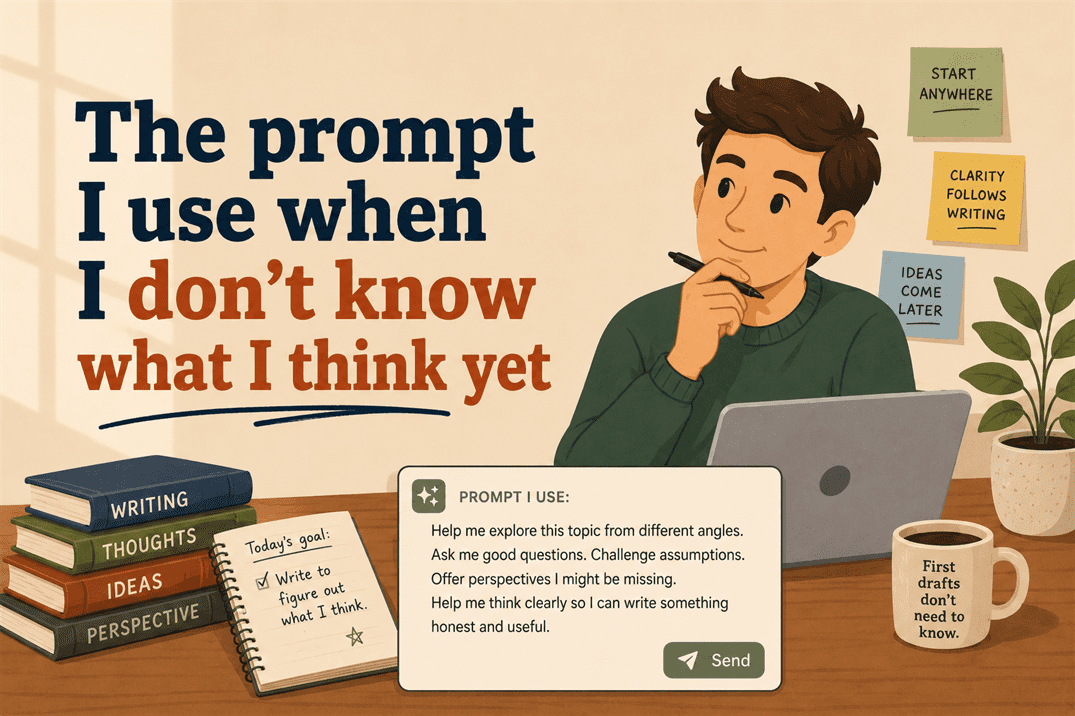
Most of what gets written about AI and writing is about AI doing the writing. Which makes sense.
It’s the obvious use case, it’s what the demos show and it’s what makes people either excited or furious depending on their priors.
But the use I come back to most often isn’t writing at all. It’s thinking.
Specifically, the moment before I know what I think, when there’s something half-formed in my head that hasn’t resolved into an actual position yet.
A topic I need to write about but haven’t cracked. A decision I’m circling. A piece of client feedback that’s bothering me in a way I can’t quite articulate.
That moment used to just be uncomfortable. Now I have somewhere to put it.
The actual prompt
It’s not complicated. Some version of: “I’m trying to work out what I think about X. Here’s where I am so far.”
Then I write out the half-formed version, the contradictions and all, without trying to make it coherent first.
What comes back isn’t usually the answer. It’s a reflection of the shape of the problem, with questions attached.
Which threads seem load-bearing. Where the logic gets wobbly. What I seem to be assuming without having decided to assume it.
And something about seeing your own half-thoughts mirrored back, reordered and made legible, is extraordinarily useful.
Not because the AI has understood you, but because the act of externalising the idea forces it into a form you can actually look at.
You can’t interrogate a feeling. You can interrogate a paragraph.
Why this is different from writing with AI
When you use AI to write, the output is the point. You’re generating something you’ll use. The quality of what it produces matters.
When you use AI to think, the output is almost incidental.
What matters is what happens to your own thinking during the conversation. The response is a prompt for your next thought, not a draft of your final one.
You’re not extracting value from what it writes. You’re using it as a surface to think against.
This is why the conversation structure suits it better than a single prompt.
You push back. You say “that’s not quite it” or “yes but the problem is actually…” and in saying that, you discover what the problem actually is.
The AI’s response doesn’t need to be brilliant. It needs to be present enough to keep you talking.
I’ve ended conversations like this having barely read half of what came back. Didn’t matter. The thinking was done.
What this is really about
There’s a long tradition of writing as thinking. Notebooks, journals, the whole practice of writing-to-discover rather than writing-to-communicate.
The idea that you don’t always know what you think until you’ve written it down is not new and it’s not wrong.
What AI adds is responsiveness.
A notebook doesn’t ask follow-up questions. It doesn’t point out that your second paragraph contradicts your first, or that you’ve used the word “feels” four times without saying what the feeling actually is.
The thinking-on-paper tradition is good, but it’s solitary. This is solitary with friction, which is different and for some kinds of problem considerably more useful.
The use case that doesn’t get enough attention is this one, not writing faster, not producing more content, not delegating the parts of your job you don’t enjoy.
Just having somewhere to take the inchoate stuff. The ideas that aren’t ready to be written but need to be tested before they get there.
Some of my best-structured pieces started as a rambling paragraph I typed at 7am before I knew what I was doing.
The AI didn’t write them. It just held the space while I figured out what I was trying to say.
The thing about output
If you judge these conversations by the quality of what the AI produces, they’ll often disappoint.
The responses can be competent without being sharp, accurate without being interesting. That’s fine. You’re not publishing them. You’re thinking with them.
The output that matters is yours.
The clarity you end up with after half an hour of conversation that started with “I have some vague thoughts about this thing, let me try to explain.” That’s the output. Everything else was scaffolding.
Take the scaffolding down when you’re done. Keep the building.
If you’re figuring out how AI fits into your writing process, or building that out for a team, I’m happy to talk.

 Sep 17, 2026
