


How to brief AI so it actually has something to say
 By Jamiek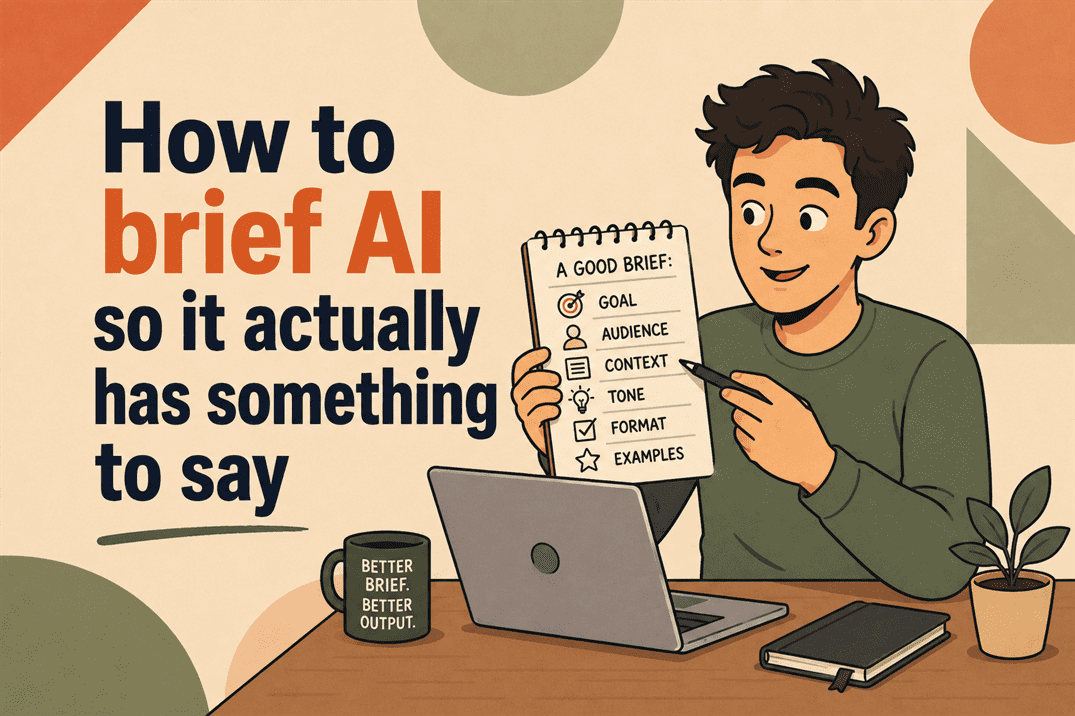
In the last post, we established that AI content is bad for one reason above all others, it has no original ideas, because nobody gave it any.
That post was the diagnosis. This one is the prescription.
It’s also slightly longer, because prescriptions that just say “eat better and exercise” are not particularly useful, and neither is “give AI better inputs” without explaining what that actually looks like in practice.
So let’s be specific.
Why your prompts are producing beige content
Most AI prompts follow a structure that almost guarantees generic output.
They look something like this:
“Write a 1,000-word blog post about [topic] for [audience]. Make it engaging and informative.”
That prompt will produce something. It will be structured. It will probably be readable. It will, in almost every case, contain nothing that couldn’t have been produced by anyone else running the same prompt.
Because it almost certainly was, probably dozens of times and those outputs exist somewhere in the training data the AI is drawing on.
Here’s a useful way to think about what you’re actually asking for when you write a prompt like that.
You’re essentially asking the AI to write the average of everything ever written about that topic. Not the best. Not the most interesting. The average.
If you want average content, that prompt is genuinely efficient.
If you want something people will actually read and remember, you need to do something different.
The difference is in what you put in before the AI writes a single word.
The briefing framework I use with clients (I’ve named it, obviously)
I call this the VOICE framework, partly because it’s a useful acronym and partly because I needed something to put on a slide once.
Here’s what it stands for:
- Viewpoint: What do you actually think about this topic? Not “it depends” or “there are many perspectives.” An actual take.
- Observation: What have you noticed, in your work or your clients’ work, that most people haven’t said out loud yet?
- Instance: What’s a specific example, story, or case that proves your point?
- Contrast: Where does the conventional wisdom get it wrong, or at least incomplete?
- Edge: What’s the thing you’d say over a drink that you’d normally soften in a published piece?
Feed the AI all five of those before you ask it to write anything.
What comes out will be unrecognisable compared to the standard prompt output, because you’ve given it the actual substance of the post.
You’ve done the thinking. The AI is now doing the arrangement.
Let me show you what this looks like in practice.
The same topic, two different briefs
Say you’re writing about hybrid working for an HR software company.
Here’s the standard approach:
“Write a blog post about the challenges of hybrid working for HR teams. The audience is HR managers at mid-sized businesses. 1,000 words.”
And here’s the VOICE approach, where the client actually fed in their perspective first:
“Write a blog post about hybrid working for HR teams. Here’s my take: the problem isn’t the logistics of hybrid working, it’s that most companies implemented it reactively in 2020 and never properly redesigned it. They just made the old model slightly more flexible and called it hybrid. I’ve noticed that the clients who struggle most are the ones who treat office days as a scheduling problem rather than a culture question. A specific example: one client was mandating Tuesdays and Thursdays in the office because it felt fair, but nobody could tell their team why those days, so attendance dropped and resentment rose. The conventional wisdom says ‘communicate clearly about expectations’ but that skips the harder question of whether the expectations themselves make sense. The thing I’d say over a drink: most hybrid policies are written to protect the company from complaints, not to actually help people work well.”
The second prompt produces a piece that no competitor could replicate, because the ideas in it came from a specific person who has observed a specific pattern.
The AI is just the medium. The thought is still yours.
The part clients always push back on
When I walk clients through this, I get a consistent objection: “But if I have to do all that thinking, what am I actually using AI for?”
It’s a fair question. And the honest answer is, a lot.
Even with a rich brief, writing is slow. Getting from a set of observations to a structured, readable, well-paced piece of content takes time and skill that many subject-matter experts understandably don’t want to spend.
The AI handles the scaffolding, the transitions, the pacing, the heading structure, the introduction that doesn’t start with “In today’s fast-paced world.” (A service that frankly deserves more credit than it gets.)
What the AI can’t do is have the conversation with the client that identifies those observations in the first place.
It can’t sit in on the sales call where someone says something that makes you think “that’s actually a really interesting pattern.”
It can’t notice that three separate clients have made the same mistake this month and turn that into a post.
That’s the human part. The AI gets the rest.
The workflow that actually works looks like this: you think, AI drafts, you edit. The bit most content pipelines skip is the first step.
What good input actually looks like
To make this more concrete, here are the types of input that consistently produce better AI output.
These aren’t abstract principles. They’re the things I ask clients to send me before I touch a brief.
A strong opinion on the topic, stated plainly. Not “there are advantages and disadvantages to X.” An actual position. “X is usually the wrong choice for businesses under fifty people, and here’s why.” If you’re not sure you have one, ask yourself: what would you tell a friend who was about to make a common mistake in this area?
A story from your own experience. It doesn’t have to be dramatic. It just has to be specific. “Last month, a client came to us having already tried Y, and what we found was Z.” Specificity is almost impossible to fake, which is exactly why it’s valuable.
The thing everyone in your industry says that you think is slightly wrong. This is the most underused type of input and consistently produces the most interesting content. Every industry has its received wisdom. The people who’ve been in it long enough to see the edges of that wisdom are sitting on genuinely useful content and mostly not writing it.
A question your clients ask repeatedly that reveals a gap in their understanding. This one is particularly useful because it tells you both the topic and the angle. If clients keep asking “how do we know if our content is working,” that’s not just a topic. It’s a signal that the conventional metrics are confusing people, and that’s a post.
The result of something you tried that didn’t go as expected. Failure posts and honest retrospectives perform exceptionally well because they’re rare. Most businesses only publish their wins. The ones that publish the honest version of what happened when something didn’t work build the kind of trust that content about best practices never quite manages.
A note on the briefing conversation
One thing I’ve started doing with clients, which has changed the quality of the briefs I receive, is replacing the written brief questionnaire with a fifteen-minute voice note or call.
People think differently when they’re talking than when they’re writing.
When you ask someone to fill in a written brief, they self-edit. They polish. They write what sounds right rather than what they actually think.
When you ask them to just talk through a topic, they say things like “I mean, honestly, I think most people are approaching this completely backwards” and then explain why, with a specific example, in under two minutes.
That unpolished version is almost always more interesting than what they’d have typed.
I transcribe it (AI is, naturally, very good at this), pull out the key observations and build the brief from there.
The content that comes from that process sounds like a person, because it started with one.
The payoff
Here’s the thing about putting more into the brief. The output requires less editing. Not no editing, but substantially less.
When the AI has genuine material to work with, it doesn’t need to pad. It doesn’t need to hedge. It doesn’t need to open with a definition of the topic or close with “in conclusion, this is an important area to consider.”
More importantly, the content that comes out of a properly briefed AI session has a point of view that holds together.
It argues something. It takes the reader somewhere.
That’s what separates content that gets shared from content that gets skimmed and closed.
The AI hasn’t changed. The output has, because the input did.
That’s the whole game, really. Most businesses are playing it the wrong way round, wondering why the output is generic, while continuing to give the AI absolutely nothing to work with.
You can solve that today, without buying a new tool or hiring someone new. You just have to decide to actually think before you prompt.
Which, in fairness, is also good advice for things that have nothing to do with AI.
If your AI content is coming out flat, there’s a good chance the problem is earlier in the process than you think. I can help with that.

 Sep 17, 2026
