


“We’ll get AI to do it” – A writer’s guide to nodding along while quietly losing the plot
 By Jamiek
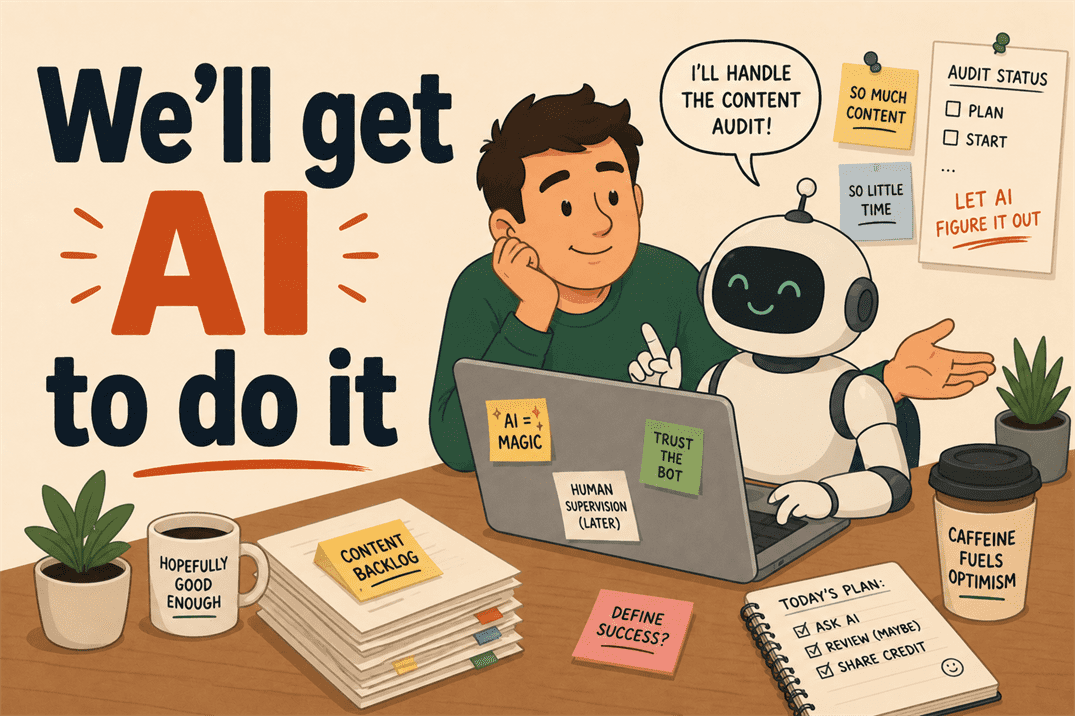
There is a specific face you make when a client says this. You’ve probably practiced it in the mirror without knowing.
It’s the face of someone who has just been told their flight is delayed by six hours and is choosing, consciously, to remain pleasant about it.
“Don’t worry about that piece, we’ll get AI to do it.”
Right. Great. Brilliant news. Let me just pop that invoice away then.
I’ve heard this sentence more times in the last two years than I’ve heard my own name, and I want to be clear, I’m not here to argue that AI can’t write.
It can write. It writes constantly, prolifically and with the confidence of someone who has never once worried about a brief being unclear.
What I want to talk about is what actually happens after that sentence is said, because there is a whole cinematic sequence that plays out and it almost always ends with someone emailing me.
The five stages of “we’ll get AI to do it”
How many of you have seen this?
Stage one: The announcement.
Usually delivered mid-call, with the casual energy of someone cancelling a dentist appointment.
There’s no real conversation. Just the information and then a slight pivot to other topics, as though you should be fine with it. You are, outwardly, fine with it.
Stage two: The content appears.
You don’t always see this part. But sometimes you do, because the client forwards you a draft to “have a look at.”
The draft is technically correct in the same way that a stock photo of a business meeting is technically an image of people working.
Stage three: The quiet doubts.
Someone on the client’s team notices that the piece reads like it was written by a very confident entity that has absorbed a lot of text about this subject but has never actually cared about it.
The transitions are fine. The structure is fine. Something is missing. Nobody can quite name it. Someone suggests adding more personality.
Stage four: The feedback loop.
The piece goes back into the tool. More personality is requested. The tool obliges by inserting phrases like “in today’s fast-changing world” and “it’s more important than ever.”
The piece is now technically longer.
Stage five: The email.
“Hey Jamie, we’re actually struggling a bit with this one. Would you have capacity to take a look?”
I’m not gloating. I want to be very clear that I’m not gloating. But I do always know it’s coming.
What’s actually happening
The problem isn’t the AI. The problem is a specific misunderstanding about what writing is for.
When a client says “we’ll get AI to do it,” they’re usually thinking about writing as content production.
Words go in, article comes out, job done, money saved.
At that level of abstraction, they’re not wrong. The words do come out. There is, in fact, an article.
But writing for a business, real writing, the kind that earns trust from a reader who has no particular reason to trust you, isn’t primarily a production problem.
It’s a judgment problem. It’s decisions, made constantly, about what to say and what to leave out. What angle serves the reader. Where to be direct and where to let something breathe. When the brief is wrong and someone should say so.
That last one is the one AI will never do.
It will execute the brief with extraordinary thoroughness. It will not tell you the brief is pointing in the wrong direction.
So what do you say when it happens?
A few things have worked for me, and I’ll share them without pretending any of them are magic.
The first is to not take it personally in the moment, even if it stings.
The client isn’t saying you’re replaceable in principle. They’re saying this particular piece doesn’t feel worth the spend.
That’s useful information. It means either the brief was small enough that AI really is the right call, or it means they haven’t yet connected the quality of writing to the outcomes they care about.
Both of those are conversations worth having but not in the middle of a call.
The second is to let it play out where it’s going to play out.
I’ve stopped trying to pre-empt the AI experiment. Clients need to run it. Some of them will run it and be perfectly happy with the results, and that’s fine, there are pieces where it genuinely works and the stakes are low enough that “fine” is sufficient.
Others will come back. When they do, the conversation about what you actually bring is much easier to have, because they’ve now experienced the alternative.
The third is to get clearer about what you’re selling, so that “we’ll get AI to do it” applies to a narrower and narrower slice of your work.
If what you’re offering is words-on-a-page, you’re competing directly with a thing that produces words-on-a-page for pennies.
If what you’re offering is editorial judgment, a point of view, an understanding of the reader, and the ability to tell a client when their brief is going to produce something nobody wants to read, that’s a harder thing to replace.
Not impossible. Harder.
The face
I still make the face sometimes. I’m not sure it’s going away.
But I’ve stopped interpreting “we’ll get AI to do it” as a verdict. It’s more like a detour, one that occasionally ends with a slightly frantic email and a brief that finally has a budget attached to it.
The work is still there. It’s just waiting for someone to realise that “technically correct” and “actually good” are not always the same place.
If you’re trying to figure out where your writing sits on that spectrum or you’ve just come back from a detour and you’d like some help, get in touch.
I’ve seen a lot of briefs. I can usually tell within about thirty seconds which category they’re in.

 Nov 14, 2026

