


How to write a job spec for your first content hire
 By Jamiek
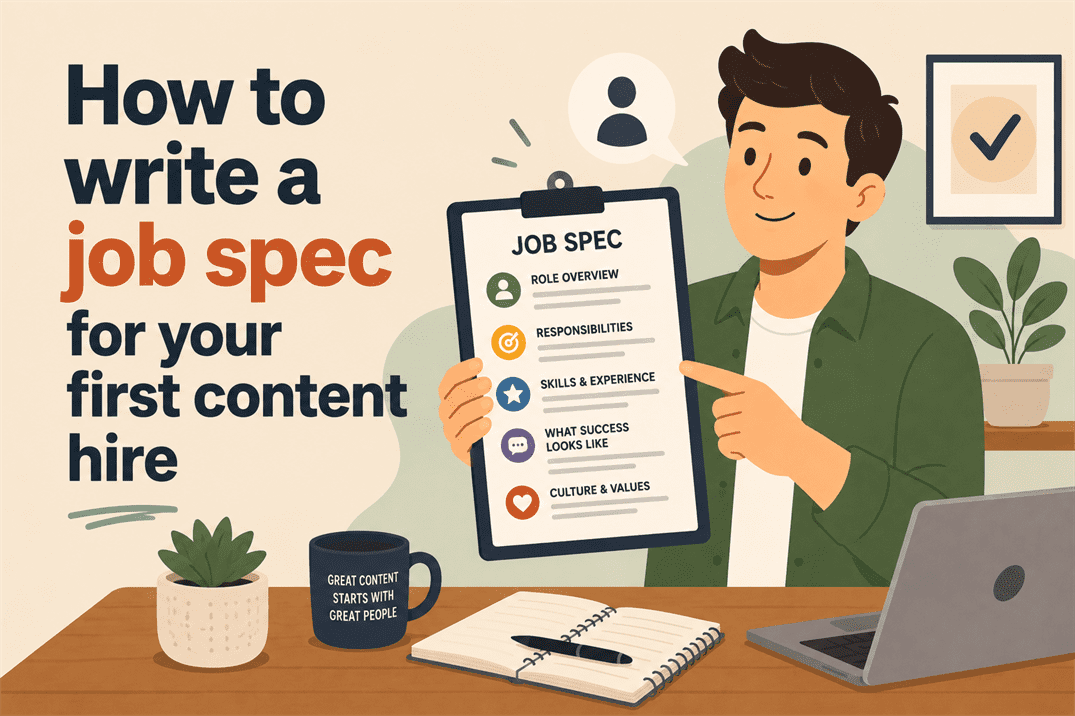
Hiring your first dedicated content person sounds like a fairly straightforward exercise.
You need someone to write your blog posts, look after the website, perhaps manage your social media and generally take some of the content workload off your already rather full plate.
Then you sit down to write the job spec and suddenly you’re not entirely sure what you’re hiring.
I’ve seen this happen plenty of times.
A business knows it needs help with content. The founder has been writing everything themselves, the marketing manager has been juggling six different responsibilities, or the blog has become that thing everyone agrees needs attention but nobody has time to touch.
The need is obvious. The job description is considerably less so.
Part of the problem is that content has become an umbrella term for an awful lot of different work.
Writing, editing, SEO, strategy, social media, content planning, publishing, analytics, managing contributors. It’s quite a list when you put it all together.
I’ve worked with writers, managed content teams and been involved in the recruitment and assessment side of things. I’ve seen some excellent appointments and some rather less successful attempts to find one person who can do absolutely everything.
The job spec often tells you quite a lot about which direction things are heading.
First, what are you actually hiring?
One of the things I’ve noticed when working with businesses is that they often know what needs doing but haven’t quite separated the different skills involved.
For example, there’s a considerable difference between a:
- Content writer who produces blog posts, website copy and long-form SEO content.
- Content marketer who looks after strategy and distribution as well as writing.
- Content or managing editor who manages other writers, edits their work and maintains quality.
- Content manager who handles planning, briefing, publishing and content operations, potentially without doing much writing themselves.
These aren’t interchangeable job titles. They describe different responsibilities and require different strengths.
I’ve seen roles where the brief appears to be looking for a writer, but the responsibilities include developing the content strategy, managing freelancers, running social media, reporting on performance and occasionally updating the website.
That’s quite a promotion for someone who’s ostensibly been hired to write blog posts.
The problem is that when you combine several different roles into one job spec, you tend to attract candidates with a bit of experience in everything and real expertise in very little.
You might get lucky, of course, but it’s an expensive way to find out.
One thing I find useful when working out what a role actually involves is to look at an ordinary working week.
What will this person spend most of their time doing?
Not what you’d like them to do eventually, or what might be useful if the business doubles in size. What will they actually be doing on a Tuesday morning?
If the answer is writing two blog posts, coordinating social content and updating website pages, you’re probably looking for a content writer with some coordination responsibilities.
There’s no need to call them Head of Content unless you genuinely want someone to head up content.
The title might sound impressive on your company org chart, but it’ll also attract candidates with rather different expectations about the job and the salary.
The job spec: Getting the important bits right
I’ve read, written and applied to plenty of job specs over the years.
Some are excellent. Others leave you wondering whether the person who wrote them has ever met the person they’re hoping to hire.
A few things are worth getting right.
The job title
Let’s start with the obvious.
People search for jobs using terms they recognise. Content Writer, Content Marketing Manager and SEO Content Specialist are all perfectly respectable titles that tell candidates something useful.
Content Ninja, Brand Storyteller and Digital Wordsmith are less helpful. They might sound creative in a brainstorming session, but they’re unlikely to improve the quality of your applicants.
I’ve always thought there’s something slightly odd about businesses trying to make straightforward job titles sound more exciting.
You’re hiring someone to write content, not asking them to defend the galaxy from an approaching fleet of rogue blog posts.
Keep the title accurate and make sure it reflects the level of responsibility.
If it’s a senior position, say so. If it’s a mid-level writing role, there’s no shame in calling it that.
The role summary
This is where you explain what the person will be doing, who they’ll work with and what the role is intended to achieve.
Two to four sentences should be plenty.
We’ve all seen job descriptions that spend more time explaining the company’s exciting journey and ambitious growth plans than they do explaining the actual job.
It’s lovely that you’ve got big plans, but the candidate would probably also like to know what they’ll be doing between Monday and Friday.
Something along these lines works well:
“We’re looking for a content writer to own our blog and support our SEO programme. You’ll work closely with the marketing lead to plan, write and publish two to three pieces of content per week, with a focus on organic search growth and lead generation.”
It tells the candidate what the job involves and gives them a reasonable idea of what success looks like.
Compare that with:
“At [Company], we’re on an exciting mission to disrupt the way businesses think about [vague category]. We’re a passionate, fast-moving team who love what we do, and we’re looking for a rockstar content creator to join our journey.”
I’m sure the company is lovely. I’m also none the wiser about the job.
Responsibilities
This is where things can get a little ambitious.
I’ve seen content roles with responsibility lists that read like someone has emptied the entire marketing department into a document and decided to call it a job.
Writing blog posts, managing social media, producing email campaigns, overseeing SEO, managing freelancers, developing strategy, reporting on analytics, updating the website…
All perfectly reasonable activities in their own right. Together, they’re potentially three jobs and rather exhausting ones at that.
The responsibilities section should reflect the work the person will actually be doing.
For example:
- Write two SEO-focused blog posts per week.
- Brief and edit content from external contributors.
- Maintain the editorial calendar.
- Update and refresh existing website content.
- Work with the marketing team on content campaigns.
That’s considerably more useful than “create engaging content across multiple channels”.
There’s also a practical consideration here. If you’re asking someone to cover several disciplines, the seniority and salary need to reflect that.
Experienced candidates will spot an overloaded job description pretty quickly.
Skills and experience
This is another area where businesses make life unnecessarily difficult for themselves.
The classic example is the requirement for five years of experience in a role that barely existed five years ago. Or the list of fifteen different skills, all apparently essential, for a relatively junior position.
It helps to separate genuine requirements from things that would simply be nice to have.
For a content role, the essentials might include:
- Strong writing and editing skills.
- An understanding of SEO fundamentals.
- Experience working with a CMS such as WordPress.
- The ability to work from a brief and meet deadlines.
- Experience producing the types of content you’ll need.
Depending on the position, you might also want experience managing other writers, working in a particular industry or producing technical content.
One thing I’d be careful about is using years of experience as a shortcut for judging ability.
Someone with three years of excellent writing experience might be considerably better suited to your role than someone with eight years of producing fairly average content.
A portfolio will often tell you more than a number on a CV. I’d much rather see examples of someone’s work than rely on a claim that they’ve been doing something for a particular length of time.
What you’re offering
Salary, location, remote working arrangements and benefits. None of this is particularly glamorous, but it’s important.
Salary transparency has become increasingly important to candidates, and leaving the figure out can mean losing people before they’ve even considered applying.
I understand why some companies prefer to keep their options open. There’s always the temptation to see what the market produces and negotiate from there.
But experienced candidates aren’t necessarily going to spend time applying for a role when they have no idea whether the salary is remotely competitive.
The same applies to flexible working.
I’ve seen the phrase used to describe everything from fully remote working to an arrangement where you can occasionally leave the office at 4.30pm if you’ve finished everything.
Those are rather different propositions.
If the role is remote, say so. If it’s hybrid, explain how many days in the office are expected. If there’s genuine flexibility around working hours, describe what that looks like.
A little clarity here saves everyone time.
Your job spec says something about your business
Something else worth thinking about is the tone of the job description itself.
I’ve worked with businesses of all sizes, and one thing I’ve noticed is how much a company’s communication style can influence the people it attracts.
A job spec is often one of the first proper interactions someone has with your business. It gives them an impression of how you communicate, what you value and what working with you might be like.
If your company prides itself on being friendly, approachable and straightforward, but the job spec reads like it was assembled by a committee of corporate lawyers, there’s a bit of a disconnect.
Equally, if you’re a fairly traditional organisation, there’s no need to pretend you’re a quirky startup where everyone communicates exclusively in GIFs.
Write in a way that reflects your actual business.
You don’t need to be hilarious, either. A little personality goes a long way, particularly when candidates are reading their fifteenth job description of the morning.
What does a decent content job spec look like?
You don’t need a twelve-page document or a list of every possible task the successful candidate might encounter during their first three years.
For an early-stage business hiring its first content writer, I’d expect something along these lines:
Job title: Content Writer.
Role summary: Two or three sentences explaining the role, its purpose and who the person will work with.
About the company: A short introduction covering what the business does, its size and where it’s heading. Four or five sentences should be plenty.
Responsibilities: Around six to eight specific bullet points describing the daily work.
Skills and experience: A clear distinction between essential requirements and desirable experience. Ask for a portfolio or examples of previous work.
What you offer: Salary range, location, working arrangements, benefits and a realistic description of the company culture.
That’s it. One page, perhaps a page and a half.
The aim is to give suitable candidates enough information to recognise that the role is right for them, while allowing unsuitable candidates to realise it isn’t.
That second part is quite important. A good job spec should help filter applications before they land in your inbox.
The bit I’d spend more time thinking about
There’s one thing I think businesses sometimes overlook when hiring their first content person.
What does success look like?
It’s easy to get caught up in the job title, the responsibilities and the list of required skills. But I’ve seen how much difference it makes when someone joins a business with a clear understanding of what’s expected of them.
Think about what you’d like that person to have achieved after three months, six months and twelve months.
Perhaps the first three months are about understanding the business, getting to grips with the existing content and establishing an editorial process.
By six months, they’re producing content consistently, managing the editorial calendar and working more independently.
After twelve months, they might be contributing to the wider content strategy, identifying opportunities and helping the business get more value from its existing content.
Those are just examples, of course. The important thing is that you have some idea of what the role is supposed to achieve.
I’ve seen the consequences of hiring someone with a vague brief and equally vague expectations.
The employee thinks they’re there to write. The manager expects them to develop the strategy. The founder wants them to generate leads, improve search rankings and somehow make the company sound more interesting.
Nobody’s particularly happy, and eventually everyone starts wondering whether they hired the wrong person.
Sometimes they did. Sometimes the role was never properly defined in the first place.
A little thought upfront saves a lot of frustration later
I’ve been on both sides of this particular table more times than I can count.
I’ve worked with brilliant writers, helped manage content teams, assessed writing ability and seen what happens when the right person lands in the wrong role.
Getting the job spec right won’t guarantee a successful hire. There are plenty of other factors involved, from management and communication to company culture and the quality of the onboarding process.
But it gives you a much better starting point.
The best hires I’ve worked with have generally had three things in common:
- They understood what was expected of them
- They had the skills to do the work
- They were given enough direction to make a meaningful contribution.
None of that is particularly complicated. It just requires a little thought before the advert goes live.
And if you’re currently trying to recruit one person to handle your entire content operation, from writing the blog to developing the strategy and managing the marketing department, it might be worth having another look at that job description.
You may be hiring a content person. You may actually be hiring an entire department.
If you’re not quite sure what kind of content support your business needs, or you’d like a hand defining a role and finding the right skills, get in touch.
I’ve spent enough time on both sides of the process to know where the usual stumbling blocks are.

 Nov 26, 2026

