


Building authority through content: Why showing off isn’t the same as knowing your stuff
 By Jamiek
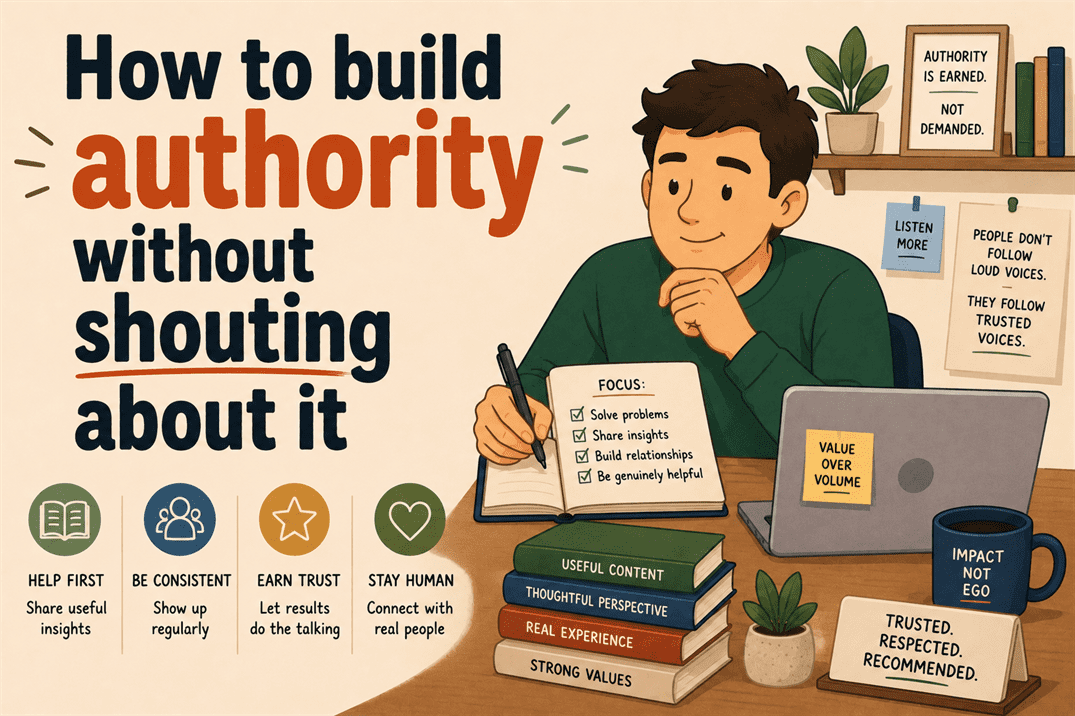
There’s a particular kind of person on the internet who announces their expertise the way a car alarm announces itself at 2am.
Loudly, repeatedly and in a way that makes everyone in the vicinity wish they would just stop.
You know the type. Thought leader. Ten years in the industry. Passionate about disruption. Currently explaining something you already knew in a carousel post with a font choice that suggests real confidence issues.
I’ve spent more than 20 years working in content and marketing, and one thing I’ve noticed is that the people who genuinely know their stuff don’t always make the biggest noise about it.
Some are terrible at promoting themselves, myself included.
I’ve also worked with people whose knowledge and experience could fill a small library, yet you’d struggle to get them to write a LinkedIn post about it.
Others are very good at communicating what they know, but they don’t feel the need to remind everyone of their expertise in every other sentence.
There’s a difference between being recognised as an authority and repeatedly announcing that you are one. The internet sometimes struggles with this distinction.
Building authority through content takes time. It comes from what you publish, the opinions you develop, the problems you help people solve and the consistency of your thinking over time.
And there’s a lot more to it than posting three times a week and adding “industry expert” to your LinkedIn headline.
Start sharing what you know before anyone’s paying attention
One of the slightly frustrating things about building a reputation through content is that you rarely get much recognition at the beginning.
You can spend hours researching and writing a genuinely useful article, publish it, share it across your social channels and then sit back to admire the response.
Which turns out to be three likes, one of them from your mum.
I’ve seen this happen often enough to know that the early stages of building a content presence can feel rather thankless.
The temptation is to start writing things specifically designed to make you look knowledgeable.
You talk about your experience, highlight your achievements and make sure everyone knows how long you’ve been doing whatever it is you do.
There’s nothing wrong with sharing credentials when they’re relevant. But if every piece of content feels like an extended job application, readers will eventually notice.
The content that tends to make a stronger impression is usually much more focused on the subject itself.
A problem you’ve encountered. Something you’ve learned from working with a client. An industry assumption you think deserves questioning. A process you’ve seen businesses get spectacularly wrong.
These are the things people find interesting because they give them something useful to think about.
Over time, your work starts to build a picture of how you approach problems and what you understand about your industry.
People begin to recognise your name, associate you with particular subjects and come back because they find your perspective useful.
That’s a much better foundation for authority than repeatedly telling people how experienced you are.
Consistency is about your thinking, not your posting schedule
There’s an awful lot of advice out there about content consistency.
Post three times a week. Publish one blog every fortnight. Share something on LinkedIn every morning before you’ve even had your coffee.
I’m not particularly interested in arguing against a publishing schedule. Regular content gives people more opportunities to find you, and disappearing for six months probably isn’t the best way to build a reputation.
But there’s another kind of consistency that I think matters considerably more.
The consistency of your thinking.
If someone reads ten of your articles, they should start to recognise your perspective. They should get a sense of the things you care about, the arguments you tend to make and the way you approach your subject.
That doesn’t mean repeating the same opinions until everyone can recite them backwards.
Quite the opposite. Good thinking develops.
You encounter new information, work with different clients, see how things play out and occasionally discover that something you believed quite firmly a few years ago needs a rethink.
That’s perfectly healthy.
For example, someone writing about content strategy might publish an article about the importance of understanding your audience, followed a few months later by one about why businesses produce too much generic content.
Those ideas connect. They demonstrate a consistent interest in the relationship between content and commercial outcomes.
The reader starts to understand what matters to you and how you approach the subject.
Compare that with a collection of articles that jump from AI trends to productivity hacks to leadership lessons to the latest social media algorithm, with no obvious connection beyond the fact that you happened to have an opinion about all of them.
You might have a perfectly respectable publishing record, but it’s harder for people to associate you with anything in particular.
There’s a difference between having a lot to say and having something recognisable to say.
Small signals build a bigger reputation
Something I’ve noticed about professional reputations is that they rarely come from one spectacular piece of work.
They’re usually built through lots of smaller interactions and contributions that gradually give people confidence in what you know.
Content plays a big part in this, but the effect often extends beyond the original article or post.
You write something useful about a particular problem. Someone shares it with a colleague who’s dealing with the same issue.
You publish an opinion that gives people a different way of looking at something. It starts a conversation and someone remembers your name when the subject comes up again.
You revisit an older article because your thinking has changed, explain what you’ve learned and update your position.
Readers see that you’re interested in getting things right rather than defending everything you’ve ever written.
You also know when to keep quiet.
That last one is surprisingly important.
We’re surrounded by people who feel compelled to comment on absolutely everything.
A new marketing trend appears and suddenly everyone has a hot take. A platform changes an algorithm and half the internet becomes an expert in its inner workings overnight.
Sometimes you know enough to offer a useful perspective. Sometimes you don’t.
Being able to recognise the difference is a valuable professional skill, and it comes across in your content.
These little signals accumulate. Someone might discover you through a blog post, follow you on LinkedIn, read a few more articles and eventually get in touch because they’ve developed confidence in the way you think.
There’s no grand announcement involved. Just a series of interactions that gradually establish a reputation.
Don’t be afraid to have an opinion
This is where I think a lot of business content falls down.
It’s perfectly competent, reasonably well-written and so carefully constructed that it manages to say almost nothing.
Every possible viewpoint is acknowledged. Every statement is qualified. Every argument has been softened to avoid upsetting anyone who might happen to disagree.
The result is content that nobody could reasonably object to and very few people will remember.
I understand why businesses do this. When you’re writing on behalf of a company, there’s often a temptation to play it safe.
Nobody wants an article causing an unnecessary argument or a LinkedIn post being interpreted as an official company position on something controversial.
But there’s a difference between being sensible and being so cautious that your content loses its personality.
If you have genuine experience in a subject, you’ve probably developed opinions about it. You’ve seen what works, what doesn’t and what people consistently get wrong.
Those opinions are valuable.
For example, I have fairly strong views about the amount of generic content being produced simply because businesses feel they need to publish something.
More articles, more social posts, more words. The assumption seems to be that more content automatically means more visibility and better results.
I don’t buy that.
I’ve seen enough content to know that producing more of something that isn’t particularly useful rarely solves the underlying problem.
That’s an opinion. I can explain why I hold it, support it with examples and have a sensible conversation with someone who disagrees.
You don’t need to manufacture controversy or become the person who disagrees with absolutely everything.
Nobody needs another professional contrarian announcing that everything everyone else does is wrong.
But if you have a perspective worth sharing, share it.
And if you change your mind later, explain why. There’s nothing particularly impressive about clinging to an old opinion simply because you published it on the internet in 2022.
Let your content demonstrate your expertise
There’s a fairly simple test I like to apply to content that claims to demonstrate expertise.
Remove the author’s job title, list of qualifications and professional biography. Is there still something in the content that makes you think this person knows what they’re talking about?
If the answer is yes, you’re probably onto something.
Genuine expertise tends to reveal itself through the quality of the thinking.
It’s in the details someone notices, the connections they make, the examples they choose and their ability to explain something complicated without making the reader feel they’ve accidentally enrolled in a university course.
It’s also in the practical usefulness of what they produce.
I’ve worked with writers who could explain a technical subject beautifully because they understood it properly.
They didn’t need to pepper every paragraph with industry terminology or remind readers of their experience. Their understanding was obvious from the way they approached the subject.
That’s what good content does.
It gives readers evidence of your knowledge without requiring them to take your word for it.
A useful article might help someone solve a problem. A well-argued opinion might change how they approach a decision. A detailed case study might demonstrate that you understand the commercial realities behind the subject.
Each piece adds something to the overall impression.
And when people start recommending your work, referring others to your articles or approaching you because they’ve come to trust your judgment, you know the content is doing something worthwhile.
Authority takes longer than a LinkedIn growth hack
I suspect one reason people get frustrated with building authority through content is that they’re looking for results that are much easier to measure.
Followers. Engagement. Impressions. Website traffic.
These are all useful metrics in the right context, but they don’t necessarily tell you whether people trust your expertise.
You can have thousands of followers and very little influence over anyone’s actual decisions.
Equally, you can have a relatively small audience of people who know your work, value your opinions and recommend you when someone needs your services.
For a business, that second group can be considerably more valuable.
Building authority is a long-term activity. It comes from producing useful work, developing a recognisable point of view and giving people repeated reasons to trust what you say.
It won’t happen because you published a particularly enthusiastic LinkedIn post announcing your new personal brand strategy.
Although I’m sure the carousel looked lovely.
At Coastal Content, a lot of my work revolves around helping businesses develop content that has a purpose beyond filling their blog or keeping their social channels active.
That means thinking about what the business wants to be known for, what its audience needs and how its content can demonstrate the experience and knowledge already sitting inside the organisation.
Because most businesses don’t have a shortage of expertise. They have a shortage of ways to communicate it effectively.
If you’re thinking about building a stronger content presence and want to give people a genuine reason to pay attention, get in touch.
I’d be happy to talk about how we can make your content work harder.

 Nov 21, 2026

