


How to brief a freelance writer (and what happens when you don’t)
 By Jamiek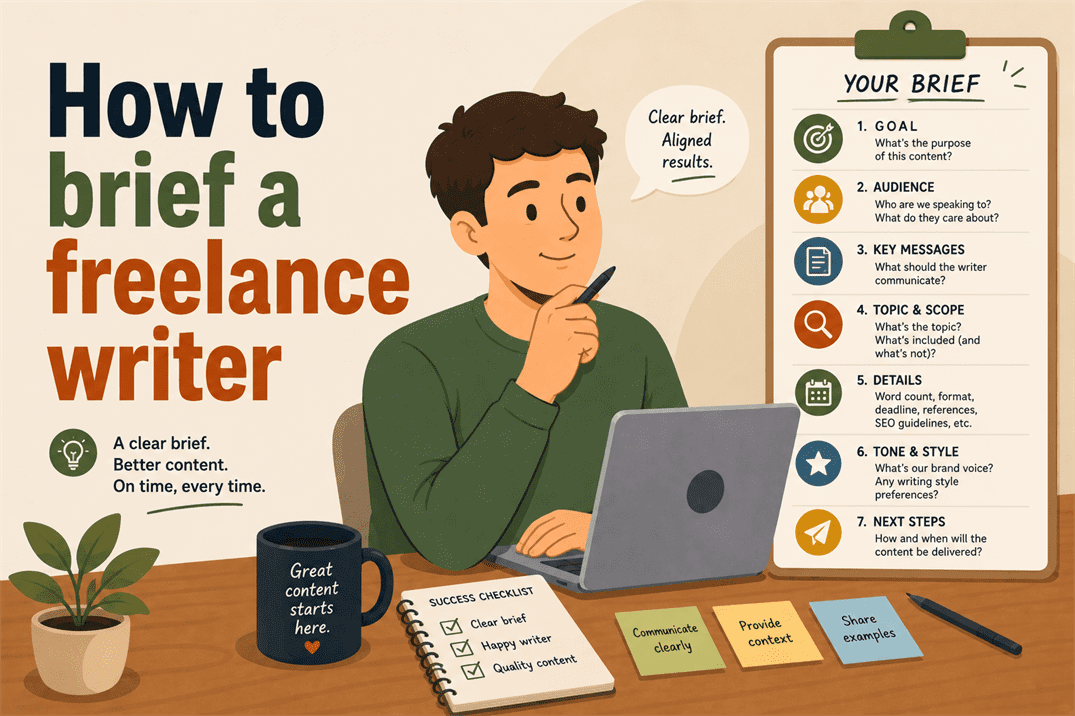
Somewhere in the world right now, a freelance writer is staring at an email that says “can you write something about our software? Approx 800 words, quite informative, let us know if you have questions thanks” and making a face.
The face is not anger. It’s a specific blend of professional resignation and quiet determination to do their best with what they’ve been given, which in this case is almost nothing.
This is the briefing problem.
It’s extremely common, entirely avoidable and responsible for more mediocre content than any other single cause including bad writers, small budgets and the perennial classic of “can we make it more punchy.”
What a brief actually needs
A good brief answers six questions before the writer has to ask them.
Who is reading this?
Not “our customers” or “businesses in the SME space.”
- An actual person with an actual situation.
- A marketing manager at a 30-person company who’s trying to justify a new tool to a CFO who doesn’t see the point.
- A small business owner who’s done one Google search and is now dangerously confident they know everything.
The more specific this is, the better the content.
What do they already believe when they arrive?
This one gets skipped constantly and it matters enormously.
A reader who’s convinced they don’t need your product needs different content to a reader who’s already sold on the category and comparing options.
Writing for both simultaneously produces content that fully serves neither.
What should they think, feel, or do after reading?
“Be informed” is not an answer. “Book a call,” “share this with their team,” or “stop assuming the cheap option is fine” are answers.
What’s the angle?
Not the topic. The angle. “Content strategy” is a topic. “Why most businesses build a content strategy backwards and what to do instead” is an angle.
One of those produces a useful, specific piece of writing. The other produces a Wikipedia entry with better formatting.
What’s the tone?
If you have a style guide, attach it. If you don’t, describe it in human terms. “
Sounds like a knowledgeable friend, not a consultant trying to justify their day rate” is more useful than “professional but approachable,” which means something different to everyone who reads it.
What does it definitely not do?
The negative brief is underused and surprisingly powerful.
“This is not a beginner’s explainer, our readers know the basics.” “Don’t mention competitor names.” “We never use the word solutions, for reasons we don’t fully understand but feel strongly about.”
This single addition removes a remarkable number of wrong drafts before they happen.
What happens when you skip all of that
Scenario one: The writer makes reasonable assumptions, produces something competent and you receive a draft that is technically fine and completely wrong for reasons you struggle to articulate.
You send feedback that says “it’s not quite what we were looking for.” The writer, who has no idea what you were looking for, takes a guess and resubmits.
You do this three more times. Everyone involved ages visibly.
Scenario two: The writer produces something genuinely good based on their best interpretation of an underspecified brief.
You rewrite it to match a vision you never described. The writer wonders why they bothered.
You wonder why you’re paying someone if you’re doing it yourself. Both of you are right.
Scenario three, which is real and has happened more than once: The brief says “blog post about our new feature launch, 600 words, SEO.”
The writer produces a clean, well-structured piece explaining the feature. What the client actually wanted was a piece that made a specific type of customer realise they had a problem the feature solves, without ever sounding like a feature announcement.
That brief existed entirely in the head of the product manager who sent the email and was not transmitted to another human being at any point in the process.
The post goes live. It’s fine. It does nothing. Nobody’s sure why.
The thirty-minute brief that saves everyone four hours
A proper brief takes about thirty minutes to write. It saves roughly four hours of revision, two uncomfortable feedback conversations and the low-grade mutual frustration of a project that should have been straightforward.
It doesn’t need to be a formal document. It doesn’t need headers and subheadings and a sign-off process.
It needs to answer the six questions above with enough specificity that a writer who knows nothing about your business could produce something recognisably close to what you had in mind.
If you can’t answer those questions, that’s useful information.
It means the brief isn’t ready yet, which is much better to discover before commissioning the work than after reading the first draft.
The short version
Brief well, get good work. Brief badly, get a guessing game dressed up as a creative process.
Your writer isn’t a mind reader. They’re good at turning clear thinking into clear writing.
The clear thinking is your contribution to the arrangement and it’s not the smaller one.
If you’d like help developing a briefing process that actually works, or you want someone who’ll ask the right questions before they start writing, you know where to find me.

 Oct 15, 2026
