


The overdue death of keyword-first thinking
 By Jamiek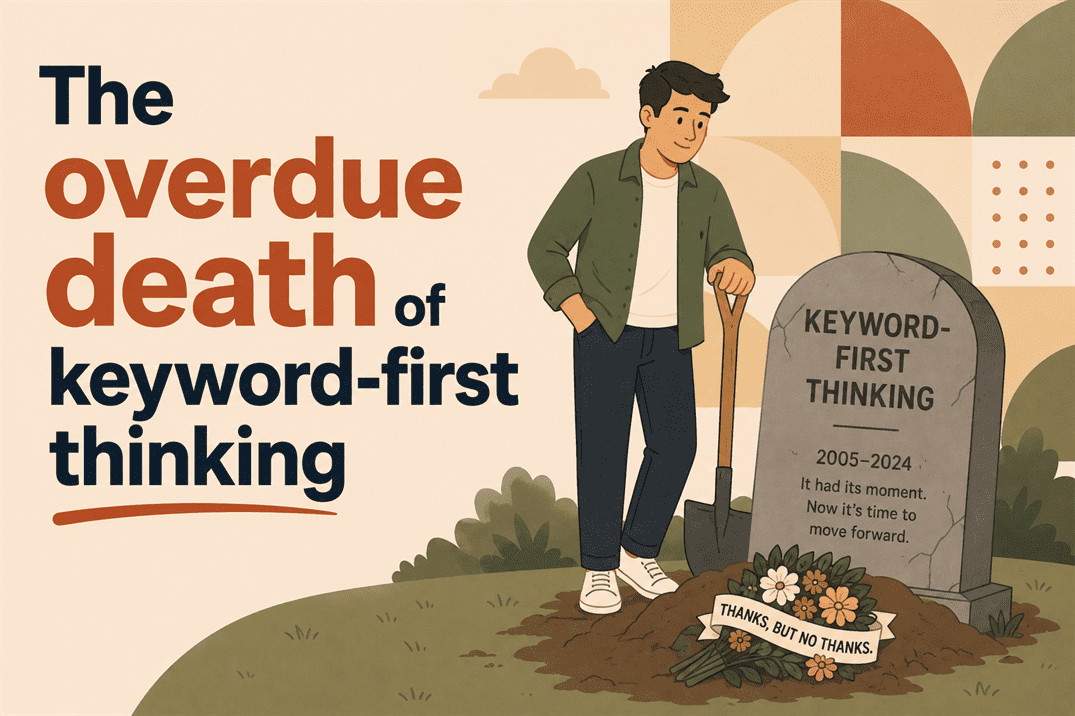
How many of you have been presented with a brief containing a keyword phrase so syntactically broken it reads like it was written by someone falling down a flight of stairs?
“Best affordable plumber London emergency no call-out fee.”
You stare at it. You stare at the blank document. You briefly consider a career in ceramics.
And then, because you’re a professional, you start trying to wedge it in somewhere.
Maybe it goes in the intro. Maybe you bury it in a subheading and hope nobody notices.
Maybe you write a sentence so contorted it technically contains the phrase but wouldn’t survive a reading by anyone with functional ears.
You’ve been there. I’ve been there. We’ve all been there, grimly fulfilling our keyword obligations like we’re paying off a debt to a particularly unreasonable search engine.
Here’s the thing though. That era is ending. Not with a bang. With a quiet, slightly embarrassed shuffle off stage.
A brief history of doing it wrong
Cast your mind back, or don’t if it’s too painful, to the golden age of keyword stuffing.
- Content that read like a ransom note assembled from search queries.
- Paragraphs that existed purely to repeat a phrase enough times to satisfy a density checker.
- Meta descriptions written for crawlers, not humans, as if the goal was to charm a robot into visiting your site and then hope a person accidentally showed up too.
The logic made a kind of sense at the time as search engines were less sophisticated.
If you said the thing enough times, you ranked for the thing. Simple, reproducible, completely hollow.
Then something inconvenient happened.
Search engines got better at understanding what people actually meant when they typed something.
Google’s BERT update in 2019 was a meaningful shift. Its subsequent developments since have continued that direction.
The algorithm started caring less about whether you’d used the exact phrase and more about whether your content actually answered the question behind it.
Suddenly, keyword-first thinking wasn’t just aesthetically unpleasant. It was actively working against you.
The phrase nobody wanted to say out loud
“Search intent” has been in the SEO vocabulary for years, but for a long time it was treated as a secondary concern.
You’d nail the keyword, then consider what the person might actually want. Intent was the afterthought you bolted on once the optimisation work was done.
That order of operations is now precisely backwards and the teams that understood this earliest have been smugly cleaning up ever since.
Search intent, for the uninitiated, is just the answer to a simple question. “What is someone actually trying to do when they type this into a search bar?”
Are they trying to learn something? Buy something? Compare something? Find a specific page they’ve visited before?
These aren’t interchangeable and a piece of content optimised for the wrong intent will underperform no matter how well it hits its keyword targets.
A post that ranks for “best running shoes” but reads like a product listing when the searcher wanted a comparison guide is optimised for the wrong thing.
A how-to article that ranks for a transactional query and then fails to mention that you can actually, you know, buy the product, is leaving work undone.
The keyword is in the room but the reader leaves unsatisfied.
Intent first, keyword second. It sounds obvious when you write it down. It is obvious. And yet.
Structure as a ranking signal
Here’s an adjacent point that doesn’t get enough airtime.
The way you structure a piece of content communicates something to search engines beyond the words it contains.
A well-structured article, one with a clear hierarchy, logical progression and sections that actually answer distinct sub-questions, is easier to parse, easier to crawl, and easier to serve as a featured snippet or AI-generated summary.
Google’s ability to extract and highlight specific sections of content has made structural clarity a functional SEO consideration, not just a readability nicety.
This matters in a very practical way.
If your H2s are vague, your sections are meandering and your content is one long undifferentiated block of prose because you were too focused on keyword placement to think about architecture, you’re leaving ranking potential on the table.
Not because you used the wrong words. Because you built an unhelpful labyrinth and expected people to find their way through it by torch.
The writers and editors who’ve internalised this think about structure before they think about keywords.
They ask what questions this piece needs to answer, in what order, and why.
The keyword brief informs the topic. The intent informs the angle. The structure delivers the answer.
Keywords, in this model, are the last consideration, not the first.
Clarity as the actual product
Let’s talk about something that sounds almost embarrassingly simple: clarity.
Not elegance. Not voice. Not brand personality, though all of those matter and we can argue about them later.
Just clarity.
The capacity to say a thing in a way that the right person understands it immediately, without effort, without re-reading the sentence twice, without that slight frown of confusion that tells you the gap between what you meant and what they read is wider than you thought.
Clarity is doing more SEO work than it gets credited for and has been for a while.
Google’s quality rater guidelines, the documents used by human evaluators to assess search result quality, put significant weight on what they call “E-E-A-T”.
Experience, expertise, authoritativeness and trustworthiness.
Clarity is the delivery mechanism for all of them.
A piece can contain genuine expertise and still fail to demonstrate it, because the writing is so dense, hedged, or structurally confused that the expertise doesn’t reach the reader.
If it doesn’t reach the reader, it doesn’t reach the rater. If it doesn’t reach the rater, it doesn’t reach the ranking.
Awkward optimisation works directly against this.
A sentence rebuilt around a keyword phrase is usually a worse sentence than it was before.
A paragraph that exists to hit a density target is usually a weaker paragraph than one written purely to inform.
The friction is invisible when you’re looking at it from the brief end, but readers feel it every time.
What keyword-first thinking actually costs you
Let’s be specific, because vagueness is the enemy of useful content and I hold myself to my own standards, at least some of the time.
Keyword-first thinking costs you in a few concrete ways.
First, it produces content that reads like it was written for an audience that doesn’t exist, people who search in exact-match phrases and want the content to mirror those phrases back at them.
Real readers don’t work that way, and increasingly, real search algorithms don’t either.
Second, it distorts your editorial process.
When the keyword is the starting point, everything else, the angle, the structure, the intended reader, the actual argument, gets arranged around it.
You end up reverse-engineering content from a phrase rather than developing content from a question.
The result is technically compliant and intellectually inert.
Third, and this is the one that stings a bit, it makes writers worse.
When you train yourself to accommodate awkward phrases, to bend syntax, to prioritise placement over precision, you’re practising a skill that actively degrades your ability to write clearly.
That’s not a metaphor. It’s a real erosion of craft that happens over time, especially in high-volume content environments.
What replaces it
None of this is an argument for ignoring keywords. They’re still the mechanism by which you understand what your audience is searching for, and that information is genuinely valuable.
The argument is about sequence and priority.
- Start with the question your audience is asking.
- Understand what kind of answer they need, not just what words they used to ask it.
- Build a structure that delivers that answer clearly, in a logical order, with sections that stand on their own.
- Write with precision and enough personality to keep someone reading past the first paragraph.
- Then, once you have something good, verify that your keyword targets are present and naturally integrated.
In well-written, intent-led content, they usually will be, because you’re talking about the same topic the searcher cares about.
The keyword becomes a confirmation, not a constraint. That’s a small shift in process and a significant shift in output quality.
The point of it all
The real reason keyword-first thinking is dying isn’t philosophical. It’s that it stopped working as reliably as it used to.
The content teams that held on to it longest are the ones now wondering why their traffic has plateaued while competitors with better content are taking ground.
Search has been moving toward rewarding genuine usefulness for years.
The tools available to measure and deliver that usefulness have got sharper.
The gap between content that technically targets a keyword and content that actually serves the searcher has become harder to paper over with volume or optimisation tricks.
So yes, the era of fitting impossible keyword phrases into sentences that limp across the finish line is ending.
Not because someone made a rule. Because the thing it was trying to game got smarter than the game.
You can put down the contorted sentence now. You’ve earned it!
If you’re trying to shift your content process away from keyword-first thinking and toward something that actually holds up, I can help with that.

 Oct 08, 2026
