Stock photos: Why every corporate website looks like a meeting of unnaturally cheerful models
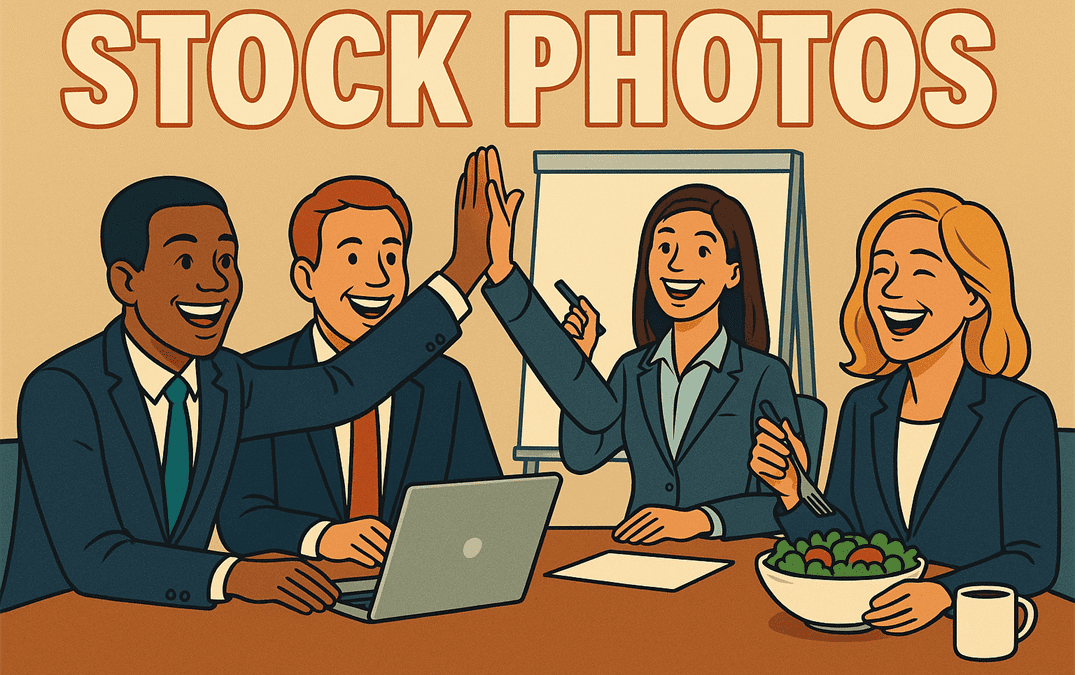
There’s something deeply suspicious about stock photos. You know the ones. A group of people in crisp suits, gathered around a conference table, laughing like someone just told the best knock-knock joke in corporate history.
Nobody has ever looked that happy in a meeting. Not even meetings with cake.
Especially not meetings with cake.
Be honest, when was the last time Sharon from accounts fist-pumped because Derek’s pie chart went up by 2%?
Exactly.
And yet, according to stock photos, every office on earth is filled with radiant models whose teeth sparkle with the light of a thousand marketing budgets.
The catalogue of clichés (a greatest hits collection)
Stock photos have a playlist, and we’ve all heard it. Over and over.
- The handshake: Two people grasping hands so firmly you’d think they were arm wrestling for control of the WiFi password.
- The brainstorming session: A group pointing at sticky notes as though they’ve just reinvented gravity.
- The “diverse team”: A carefully assembled rainbow of models, all equally delighted to be in an office that looks suspiciously like a co-working space in Berlin.
- The salad eater: A lone woman chuckling at her lettuce, because apparently lettuce is hilarious if you’ve got the right agency contract.
- The headset hero: A customer service rep wearing a headset, grinning with the intensity of someone about to sell you double glazing and a timeshare.
- The laptop on the beach: Because nothing says “work-life balance” like typing up quarterly reports on the beach surrounded by people on holiday.
We’ve been so conditioned by these images that reality feels wrong.
Where are the spontaneous high-fives in your office? Where’s the man who sits backwards on a chair during “team bonding”? Where’s the guy holding a pen like it’s a laser pointer of destiny?
The uncanny valley of happiness
What really unsettles me is the joy. These people aren’t just happy. They’re euphoric.
They’re ecstatic about pie charts. They are losing their minds over a PowerPoint slide about projected revenue.
In real offices, nobody’s that happy.
At best, we muster polite nodding, maybe a weak chuckle if someone sneaks in a pun.
Stock photo models, on the other hand, look like they just found out they’ve won a lifetime supply of oat milk.
When stock photos go feral
Every so often, stock photo libraries slip off their polished corporate mask and reveal the chaos lurking beneath.
You get gems like:
- Man holding banana like a phone (apparently fruit-based communication is trending).
- Businessman on rooftop with superhero cape (fiscal responsibility never looked so aerodynamic).
- Grandma with VR headset looking like she’s seen the future and it’s mildly disappointing.
- Couple laughing while eating salad in bed. I don’t need to explain why that one’s wrong.
And yet, these photos are sitting in a library somewhere, waiting to be used by a confused intern designing a brochure for an insurance company.
Why websites can’t quit them
Here’s the thing, stock photos are convenient.
Not every business can afford professional photography, and not every team member wants their face plastered on the homepage (“Bob from IT” barely lets anyone tag him on Facebook, let alone appear in high-res on the company site).
Stock photos look polished. They’re cheap. They’re instantly available.
And when you’re building a site at 2am, “woman happily using a laptop” starts to feel like a solid design choice.
The problem? Everyone else is using the exact same woman, with the exact same laptop, with the exact same suspiciously clean desk.
That’s how we end up with a million websites that feel like clones.
The authenticity problem
Here’s where I grudgingly make a point. Authenticity matters.
When you rely too heavily on stock photos, your brand starts to feel like beige wallpaper.
Yes, it looks clean. Yes, it’s inoffensive. But also: does anyone actually remember beige wallpaper?
Your team might not look like catalogue models, but they are real.
Real smiles, real awkwardness, real messy desks with mugs that say things like “World’s Okayest Manager.” And that’s memorable. That’s human.
How to make peace with stock photos
Let’s be fair though, stock photos aren’t evil. They’re just… overenthusiastic.
Like that one friend who insists on karaoke after midnight. The trick isn’t to ban them, it’s to mix them with reality.
- Use stock sparingly, to fill gaps, not define your entire site.
- Go for the less obvious stuff (skip the handshake, embrace the weirdness).
- Balance them with actual photos of your team, even if they’re not flawless. Imperfect authenticity beats perfect plastic any day.
Final thought (and a salad)
Picture this, you land on a company website. You see five strangers in suits, grinning like they’ve just been told lunch is free.
You scroll, and there’s a woman laughing alone with a salad. Somewhere in the footer, a headset hero beams directly into your soul.
That’s not reality. That’s stock. And deep down, we all know it.
So next time you laugh at your salad, don’t fight it. Embrace it. You’ve officially joined the stock photo cinematic universe.
The eagle-eyed among you will notice I abandoned stock images on this blog a while ago and replaced them with AI-generated images.
I’m not sure that’s an answer either, but it’s all I have right now!