


The hidden costs of AI content: Quality debt and how to avoid it
 By Jamiek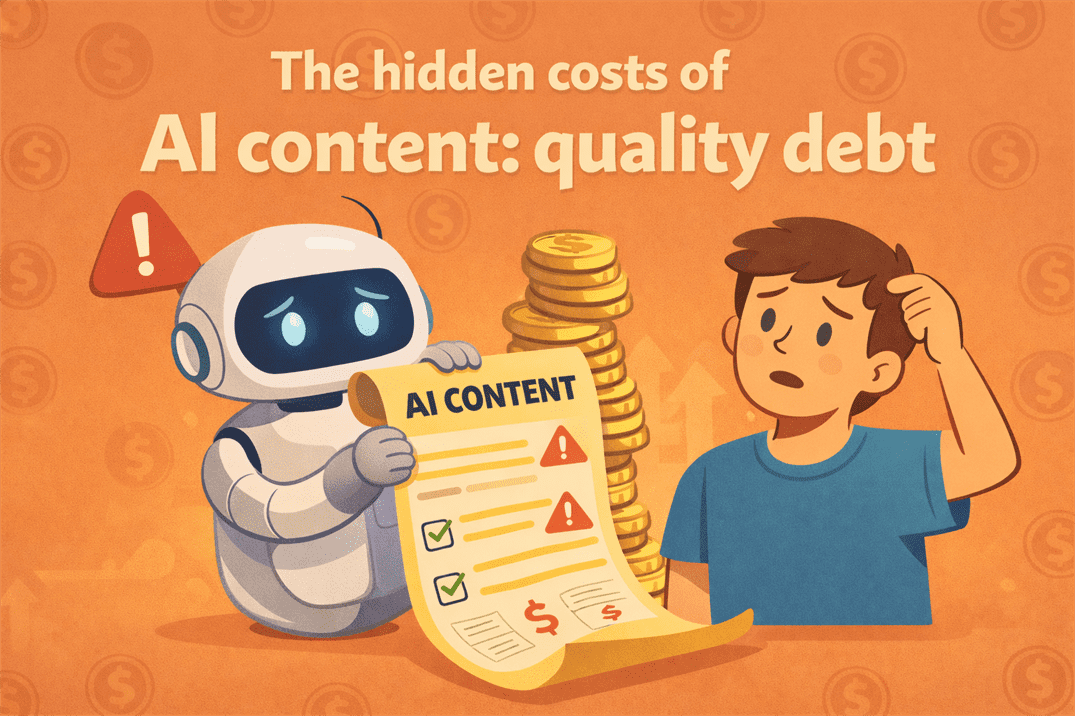
Let’s talk about AI content quality debt.
Not the shiny demo version. Not the LinkedIn carousel where someone claims they replaced their entire content team with a prompt that starts “Act as a world-class copywriter.”
I mean the quiet bill that arrives six months later. The one nobody budgeted for.
If you’ve been publishing AI content at scale, you’re either building an asset or accumulating debt.
There isn’t much middle ground. And before you accuse me of gatekeeping the robots, relax. I use AI every day. I like it. I also know when it’s lying to me with confidence.
Pull up a chair. This is the bit we don’t put on the sales page.
What is AI content quality debt?
Quality debt is what happens when content looks finished but isn’t structurally sound.
It reads fine. It’s grammatically correct. It has headings. It even has bullet points that feel productive.
But it lacks depth, clarity of thought, original positioning, lived experience and sometimes basic factual reliability.
So you publish it.
And every time you do, you borrow against your future credibility.
AI content quality debt compounds in three ways:
- Editorial cleanup later
- Brand erosion over time
- Performance decay in search and conversion
It’s like technical debt in software. Except instead of messy code, you’ve got 120 blog posts that all sound like they were written by the same polite person who has read Wikipedia twice.
You can ignore it. For a while.
Then you try to update everything at once and wonder why your content team suddenly looks like they’re training for an ultramarathon.
The seductive maths of cheap content
Let’s be honest about why this happens.
AI makes content production feel cheap.
You can:
- Generate 2,000 words in 30 seconds
- Spin out five topic variations before your coffee cools
- “Optimise” everything with an SEO plugin that gives you green lights
From a spreadsheet perspective, it’s glorious. Cost per article drops. Output rises. Everyone feels efficient.
But cheap production doesn’t mean cheap ownership.
The long-term AI editing costs are rarely included in that initial calculation.
You might save 70% on writing today. But if you need senior editors to:
- Fact-check hallucinations
- Rework bland positioning
- Inject real expertise
- Rewrite robotic phrasing
- Fix subtle inaccuracies
Then you haven’t eliminated cost. You’ve deferred it. And deferred cost tends to grow teeth.
The risks of AI content nobody budgets for
Let’s break down the risks of AI content in a way that won’t make you want to throw your laptop out of the window.
1. Brand flattening
AI averages language. That’s literally its job, to predict the most statistically likely next word.
Over time, that statistical middle ground becomes your brand voice.
Your sharp edges soften. Your personality thins. Your perspective drifts toward consensus. Everything sounds reasonable. Nothing feels distinct.
You don’t notice it at first.
Then you reread something you wrote three years ago and think, “Oh. I used to have opinions.”
2. Authority drift
AI can simulate expertise. It can’t experience it.
So what happens? Your content begins to generalise.
Instead of:
- Hard-earned insight
- Specific case examples
- Trade-offs and tensions
- Strong positioning
You get summaries.
Summaries are useful but they aren’t leadership.
Over time, your content library becomes a reference shelf rather than a point of view. And in competitive niches, that’s a slow fade.
3. Editing bottlenecks
When you scale AI content, you create review friction.
Every article requires:
- Tone correction
- Structure tightening
- Strategic alignment
- Fact validation
Multiply that by 50 posts per month.
Suddenly your editors aren’t refining ideas. They’re cleaning up after a very enthusiastic robot.
That’s where long-term AI editing costs become visible. Not in cash at first. In fatigue.
The AI content pitfalls that feel harmless
Some pitfalls are obvious. Others are sneakier.
Let me confess one of mine.
Early on, I’d generate a draft, skim it, tweak a few phrases and think, “Good enough.”
It was readable. It flowed. It had subheadings. It even had a punchy intro.
What it didn’t have was tension.
No friction. No stakes. No lived specificity.
AI content pitfalls often hide in adequacy. The work passes but it doesn’t persuade.
Why quality debt compounds
When you publish mediocre AI-assisted work at scale, you affect:
- Internal linking relevance
- Brand trust signals
- Conversion momentum
- Editorial morale
Each piece might seem fine alone. Together, they create an average gravity.
Search engines don’t reward average gravity. Audiences don’t either.
Once you’ve accumulated AI content quality debt across hundreds of URLs, paying it down requires a full, structured audit.
You end up rewriting large sections anyway. Which makes the “savings” from earlier feel optimistic.
So should you stop using AI?
No.
That would be dramatic. And inefficient.
AI is brilliant at:
- First drafts
- Structural scaffolding
- Idea expansion
- Pattern recognition
- Repurposing
The problem isn’t AI, it’s pretending AI output is finished work.
If you treat AI like a junior collaborator who needs direction, it’s powerful.
If you treat it like a senior strategist who doesn’t need supervision, you accumulate debt.
How to avoid AI content quality debt
Here’s how to use AI without quietly sabotaging yourself.
1. Separate drafting from thinking
Do the thinking first.
Positioning. Audience intent. Angle. Emotional stakes. Desired outcome.
Write that in your own words before you prompt anything, then use AI to expand, structure, or explore.
This alone eliminates half the common AI content pitfalls.
2. Inject lived specificity
After the AI draft, add:
- Real examples
- Metrics from your own experience
- Trade-offs you’ve faced
- Mistakes you made
Specificity is expensive. That’s why it stands out.
AI can’t fake your scar tissue or thousand yard stare. Use it.
3. Edit for opinion, not grammar
Stop polishing sentences first.
Ask:
- Does this take a stance?
- Is this insight earned or generic?
- Would anyone argue with this?
If the answer to the last question is no, you probably need sharper thinking.
Strong content carries risk. Not recklessness. Risk.
4. Budget for editorial depth
If you’re scaling AI content, allocate serious editorial time.
Not just proofreading. Strategic editing.
Build it into your cost model from day one. Otherwise those long-term AI editing costs will surprise you later.
5. Audit regularly
Every quarter, review a sample of your AI-assisted content.
Look for patterns:
- Repetitive phrasing
- Overused structures
- Weak conclusions
- Thin examples
If you see sameness creeping in, you’re accumulating quality debt.
Better to fix 20 posts now than 200 later.
The controversial bit
Most AI content problems aren’t caused by AI. They’re caused by people who didn’t have strong editorial standards to begin with.
AI doesn’t create bland thinking, it amplifies it.
If your strategy is vague, your audience poorly defined and your positioning soft, AI will mirror that perfectly. At scale.
Which means the real work isn’t better prompts.
It’s better thinking.
I know. That’s less exciting than “Prompt hack for 10x output.” But it’s true.
Final thoughts
I love AI. I use it daily. It makes me faster. It challenges my structure. It occasionally surprises me with phrasing I’d never consider.
But I don’t outsource judgment.
AI content quality debt is what happens when you confuse speed with progress.
If you treat AI as a drafting engine and keep ownership of insight, you build assets.
If you publish at scale without editorial friction, you build liabilities.
The difference isn’t the tool.
It’s you.
And yes, that’s slightly annoying. I’d also prefer a button that says “Create brilliant, differentiated thought leadership instantly.”
Until that exists, we do the thinking. Then we let the robot help.

 Oct 01, 2026
