


The great account wall experiment
 By Jamiek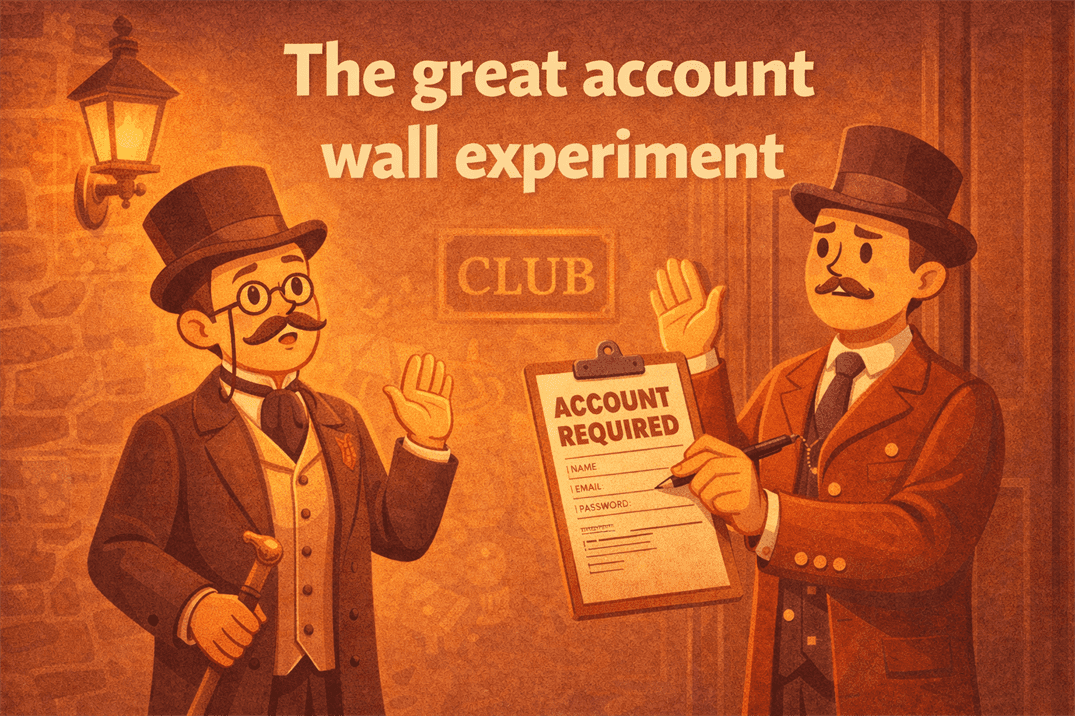
This is the part where I admit something slightly petty about myself.
If a website makes me log in or create an account before I can read the thing I just clicked on, I close the tab.
Not angrily. Not dramatically. Just a gentle, dignified retreat.
Like a Victorian gentleman declining to enter a drawing room because someone asked him to fill in a form first.
And yet.
I keep noticing more of it.
You click a headline. You’re curious. You’re ready. And then:
“Create a free account to continue.”
Free, of course. Free in the same way a gym trial is free. Technically accurate. Emotionally suspicious.
Sites like The Verge, The Independent, and plenty of others have started leaning into this soft gate.
Not a hard paywall. Not quite a newsletter sign-up. More like a velvet rope with a clipboard.
Which raises a question I can’t ignore:
Does this actually work?
Why publishers are doing this in the first place
Let’s zoom out for a second and put on our sensible shoes.
Email capture is gold. Actual, measurable, spreadsheet-friendly gold. Once you have an email address, you can:
- Retarget
- Personalise
- Segment
- Upsell
- Convert to paid
- Build direct audience relationships outside Google
It moves you from rented attention to owned attention.
And if you’ve read anything about media economics in the past decade, you’ll know that owned attention is the only thing that isn’t quietly on fire.
Ad revenue fluctuates. Search traffic shifts. Social reach changes overnight. An email list is a direct line to someone’s inbox.
From a business standpoint, it’s logical.
From a user standpoint, it’s friction and friction is expensive.
The quiet trade off nobody talks about
Publishers don’t need everyone to create an account. They need enough of the right people to do it.
High intent readers. Loyal readers. People who come back three times a week. People who are more likely to subscribe later.
The casual passerby who clicked because they were vaguely curious about a headline might bounce. And the publisher might be fine with that.
This is the bit that slightly unsettles me.
Because you like to think your curiosity matters. You want your accidental click to feel important. But in cold strategic terms, you might just be noise.
There’s a trade-off happening:
- Reach versus relationship.
- Volume versus depth.
- Anonymous traffic versus identifiable audience.
Publishers are choosing depth and if you zoom out, it makes sense.
The era of piling up pageviews and hoping for the best is wobbling. Advertisers want first party data. Investors want predictable revenue. Editorial teams want stability.
The account wall becomes less about blocking content and more about qualifying attention.
Which is annoyingly rational.
The psychology of the login moment
Now we get to the interesting bit.
When someone asks you to create an account, they’re asking for commitment. Commitment triggers resistance unless there’s clear value.
The value might be:
- Exclusive content
- Personalisation
- Community access
- Ongoing utility
If the value is simply “continue reading the article you already clicked,” that’s a thinner pitch.
It works better when you already trust the brand.
This is why a niche site with loyal followers can often get away with it more easily than a general news site competing with twenty alternatives.
There’s also something subtle happening here.
Scarcity can signal value. Friction can signal importance. When something isn’t instantly accessible, it can feel more premium.
Not always. Sometimes it just feels annoying. But in certain contexts, it works.
Habit changes everything
I suspect the real variable is habit.
If The Independent becomes part of your daily routine, creating an account feels reasonable.
If it’s your first visit, it feels presumptuous.
If you’re like me, you have a low tolerance for admin between you and information. You’re here for ideas, not onboarding flows.
You don’t want a password to read about tech trends or political analysis. You want to dip in, skim, move on.
But we aren’t the only type of user.
There’s the loyalty-driven reader. The completionist. The person who reads full features, comments thoughtfully, subscribes to newsletters and doesn’t mind logging in because they already feel invested.
Publishers are betting on them.
So does it actually work?
Short answer, yes, if your goal is audience quality over raw traffic.
Long answer, it depends on execution, brand strength and how gracefully you ask.
A soft gate after three free articles feels different from a wall on first click. A polite explanation of value feels different from a blunt demand.
A simple sign-up flow feels different from a seven field form that wants your postcode and first childhood pet’s name.
You can feel when a site respects your time.
And that’s probably the real test.
If you run a content site yourself
This is where it stops being philosophical and becomes practical.
Ask yourself:
- Do you want maximum reach?
- Or do you want a smaller, identifiable audience you can actually build a relationship with?
Those are different business models wearing similar clothes.
Here’s the slightly uncomfortable truth. If you complain about account walls but rely on ads, affiliate clicks, or your own email list for revenue, you’re participating in the same ecosystem. Just with different trade-offs.
We all want free content. We also want the people who make it to survive.
That dilemma isn’t going away.
My anti-account confession
Would I personally prefer open access? Absolutely. I am constitutionally allergic to account creation.
I already have enough passwords to start my own cybersecurity firm!
But I can’t pretend the economics aren’t shifting.
So maybe the smarter position isn’t anti-account. Maybe it’s curious account.
Curious about when it makes sense. Curious about how much friction your audience will tolerate. Curious about whether you’re building a fleeting audience or a durable one.
And if you’re anything like me, you’ll probably still close the tab sometimes. Quietly. Respectfully. With mild theatrical disappointment.
But you might also pause and think.
If this site becomes part of your routine, maybe a login isn’t the end of civilisation after all.
Look at us. Growing.

 Oct 01, 2026
