The AI content that’s technically fine and somehow depressing
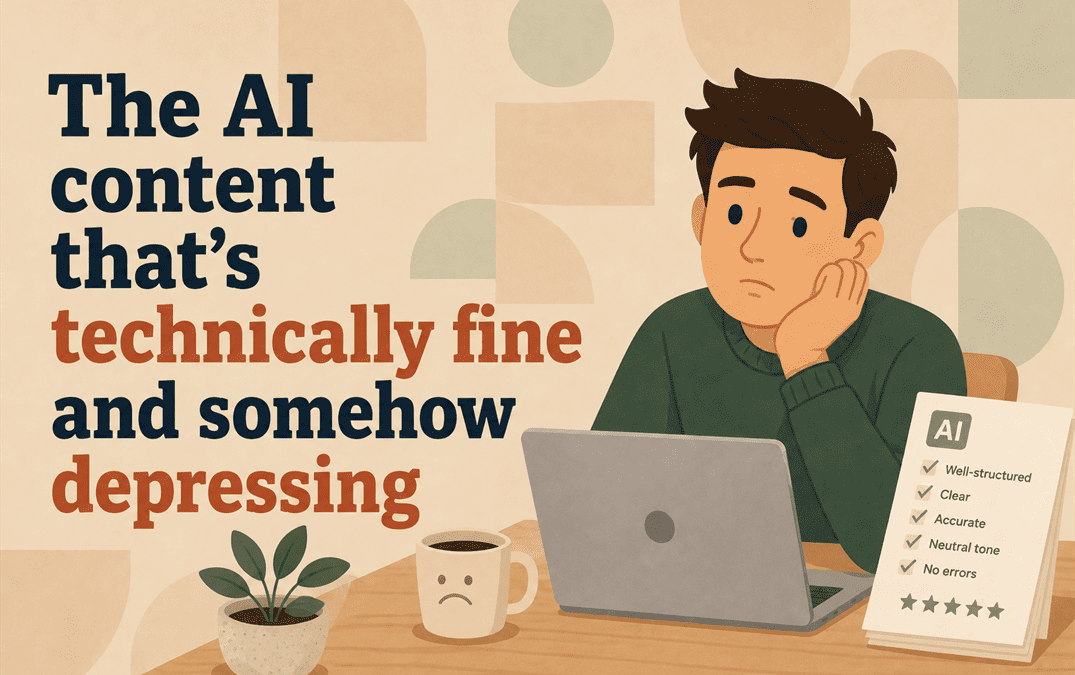
There’s a particular reading experience that’s hard to describe precisely. You finish an article. You understood all of it. Nothing was wrong.
And yet you feel vaguely like you’ve just eaten a meal that was nutritionally complete and completely joyless.
No errors. All the points covered. Decent structure. Subheadings where subheadings should be.
And somewhere in the middle of it, you stopped caring and you can’t quite put your finger on when.
That’s what I want to talk about.
The floor got very well carpeted
Correctness used to be genuinely hard to achieve at scale. Accurate, well-structured, readable content required either expertise, careful editing, or both.
AI tools removed that barrier almost entirely. You can now produce something technically proficient on virtually any topic, in any format, in a few seconds.
That’s not a criticism. It’s a context. Because what it means is that correctness is now the floor, not the ceiling.
It’s the minimum acceptable condition for a piece of writing, not an achievement.
And an awful lot of content is currently being produced as if clearing the floor is the whole job.
It isn’t.
What flatness actually is
The mild depression a technically fine piece produces isn’t random. It has a cause. The piece was written to cover rather than to say. There’s a difference.
Covering a topic means addressing the expected points in the expected order.
It’s a transaction. The reader gets the information they searched for, formatted legibly, free of mistakes. Fine. Useful, even.
But there’s nothing in it that required a perspective, nothing that made a call, nothing that came from someone who had actually thought about this rather than assembled it.
Saying something is different.
It involves a viewpoint. It involves the writer making choices about what matters more and what matters less, what to foreground, what to leave out.
It involves, at some level, being willing to be slightly wrong rather than safely comprehensive.
That willingness is where engagement lives.
The thing correctness can’t carry
There are a few things technically accurate content can’t do, no matter how well structured it is.
It can’t surprise you. If the piece contains exactly what you expected to find in exactly the order you expected to find it, your brain processes it on autopilot.
This is fine for assembly instructions. It’s death for anything that’s supposed to hold attention.
It can’t make you trust the source. Trust in written content comes from specificity, from someone saying something precise enough that it could be checked, or strange enough that it had to come from experience.
Generic accuracy doesn’t produce trust. It produces the low-level comfort of not being lied to, which is different.
And it can’t make you want to read the next thing. The flatness problem is also a retention problem.
If every piece from a source produces the mild-meal feeling, you don’t return. Not because anything was wrong. Because nothing was particularly there.
What engagement actually requires
This is where it gets specific rather than theoretical.
Engagement requires a writer who has an opinion about the material, even a small one.
Not a hot take. Not controversy for the sake of it. Just a perspective. Just the sense that the person who wrote this looked at the topic and thought something about it, rather than reported that thoughts about it exist.
It requires specificity over breadth.
The piece that covers three things properly beats the piece that touches twelve things lightly, every time, for every reader who isn’t just scanning for a single data point.
It requires the writer to respect the reader’s time more than the brief’s word count.
Which means cutting anything that’s there to bulk rather than contribute.
Which means some sections don’t exist in this piece because they existed in every other piece on the topic.
And sometimes it requires the writer to say something slightly uncomfortable, or slightly counterintuitive, or just slightly specific in a way that makes the piece feel authored rather than generated.
Not a gimmick. Just a trace of an actual person.
Correctness is a prerequisite. It’s necessary and it’s not enough. The ceiling is whatever happens above it and that part still requires judgment, which still requires a human who has some.
That’s where I spend most of my working life. If it sounds useful, you know where I am.