The writer I was trying to sound like (and when I stopped)
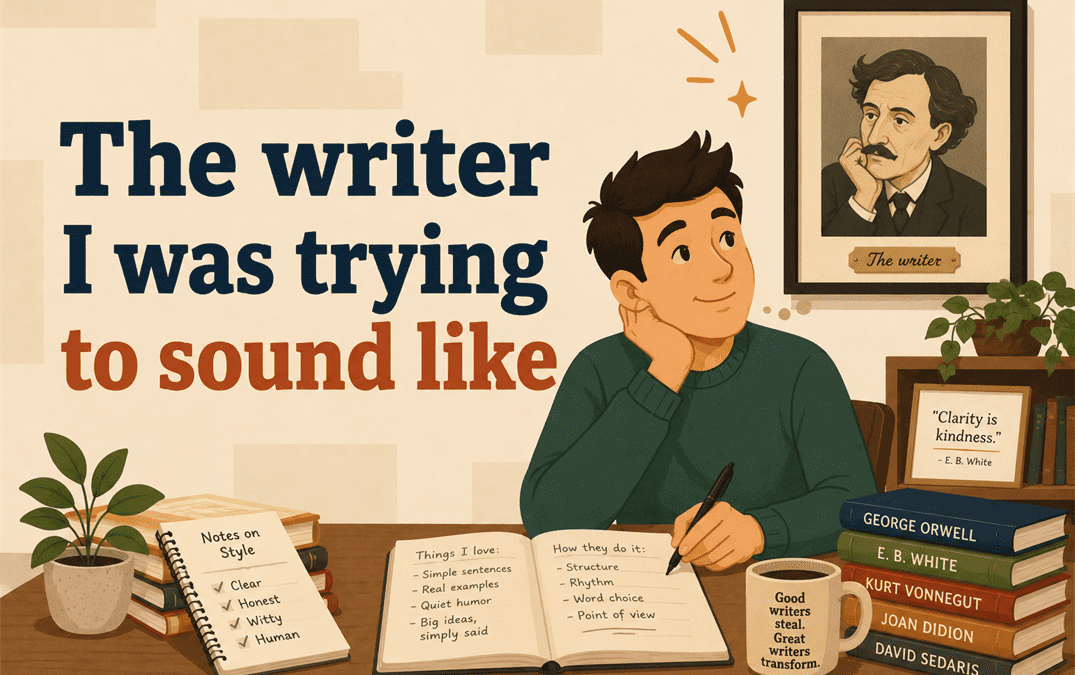
There was a period in my early thirties when every sentence I wrote had a slight lean to it. Not my lean. Someone else’s.
I’d been reading Nick Hornby obsessively, the way you read someone when you’re young and think their brain is structured better than yours.
Short declarative sentences. Lists used as emotional defence. That particular brand of self-deprecating sincerity that only works if you mean it.
I didn’t mean it yet, but I was practising. And somewhere between reading him and sitting down to write anything, his rhythms had colonised mine so completely that I couldn’t hear the join.
This is, I think, the thing nobody tells you about influence: it doesn’t feel like influence. It feels like you.
How it starts
The writers you absorb earliest get in deepest. You read them before you have a voice of your own, which means there’s no existing voice to push against them.
They just move in. Unpack. Start rearranging furniture.
For me it was Hornby first, then Bill Bryson (whose trick of treating mild inconvenience with the gravity of a natural disaster I still catch myself doing), then later David Sedaris, whose confessional absurdism looked so effortless I once spent three months writing personal essays that were just sad things that had happened to me, described in a wry tone slightly too high-pitched to pass as genuine.
None of it was dishonest, exactly. But none of it was mine.
The problem with borrowing someone else’s voice is that it fits them for reasons you can’t fully see.
Hornby’s staccato style is inseparable from his specific emotional guardedness.
Sedaris’s self-mythologising works because it’s built on material that really is that strange.
When you take the technique without the source material, you get a genre performance.
You get a tribute act, which is less than the thing it’s paying tribute to and less than whatever you’d have made if you’d stayed in the room with your own actual sentences.
The longer middle part
Finding your voice isn’t a moment. That’s the biggest myth about it. There’s no morning you wake up and think, “yes, that’s me now”.
What happens is a slow accumulation of embarrassments and revisions in which you keep noticing when something sounds wrong and gradually the gap between what you write and what you mean gets smaller.
The useful part of the imitation phase and there is a useful part, is that it teaches you what sentences can do.
Reading obsessively and then trying to replicate it is essentially a technical education, even if you don’t know that’s what it is.
You learn pace, you learn the mechanics of a build, you learn that good writing creates expectation and then manages it.
You can’t learn those things from a list of rules or style guides. You have to absorb them from writers who’ve already solved the problems.
The trap is staying there.
The imitation that was a tool becomes a habit and then a constraint. You end up writing in a voice that you know works, because you’ve seen it work for someone else, but that doesn’t actually reflect how you think.
The sentences are technically fine. They just feel borrowed.
Leaving that phase, when you eventually leave it, usually happens by accident.
You write something in a rush, without enough time to edit yourself back into the approved register and what comes out is more direct and stranger and more obviously yours.
Or someone who knows your work says: that bit, where you stopped trying, that’s the bit I wanted more of.
Or you just get tired of the version of yourself that sounds like a plausible imitation of a professional writer, and start writing like a person instead.
This never stops, by the way
Here’s the part I didn’t expect, the process doesn’t end. You don’t graduate out of it.
I recently overhauled the Coastal Content blog. Not the design, not the topic list, the actual voice.
For a long time, the blog sounded like a confident, capable content professional, which is what I thought clients needed to read.
It was the right kind of reassuring. Structured. Sensible. Quietly authoritative in a way that said: yes, I do know what I’m talking about, please hire me.
It was also completely bloodless.
The version of me that wrote those posts was performing competence rather than demonstrating it.
I was doing for my own brand what I’d spent years telling other writers not to do.
I was writing for an imaginary audience’s expectations rather than writing what I actually thought, in the way I actually think it.
Changing that has been the best move I’ve made with the blog.
Not because the old version was dishonest, but because this version is more useful, which sounds counterintuitive until you realise that useful writing requires trust, and trust requires the reader to feel like they’re talking to an actual person.
A person who finds things funny that are genuinely funny, gets frustrated by things that are genuinely frustrating and has opinions that are actually their opinions rather than the distilled consensus of industry best practice.
The writers I used to try to sound like were all, whatever else, clearly themselves. That was the thing I was trying to steal.
It turns out you can’t steal it. You can only do the slower, more annoying work of finding out what the equivalent is for you.
What I’ve kept
The influence doesn’t go away and it shouldn’t. I still hear Hornby in the rhythm of certain sentences. Still catch Bryson’s scale problem in myself when I write about minor travel mishaps as if they constitute genuine suffering.
These things are threaded into how I think now, which means they’re no longer imitation. They’ve become part of the instrument.
The difference is I know what’s mine and what I borrowed. I can hear the distinction. And increasingly, the borrowed parts serve the voice rather than replacing it.
That, as far as I can tell, is what a writing voice actually is.
Not some pure unborrowed thing you were born with, but the specific arrangement of influences, habits and decisions that makes your sentences sound like yours and nobody else’s.
It takes a long time to hear it. It takes longer to trust it.
But it gets there.
If any of this sounds familiar, or if you’re working through something similar with your own writing or your team’s, I’m always happy to talk it through.