What a content strategy actually looks like
I spent part of this week with a startup that had been told, in no uncertain terms, that they needed a content strategy.
The person who told them this was a marketer. A confident one. The kind who uses phrases like “brand voice alignment” in casual conversation and doesn’t flinch.
The startup founders nodded along, wrote it down and then quietly Googled “what is a content strategy” on the way home.
Here’s the part that made my day: the marketer didn’t know either.
Not properly. They knew the phrase. They’d used it in decks. They had strong feelings about pillar pages.
But when the startup asked what they were actually supposed to build, produce, or do differently on a Monday morning, the answer dissolved into something about “establishing authority” and “showing up consistently.”
Right. So the same as nothing, then.
If you’re a startup or SMB who’s been told you need a content strategy and you’re not entirely sure what that means, this one’s for you.
And if you’re a marketer who’s been telling people they need one without fully explaining it, also for you.
We’re all learning here. No names named.
What people think it means
Most people, when they hear “content strategy,” picture a content calendar. Lots of dates, lots of post titles, a colour-coded spreadsheet and a mild sense of productivity.
That’s a content plan. It’s a useful thing. It is not a strategy.
Others picture a brand bible with fonts, tone of voice, the preferred Oxford comma stance.
Also useful. Also not a strategy.
A strategy is the thinking that sits underneath all of that.
It’s the bit that answers the questions a calendar and a brand bible can’t: why are we making this, who exactly is it for, what do we want them to do and how will we know if it’s working?
Without that layer, you’re just producing content. Which is fine if you like producing content.
Less fine if you’re hoping it does something for your business.
What is a content strategy?
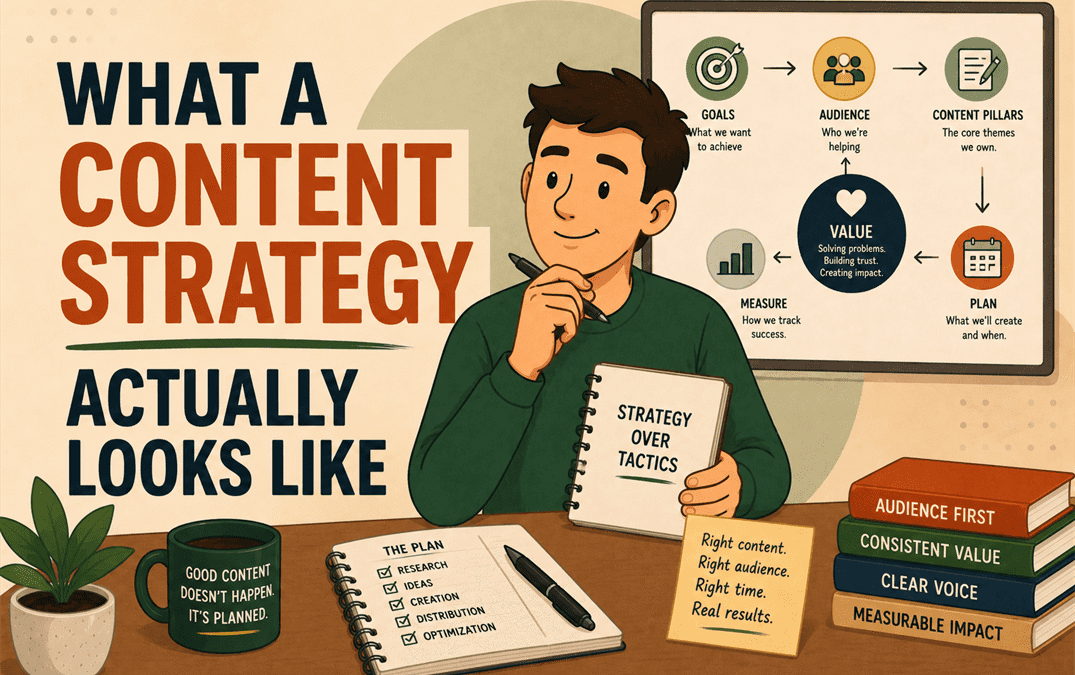
A content strategy is a set of deliberate decisions about how your content will serve a specific goal.
That’s it. That’s the whole thing.
The reason it sounds complicated is that “a set of deliberate decisions” covers a lot of ground, and different businesses have very different goals, audiences, and starting points.
But the core of it is straightforward.
Those decisions include things like:
Who you’re writing for, specifically. Not “SMBs” or “people who like fitness”, real humans with real problems, at a specific point in the buying cycle or customer relationship.
What you want content to do. Generate organic search traffic? Build trust with people already in your pipeline? Reduce support queries? Retain existing customers?
These are all legitimate goals. They produce very different content.
Where it lives and how people find it. A blog, a newsletter, a LinkedIn presence, a YouTube channel. The right answer depends on where your audience is, not where you’d find it easiest to post.
How much you can realistically produce. A strategy that requires five blog posts a week when you have one part-time person writing them isn’t a strategy. It’s a fantasy with a publication schedule.
How you’ll measure whether it’s working. This is the one most often skipped and the one that matters most six months in when someone asks why you’ve been doing it.
Why “just start posting” doesn’t work
The startup I was working with had been posting. They had a blog. They had a LinkedIn. The blog had seven posts on it, each written by a different person with a different idea of who the reader was.
The LinkedIn was a mix of product updates, motivational quotes and one very long post about company culture that got four likes, three of which were employees.
None of this was bad exactly. It just wasn’t connected to anything. There was no thread between what they were producing and what they were trying to achieve.
So the content existed and the business continued at roughly the same pace and everyone vaguely suspected content marketing didn’t really work.
Content marketing works. Content scattered across channels with no clear purpose, produced inconsistently by people who disagree about the audience, doesn’t work.
Where to start if you don’t have one
You don’t need a consultant, a workshop, a content audit, or a 40-slide deck to get started.
You just need answers to a small number of questions.
What’s the one business problem you most want content to help with right now?
More leads, better leads, faster trust-building, lower churn, something else? Pick one. You can have two later. Start with one.
Who’s experiencing the problem your product or service solves?
Describe that person in enough detail that a writer could find them in a room. What do they read? What do they search for? What keeps them from buying sooner?
What do you want them to do after they’ve read something you’ve published?
The answer “feel good about us” doesn’t count. Think about a behaviour, subscribe, book a call, share it, come back, click something.
What can you actually produce, consistently, with the time and budget you have right now?
Not aspirationally. Realistically.
Answer those questions and you have the skeleton of a strategy.
Everything else, the calendar, the briefs, the brand guidelines, the distribution plan, hangs off that skeleton.
Without it, you’re decorating a house that hasn’t been built yet.
The part that requires honesty
Most content strategy problems aren’t really content problems. They’re clarity problems.
Businesses that aren’t sure what makes them different, who they’re best for, or where they’re trying to be in three years will produce content that reflects that uncertainty.
It’ll be fine. It’ll tick boxes. It won’t move anything.
Getting clear on the strategy questions above often forces a harder conversation about positioning, audience and goals that the business needs to have anyway.
Content just tends to be the thing that makes it unavoidable.
Which, honestly, isn’t the worst reason to start.
If you’ve been handed a vague content brief, told you need a strategy, or inherited a blog with seven posts and no clear direction, get in touch.
I’ve spent twenty years doing this. I’m good at the clarity bit.