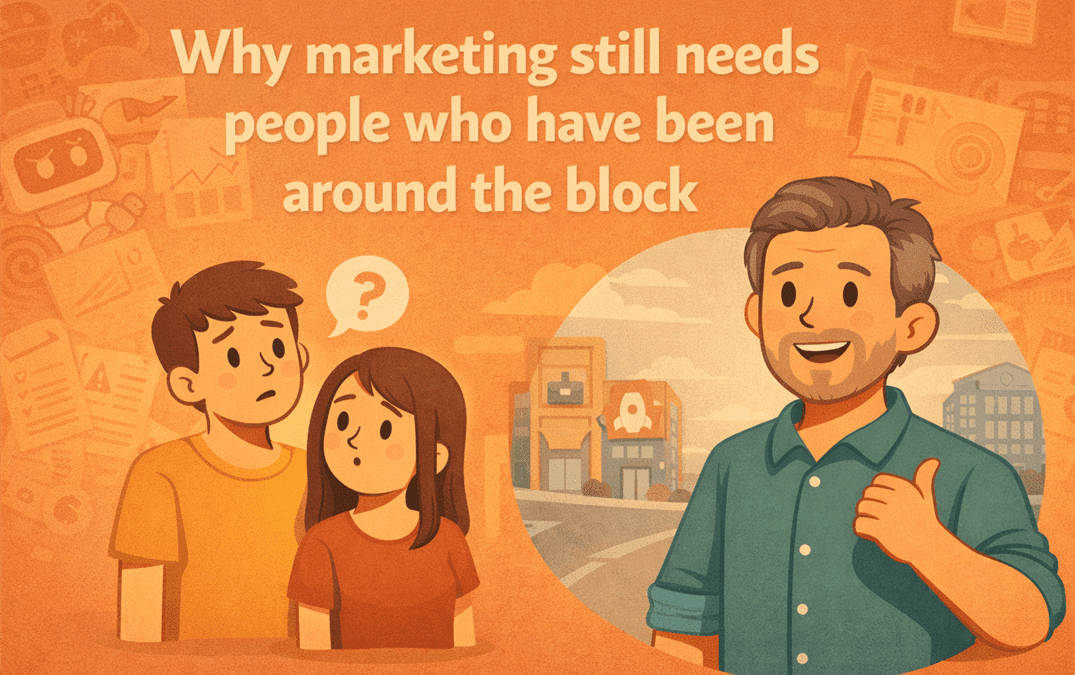
Experience is not outdated: Why marketing still needs people who have been around the block
I hesitated before writing this.
Not because I don’t believe it. I absolutely do. But because the internet has a way of turning “experience matters” into “old man yells at algorithm.”
That’s not what this is.
This is a love letter to scar tissue.
And if you’ve been in marketing or content for more than five minutes, you’ve got some.
The current state of marketing: faster, louder, weirder
Let’s start here.
Marketing right now is:
- Algorithm-driven
- AI-assisted
- Trend-obsessed
- Platform-fragmented
- Performance-measured to the decimal point
Everyone is building funnels. Everyone is building personal brands. Everyone has a “framework.”
You can spin up a website in an afternoon. You can generate 3,000 words before lunch. You can launch a paid campaign with a tutorial and a credit card.
It’s brilliant.
It’s also slightly unhinged.
The barrier to entry has collapsed. Which means the barrier to noise has also collapsed.
And in that noise, experience becomes less visible but more valuable.
I’ve seen this movie before
Here’s the part where I sound like your slightly smug uncle.
I’ve seen this before.
Not AI, obviously. But hype cycles. Platform shifts. “This changes everything” moments.
I remember when:
- SEO was stuffing keywords in white text
- Facebook organic reach felt infinite
- Google Plus was going to dominate
- Every business needed an app
- Vine was the future of content
You know what survived all of that?
Fundamentals.
- Clear positioning
- Strong messaging
- Understanding human behaviour
- Knowing how to structure an argument
- Knowing when to ignore a shiny new tactic
Experience doesn’t make you smarter by default. It makes you pattern-aware.
That matters.
AI didn’t remove the need for judgement
AI is extraordinary. I use it daily. It speeds up drafting, research structuring.
But here’s what it doesn’t do.
It doesn’t:
- Know when a strategy is misaligned with a business model
- Sense when a brand voice is drifting
- Understand political nuance in a sensitive campaign
- Recognise when a metric looks good but means nothing
It produces. It predicts. It optimises.
It does not carry memory.
When you’ve been in the industry for 20 years, you’ve made expensive mistakes.
You’ve overpromised. You’ve chased trends. You’ve recovered from campaigns that flopped quietly and campaigns that flopped publicly.
That lived context becomes editorial judgement.
You can’t prompt your way into that.
The myth of “fresh ideas solve everything”
Let me be clear. I love fresh ideas. I love ambition. I love people who aren’t yet tired of the internet.
Newcomers bring energy. They question assumptions. They don’t carry outdated rules.
That’s healthy.
But fresh ideas without historical context can repeat old mistakes with better design.
Sometimes I’ll see a “new” marketing tactic going viral and think, “Ah yes. That’s 2009 with better typography.”
It’s not that young marketers are naive. It’s that they haven’t yet seen the full cycle.
Experience gives you temporal depth.
You remember what happened after the initial surge. You remember the backlash. You remember the regulatory shift. You remember the algorithm change.
You don’t just ask, “Will this work?”
You ask, “How long will it work for and what happens next?”
That question alone can save a company a lot of money.
What 20+ years actually gives you
Let’s strip away ego for a moment. Experience doesn’t automatically mean wisdom. Plenty of people coast for decades.
But when experience is paired with reflection, you get:
- Pattern recognition
- Emotional resilience
- Calibrated risk assessment
- Clearer communication
- Fewer dramatic overreactions
You stop panicking at every update. You stop declaring the death of blogging every six months.
You stop rebuilding your entire strategy because of one podcast episode.
You’ve weathered storms and that calm is contagious in a team.
The emotional side nobody talks about
Marketing isn’t just tactics. It’s pressure.
Deadlines. Revenue targets. Public launches. Investor expectations.
When things wobble, you don’t just need someone who knows the latest growth hack.
You need someone who has:
- Seen a campaign underperform and adjusted
- Handled public criticism
- Managed a rebrand without losing the plot
- Rebuilt traffic after an algorithm hit
Experience builds emotional range.
You learn that not every dip is a disaster. Not every spike is sustainable. Not every critic is correct.
That steadiness has value.
Where newcomers shine and where veterans anchor
This isn’t a competition, it’s an ecosystem.
Newcomers often excel at:
- Speed
- Cultural fluency
- Platform-native creativity
- Fearlessness
Veterans tend to bring:
- Strategic framing
- Long-term thinking
- Cross-channel understanding
- Crisis perspective
When you combine those, you get magic. When you ignore experience because it feels less flashy, you lose ballast. And boats without ballast tip over easily.
Yes, that metaphor arrived uninvited but we’re keeping it.
The AI layer makes experience more valuable, not less
There’s a narrative floating around that AI levels the playing field.
To a degree, it does. It lowers technical barriers. It accelerates output.
But it also amplifies strategic mistakes at scale.
If your positioning is weak, AI will produce a lot of weak content very quickly.
If your messaging is confused, AI will confidently expand that confusion into a full content calendar.
Experience acts as a filter.
- You recognise when something sounds impressive but lacks substance
- You sense when a metric is vanity dressed as performance
- You know when to pause before scaling
That instinct is built from repetition, not tutorials.
The quiet confidence of “been there, done that”
I used to think I had to keep up with every new tactic to stay relevant.
Now I think differently.
Relevance is not about knowing every tool. It’s about understanding leverage points.
After two decades, you develop a kind of quiet confidence.
You don’t chase every trend. You evaluate it.
You don’t rebuild your entire strategy every quarter. You refine.
You don’t assume the latest platform will replace fundamentals. You integrate where it makes sense.
That doesn’t make you old.
It makes you durable.
So what am I really saying?
I’m not saying hire older people and ignore the young. I’m saying don’t confuse novelty with value.
In a world where anyone can generate content, build funnels and launch campaigns overnight, the differentiator is not output.
It’s judgement.
It’s perspective.
It’s knowing what not to do.
If you’re choosing who to trust with your brand, your revenue, your reputation, ask yourself:
Do you want someone who has only seen the upswing?
Or someone who has seen the upswing, the crash, the rebuild and the reinvention?
I know which one I’d pick.
And yes, I would say that as someone with 20+ years in the industry, a collection of battle scars and a deep appreciation for both new ideas and old lessons.
Experience isn’t outdated.
It’s compound interest.
And if you’ve been around long enough to watch trends rise and fall like I have, you already know how powerful compounding can be.
If you value experience, you know what to do.