The invisible signals that make writing feel trustworthy
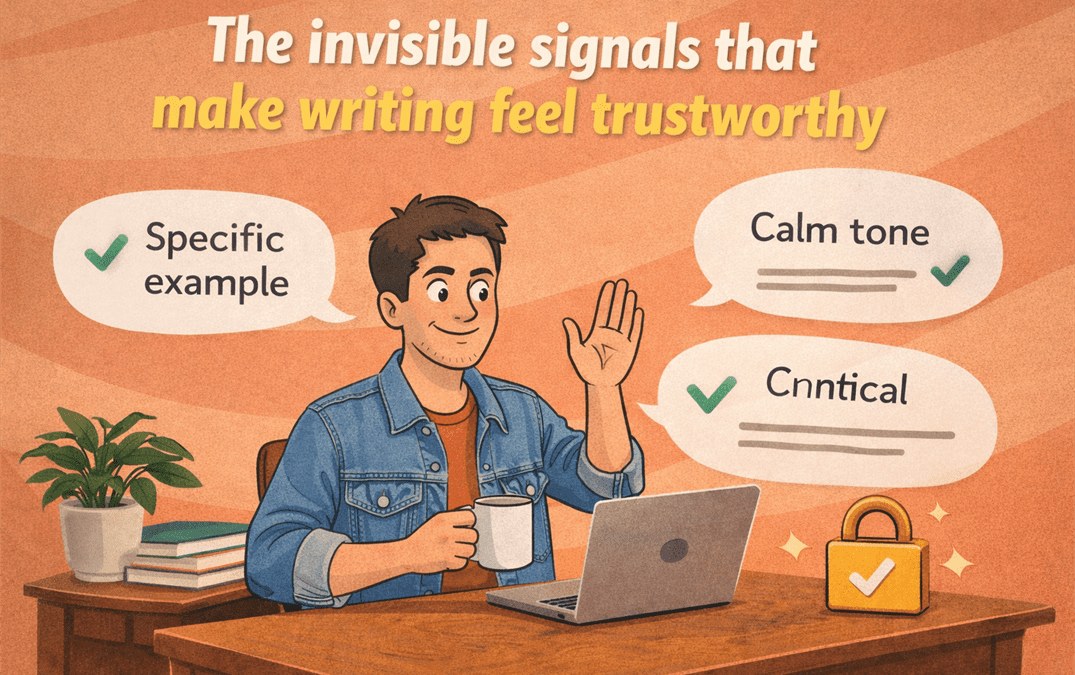
Let’s talk about trust. Not the dramatic kind. Not the “I would hand you my life savings” kind.
I mean the quieter version. The one where you’re halfway through an article and you realise you’ve stopped evaluating it.
You’re not thinking, “Is this person credible?”
You’re thinking, “Yes. That makes sense.”
That shift is subtle. You don’t see it happen. But it’s everything.
Because most writing doesn’t fail on information. It fails on feel.
You can say all the correct things and still feel vaguely unconvincing. Like someone who memorised the talking points but hasn’t actually lived with the idea.
Trustworthy writing carries invisible signals.
Cadence: Rhythm tells on you
Cadence is the rhythm of your sentences. And yes, this is the part where I admit that rhythm can betray you.
If every sentence is perfectly structured, perfectly balanced and perfectly punchy, something starts to feel… manufactured.
Humans don’t talk in immaculate symmetry. We wander slightly. We qualify things. We build momentum and then ease off.
Our speech has variation.
When writing has a natural mix of longer and shorter sentences, it feels lived in.
When every line hits like a rehearsed slogan, readers may not know why, but they feel distance.
Trust increases when rhythm feels human.
I often read my drafts aloud. Not because I enjoy hearing myself speak in an empty room, but because awkward rhythm reveals itself immediately.
If I stumble or run out of breath, the sentence probably needs reshaping.
Specificity: Vague is the enemy of trust
Vague writing is polite. It avoids risk. It also avoids conviction.
Many companies love this style as it’s safe and isn’t likely to generate negative feedback.
The downside is, it isn’t likely to generate any feedback whatsoever.
When someone says, “Many businesses struggle with content,” you nod politely and move on.
When someone says, “Most businesses publish consistently but rarely revisit their core message after month three,” you lean in.
Specificity suggests experience.
It tells the reader, “I’ve seen this play out.” It feels grounded rather than theoretical.
And here’s the interesting part. You don’t need data for every claim to sound credible. You need texture.
Concrete examples. Clear scenarios. Realistic details.
Trust builds when writing feels observed, not assembled.
Examples: Proof without posturing
There’s a fine line between sounding authoritative and sounding like you’re auditioning for a panel discussion.
Examples do the heavy lifting.
Instead of declaring, “Strong framing increases engagement,” show what weak framing looks like and then contrast it with something sharper.
Walk the reader through the difference with examples or with discussion.
When readers can see it, they believe it.
Examples reduce abstraction. They move the argument from theory into practice. And practice feels real.
This is why I rarely trust writing that stays entirely in generalities.
If someone can’t illustrate their point with at least one concrete example, I start wondering whether the insight is solid or just elegantly phrased.
Narrative control: Confidence without noise
Trustworthy writing has a steady hand.
It doesn’t overexplain. It doesn’t apologise for existing. It doesn’t hedge every claim with layers of self protection.
At the same time, it doesn’t shout. There’s a composure to it.
Narrative control means you know where the piece is going and introduce ideas in sequence.
You don’t wander off into interesting but irrelevant tangents just because you can.
Readers feel that control. They sense when someone is thinking clearly versus improvising.
If your argument loops back on itself or contradicts earlier points, trust drops. If each section builds naturally on the previous one, trust rises.
Tone: Calm beats dramatic
This might be my mildly sarcastic observation of the day.
If everything is urgent, nothing is.
Writing that constantly escalates with dramatic claims, sweeping generalisations, and “this changes everything” energy can feel exciting. It can also feel unstable.
Think of furniture shopping. When was the last time you went to a furniture store and there weren’t “sale ending soon” messaging everywhere?
When was the last time you actually believed a sale was a real sale? Or hurried to buy something because you genuinely thought there wasn’t going to be another sale next week?
Trust often lives in moderation.
Calm explanations. Measured confidence. Clear reasoning.
You don’t need to declare that something is revolutionary. You need to explain why it matters.
There’s a difference.
When tone feels steady, readers relax. And relaxed readers are more open.
The absence of desperation
Writing that tries too hard to impress signals insecurity. Overloaded vocabulary. Excessive jargon. Constant reminders of how important the topic is.
Trustworthy writing doesn’t strain. Sometimes it doesn’t seem like it cares whether you read it or not.
It states its case clearly and lets the reader decide.
Ironically, the less you chase validation on the page, the more authority you project.
This is something I had to learn the hard way. Early on, I wanted every article to prove I was smart. Now I want every article to prove I’ve thought carefully.
That shift changed everything.
What makes writing feel trustworthy?
It’s rarely one big thing, but a culmination of several smaller ones.
- It’s rhythm that feels human.
- Specific details that suggest experience.
- Examples that ground abstract ideas.
- Structure that holds steady.
- Tone that doesn’t overreact.
None of these elements shout. They accumulate.
And here’s the slightly humbling part.
Readers won’t compliment you on your cadence. They won’t say, “Excellent narrative control.”
They’ll simply keep reading. They’ll share the post. They’ll come back.
Which, if we’re honest, is the real compliment and the real goal we’re usually aiming for.
If you want your writing to feel trustworthy, stop trying to sound impressive and start trying to sound clear. Let the insight carry the weight. Let the structure do its job.
And if in doubt, read it aloud. If you sound like a person rather than a press release, you’re probably on the right track.
If you still can’t make it work, contact me.