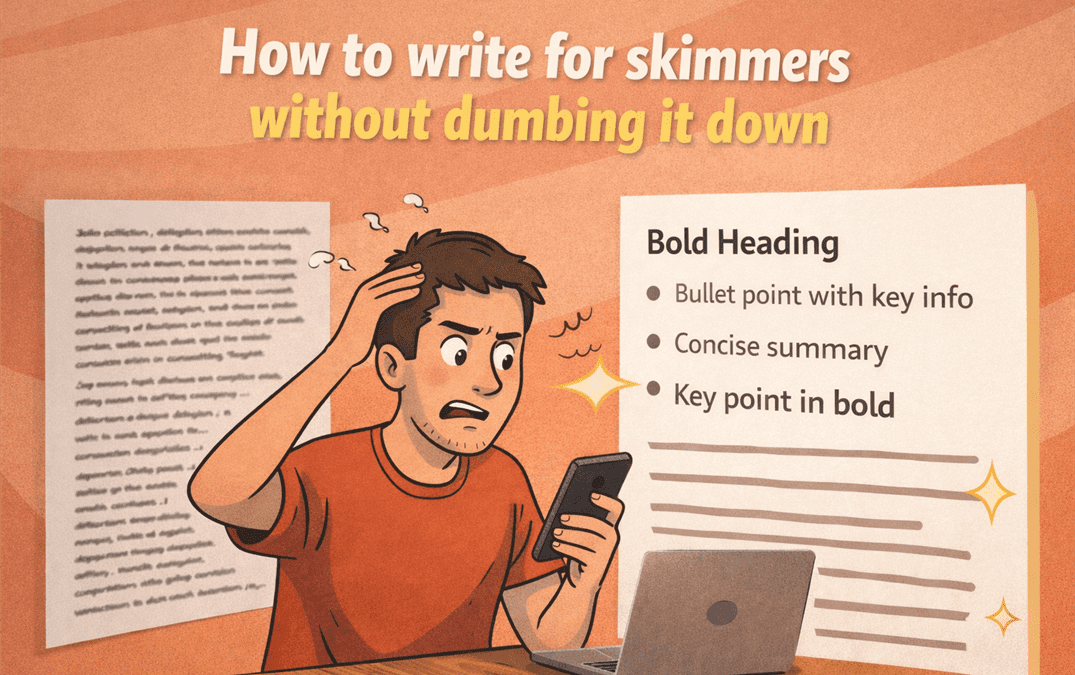
How to write for skimmers without dumbing it down
Let’s start with a controversial truth. Most people are not reading your blog post.
They’re circling it. Hovering. Sampling.
Doing that thing where their eyes bounce down the left side of the screen like they’re checking the structural integrity of your subheadings.
You poured your soul into paragraph four. They’re scanning for bold text.
This isn’t a moral failing. It’s bandwidth.
The average reader is juggling twelve tabs, three notifications and a vague sense that they should probably be doing something else.
If you expect deep, uninterrupted literary devotion, you’re competing with Slack and workload.
So, the question isn’t “How do I force people to read properly?”
It’s “How do I design writing that respects how people actually read?”
Writing for skimmers does not mean lowering the intellectual bar. It means lowering the cognitive requirement.
Skimming isn’t stupidity
Skimming is a filtering mechanism.
Readers are trying to decide, quickly and efficiently, whether your content deserves deeper attention.
They’re not rejecting complexity. They’re evaluating relevance.
When someone scans your headings and bold phrases, they’re asking:
- Is this useful to me?
- Is this worth my time?
- Is this just the usual content noise?
If your structure answers those questions clearly, they’ll slow down.
If it doesn’t, they won’t.
So, the goal isn’t to oversimplify. It’s to signal value early and often.
Formatting is psychology in disguise
Let’s talk about formatting.
White space isn’t just aesthetic. It reduces perceived effort. Shorter paragraphs don’t make ideas simpler. They make them more accessible.
Subheadings aren’t decorative. They’re signposts.
When a reader scrolls through your article, they’re building a mental outline before they commit to reading it fully. If that outline feels coherent, they’ll invest attention.
If it feels messy or too much like hard work, they’ll leave.
This is where many writers get defensive.
“But my ideas are nuanced.”
Great. Keep the nuance.
Just don’t hide it inside a wall of text that requires stamina training.
You can present sophisticated thinking in structured, digestible layers. In fact, that’s usually the mark of someone who understands their material deeply.
Clarity is one of the pillars of good writing (and editing) so use it well.
Cognitive load is the silent deal breaker
Cognitive load is simply how hard your writing makes the reader work.
Dense paragraphs, abstract phrasing, vague transitions and bloated sentences all increase load.
Not because your audience isn’t capable, but because time and attention are finite.
If someone has to reread a sentence to understand what you mean, it’s not going to work.
If they have to hold three concepts in their head before you connect them, that won’t work either.
If they can’t tell where the argument is going, that’s definitely not going to work.
When I edit, I’m not asking, “Is this clever?”
I’m asking, “Is this easy to follow?”
There’s a big difference between the two.
Clever writing impresses. Clear writing persuades.
Depth doesn’t require density
There’s a myth that serious ideas require heavy prose.
They don’t, despite what English teachers like to tell us.
You can explore positioning strategy, behavioural psychology, or decision architecture in language that feels conversational.
In fact, conversational language often carries complex ideas more effectively because it mirrors how people think.
If you can explain something over coffee without sounding like you’re presenting at a conference, you can write it that way too.
I know, I have made a career out of it!
The key is layering.
Start with a clear statement. Add context. Add nuance. Add implication.
What you don’t need is five subordinate clauses performing acrobatics in a single sentence.
Depth comes from insight, not sentence length.
Design for two types of readers
Every blog post has two audiences.
- The skimmer, who is scanning for relevance.
- The reader, who commits once convinced.
Your job as a writer is to convert the first into the second.
You do that by making the structure scannable and the substance worthwhile.
Clear headings. Logical progression. Intentional bolding. Concise summaries of complex sections.
Then, when someone slows down, reward them with substance.
- If they skim and find fluff, they leave.
- If they skim and find clarity, they read.
This is not dumbing down. It’s respecting a reader’s attention.
The ego trap
Sometimes we resist writing for skimmers because it bruises our writer ego. We want to be read carefully. Slowly. Appreciatively.
We imagine someone sitting upright, nodding at our transitions.
Instead, they’re scanning on their phone in a queue.
You can fight that reality. Or you can design for it.
When you embrace it, something interesting happens. Your writing becomes tighter. Your arguments become cleaner. Your ideas become more deliberate.
Because when you know people might skim, you stop wasting space.
And that discipline improves everything.
What I do now
When I draft, I write naturally. I don’t obsess over formatting in the first pass.
Then I step back and look at the piece as if I’m in a hurry.
- Can I understand the structure just from the headings?
- Do the bold phrases communicate real meaning or just decoration?
- If I read every third paragraph, does the argument still hold together?
If the answer is no, I tighten it or revise it.
Not by removing complexity, but by organising it more clearly.
Writing for skimmers isn’t about shrinking your thinking. It’s about shaping it so the doorway is wide enough for busy minds to walk through.
And once they’re inside, you can go as deep as you like.
Just don’t expect them to read paragraph four if paragraph one felt like a homework assignment.
Let’s ace that first paragraph together, get in touch!