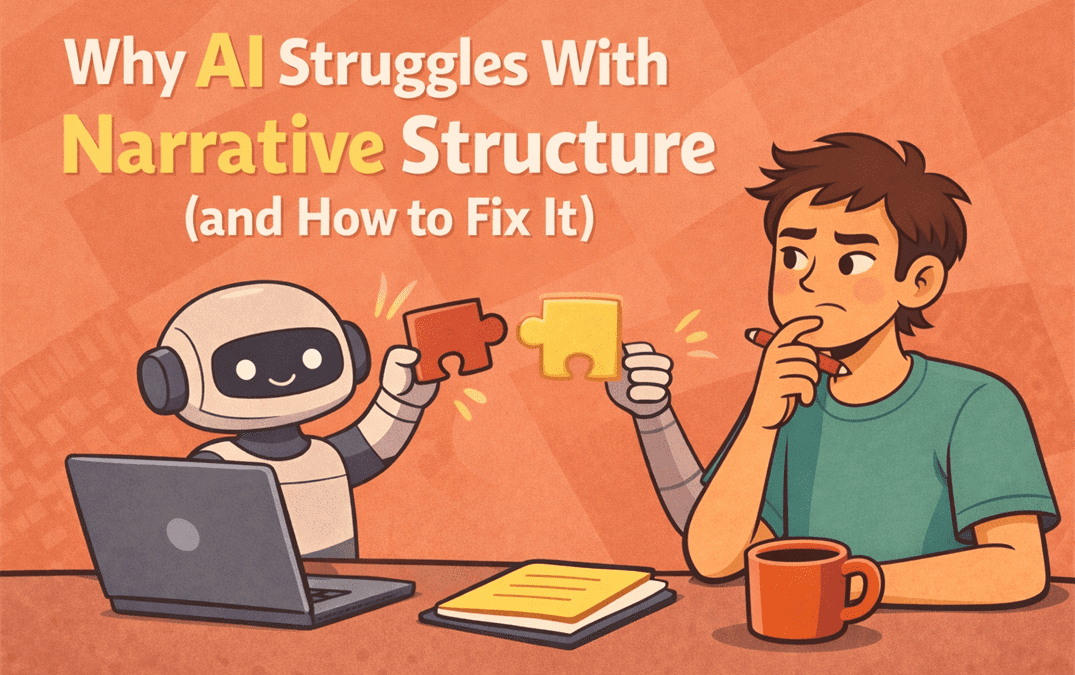
Why AI struggles with narrative structure (and how to fix it)
I want to start by defending AI for a moment.
It’s very good at sentences. Suspiciously good. The kind of good that makes you nod along and think, “Yes, this is writing.”
Then you reach the end and realise nothing actually happened.
No arc. No momentum. No feeling of arrival.
Just a collection of competent sentences politely standing next to each other like strangers at a bus stop.
That’s the heart of the AI narrative structure problem. Not intelligence. Not grammar. Not vocabulary.
Structure. Or more accurately, the absence of lived narrative instinct.
Let’s talk about why this happens and what you can do about it without turning into a full-time AI babysitter.
AI thinks in blocks, not journeys
Humans write in journeys. We start somewhere vague, wander around, change our minds and eventually land on a point that feels earned.
AI writes in blocks.
It stacks ideas neatly. It introduces concepts in the correct order. It closes loops efficiently.
It does all the things writing teachers asked for, just without the mess that makes stories feel real.
Narrative structure needs tension. Setup. Release. Slight discomfort. A reason to keep reading that isn’t just “this is informative.”
AI doesn’t feel that pull. It doesn’t wonder where this is going. It already knows the destination, so it rushes there using minimal effort.
That’s why AI-generated stories and essays often feel flat even when they’re technically sound.
The middle is where AI gets lost
Beginnings are easy. Endings are easy. The middle is where narrative goes to misbehave.
This is where humans digress, double back, insert examples, tell a story that feels slightly unnecessary but somehow clarifies everything.
This is also where most AI storytelling problems show up.
AI middles tend to:
- Repeat the premise in new words
- Add more explanation instead of progression
- Lose the thread while technically staying on topic
You’ll see paragraphs that feel busy but directionless. The writing is moving, but the story is standing still.
That’s not a prompt issue. It’s a narrative one.
AI doesn’t understand why a story exists
Humans write because something bothered them. Or surprised them. Or confused them. There’s a spark underneath the words.
AI writes because it was asked to.
That difference matters more than people admit.
Narrative structure is shaped by intent. You choose what to emphasise, what to skip, what to linger on, based on why you’re telling the story at all.
AI can infer intent. It can’t feel urgency. So it treats all parts of the narrative as equally important.
Which is why everything ends up evenly paced, evenly weighted and evenly forgettable.
This is why AI narratives feel “smooth but empty”
If you’ve ever read an AI draft and thought, “This flows, but I don’t care,” you’re not imagining things.
Flow without purpose is just motion.
Improving AI flow is not about making transitions nicer. It’s about restoring imbalance.
Letting some ideas dominate. Letting others rush past. Creating emphasis through structure, not polish.
Humans naturally do this. AI needs help.
How to fix AI narrative structure without rewriting everything
Here’s the good news. You don’t need to throw AI drafts away. You just need to stop treating them as finished.
Think of AI output as raw narrative material. Clay, not sculpture.
Add the human touch to make it worthy of admiration.
Here’s the process that actually works.
1. Decide the story before you edit the words
Before touching sentences, answer one question: What is this really about?
Not the topic of the story. The point of it.
Is it a warning? A realisation? A correction? A lesson learned the hard way?
Write that down in one messy sentence. That becomes your narrative spine.
If a paragraph doesn’t push it forward, it gets cut or reshaped.
2. Rebuild the middle manually
Leave the intro. Leave the conclusion.
Then focus entirely on the middle. This is where editing AI narratives pays off.
Ask yourself:
- Where should the reader feel uncertain?
- Where should they nod?
- Where should something click?
Add a story. Add a mistake. Add a moment of doubt.
AI won’t invent these convincingly on its own. You have to supply the mess.
3. Kill symmetry
AI loves balance. You should not.
If three sections feel evenly weighted, break one. Shorten another. Let one run longer because it matters more.
Narrative structure thrives on unevenness. It tells the reader where to focus without saying it out loud.
4. Replace explanations with moments
Any time you see a paragraph explaining something perfectly, ask if it could be shown instead.
A quick anecdote beats five sentences of clarification. A small failure beats a polished summary.
This is where AI storytelling problems quietly disappear.
5. Read it like a human, not an editor
Read it aloud. Seriously.
Where do you get bored? Where do you skim? Where does your attention drift even though the writing is “good”?
That’s where the narrative broke, not the grammar.
Fix that and the rest usually falls into place.
AI doesn’t fail at storytelling. It just doesn’t care
That sounds harsh, but it’s oddly freeing. AI isn’t broken. It’s indifferent.
Narrative structure is emotional architecture. It depends on anticipation, frustration, relief. AI can mimic the shape, but it doesn’t feel the weight.
Which means the fix isn’t more prompting. It’s ownership.
Use AI to get words on the page fast. Then step in and do the part only a human can do.
Decide what matters. Decide why it matters. Decide how it should land.
That’s not a flaw in AI. That’s the collaboration.
And once you stop expecting AI to tell the story for you, it becomes a very good assistant instead of a very confident narrator who never quite gets to the point.
Which, honestly, we’ve all met before.