Why everything suddenly requires a subscription, including things that definitely shouldn’t
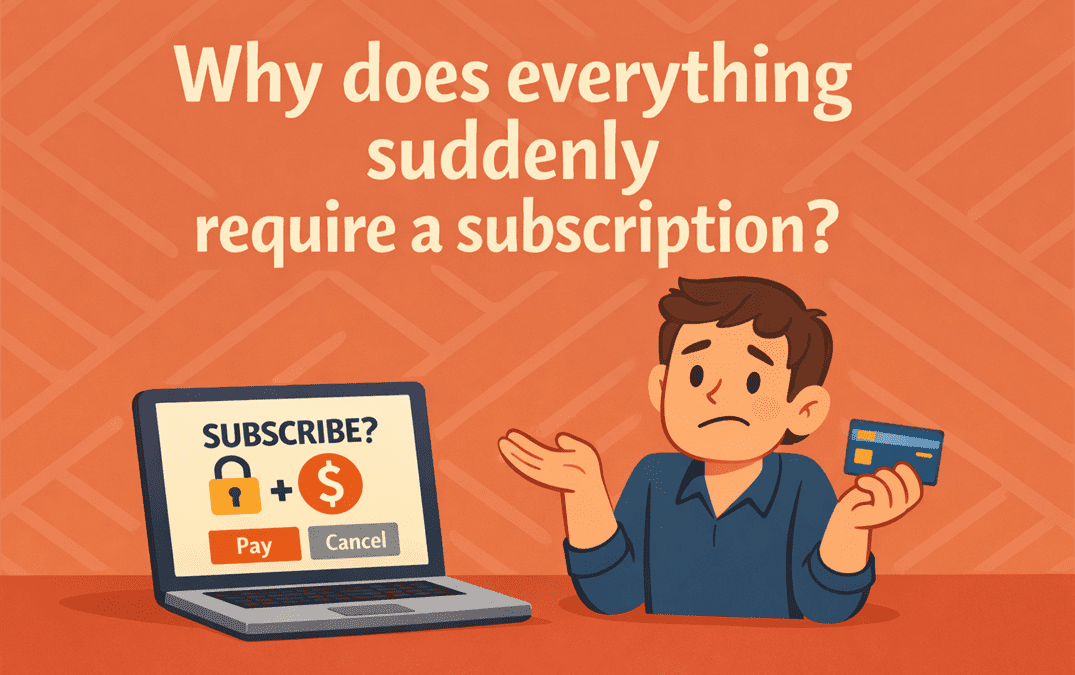
Let’s take a moment and honour the simple truth we all seem to be ignoring.
At some point in the last few years, someone flicked a switch marked Subscriptions For Everything and now we’re paying monthly fees for software, socks, stationery, meditation sounds, password managers, note apps, grocery lists, and that one service that emails you inspirational quotes from historical figures who probably never said them.
Seriously, when did this happen? Did we vote? Did someone put out a memo?
Did a committee gather in a secret basement, rub their hands together and declare, “From this day forward, nothing shall be purchased. Everything shall be rented forever”?
I would have liked to attend that meeting.
We have accepted the strangest deal in history
Here’s the strange part. We all accepted it. Cheerfully. Like a group of politely confused penguins waddling into a sauna they didn’t book.
Somewhere along the way the idea that we’d buy something once and actually own it became quaint. Old fashioned.
The digital equivalent of a rotary phone and that wallpaper everyone pretends they didn’t have in the 90s.
And in its place, we got subscriptions, the financial version of a thousand tiny mosquitoes nibbling your bank balance to death.
Don’t get me wrong, recurring revenue keeps many excellent businesses alive.
I like excellent businesses. But nobody prepared us for the moment when even the most basic tool would pop up a message saying, with the confidence of a Disney villain, “To continue using the button you’ve been using for free, please sign up for our Premium Plus Infinity Tier”.
The world’s tiniest invoices add up
The worst part is how normal it feels now.
We sign up without blinking. We let our cards auto renew.
We convince ourselves we absolutely need twelve different productivity apps because one tracks habits, one tracks tasks, one tracks ideas, and one sends us cheerful push notifications reminding us to hydrate like a Victorian ghost nanny.
Meanwhile, tucked under this mountain of monthly payments is a bigger, stranger truth.
We don’t own any of it. Not the software. Not the digital library. Not the thing that manages our passwords for us like a stern butler.
We are renting everything. Forever. In perpetuity.
Until the day the subscription lords decide to retire on a yacht shaped like a giant QR code.
Try explaining this to your grandparents
Imagine telling your grandparents that you pay a monthly fee to edit documents. Or to access emojis. Or to sync notes.
They’d look at you the same way you’d look at someone who pays rent on a toaster.
We reached a moment where ownership became optional and renting became fashionable.
And I’m not entirely convinced we noticed.
It isn’t all bad but it is undeniably odd
Of course, some people genuinely love subscriptions.
They enjoy the predictability. They enjoy the steady updates. They enjoy collecting monthly charges the way old explorers collected interesting beetles.
That’s valid. But I think we also need a moment to acknowledge how surreal it is.
Our digital lives are built on a business model that assumes we’ll happily keep paying for things we already bought.
And we do. Because the alternative is losing access and returning to the dark ages of PDF instructions and manual backups.
The existential question at the heart of it all
I say all this with love. Subscriptions can be great. Sustainable. Fair. Helpful. They keep creators paid and products evolving.
But every now and then it’s worth stepping back and asking the big philosophical question that Plato would have asked if he’d lived during the era of mobile apps.
Do I really need to pay £3.99 a month to unlock advanced features in a calculator?
Maybe yes. Maybe no. Maybe the feeling of buying something once and owning it forever will return one day like vinyl records or low rise jeans.
Until then, I’ll be here, managing my growing spreadsheet of monthly fees and whispering quiet affirmations that at least my cloud synced file organiser now has dark mode.
I don’t charge a subscription for content creation or editing. Just so you know.