How to identify AI written content: Or, that time I realised nobody actually cares who typed the words
Let’s begin with a confession.
Every time someone asks me, usually with the same hushed tone people reserve for asking whether their neighbour is a spy, “Jamie, how do you tell if AI wrote this?”, I have to fight the urge to respond with something deeply unhelpful like, “Hold it up to the light and look for the watermark”.
I don’t, of course. I’m a professional. Mostly.
You’re probably here expecting a list of high tech wizard-tools that scan, analyse and interrogate text like a literary CSI unit.
Instead, I’m going to tell you the thing nobody puts on the brochure.
It doesn’t matter whether AI wrote the content or not.
I know. Shocking plot twist. Call me M. Night Shyamalan with a keyboard.
Here’s the part where I’m supposed to say this is a bold opinion, but honestly, it isn’t.
Copywriting at its core
I’ve been a copywriter for twenty years.
That’s two decades of clients, drafts, rewrites, deadlines, caffeine abuse and the occasional quiet sob into a keyboard.
And through all of that, one rule never changed.
Deliver value. Serve the reader. Make the words useful, or interesting, or at the very least not an act of literary vandalism.
That’s it. That’s the gig.
Somewhere along the way, AI wandered into the industry like a very enthusiastic teenager who doesn’t quite know how the kettle works.
Suddenly half the internet started whispering about “detecting AI content”, as if we were hunting truffles or ghosts.
But here’s the truth you already know.
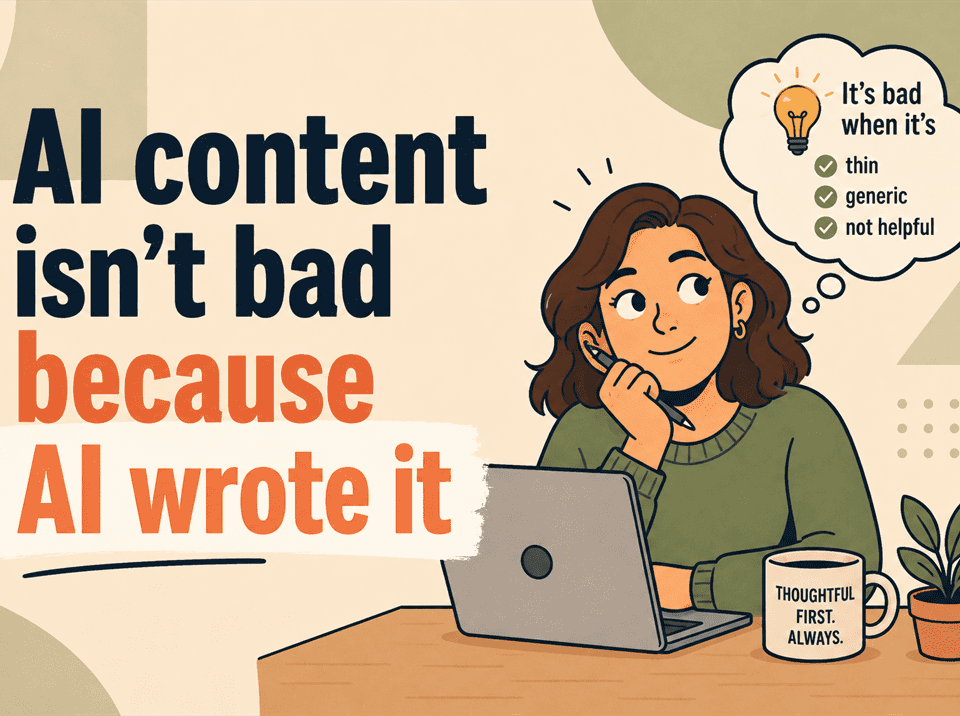
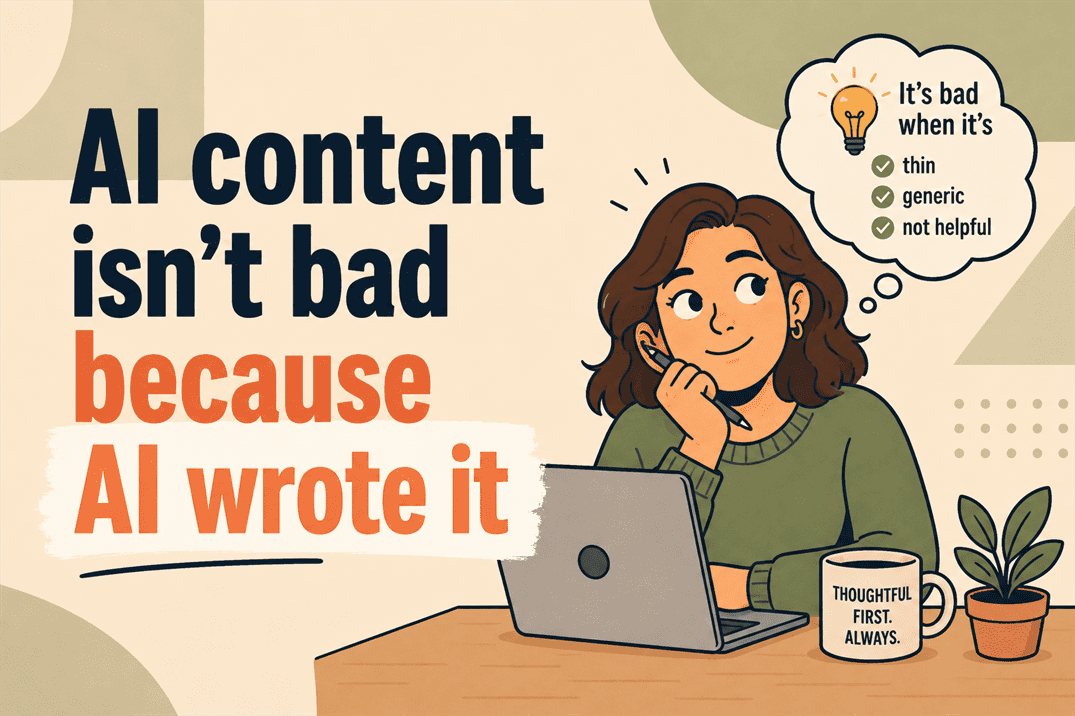
If the content helps someone, solves something, answers something, or lightens a mental load they didn’t sign up for, nobody stops mid-sentence and declares, “Well hang on, this metaphor feels suspiciously silicon flavoured”.
Readers care about usefulness. Readers care about clarity. Readers care about whether you’ve wasted their time.
They do not care whether a human, a robot or a committee of tired elves put the letters together.
And honestly, neither should you.
Writing from the trenches
Let me tell you a tiny behind the scenes secret from the writing trenches.
Every writer throughout history has used tools. Quills. Typewriters. Thesauruses. Spellcheckers.
Tools evolve. The job remains the same.
AI is just the newest thing to sit in the toolbox, right between Grammarly and the half eaten biscuit you swore you’d clean out last spring.
Does that mean AI writes perfectly? Absolutely not.
AI can waffle. It can over explain. It can invent words I’m pretty sure weren’t approved by any council of linguists.
It can produce phrases like “needle moving synergy optimisation” that feel like they escaped from a corporate PowerPoint with too many gradients.
But you know what else can do all that? Humans. Especially before coffee.
So here’s my suggestion, dear reader. Instead of playing detective, focus on the only question that matters.
Does this piece of writing help you? Does it spark something? Does it provoke an emotion or action?
Does it explain the thing you needed explained without sending you down a spiral of confusion that requires a follow up search titled “help please I’m lost”?
If yes, congratulate the writer, or the tool, or the entire ecosystem that conspired to make your day easier.
If no, feel free to close the tab with the same gentle disappointment you reserve for biscuit tins that contain sewing supplies rather than biscuits.
In the end, identifying AI written content is a little like trying to work out which scenes in The Lord of the Rings used CGI.
Interesting if you want a trivia point, irrelevant if you just want to enjoy the story.
Value wins. Always has. Always will.
If your AI content needs some love and attention so it delivers value, get in touch.