Why most blog posts fail before the first paragraph
Let me confess something mildly embarrassing. I used to think the hard part of writing a blog post was… writing the blog post.
Research. Structure. Flow. Clever turns of phrase. A quote from someone impressive so I looked well read and emotionally stable.
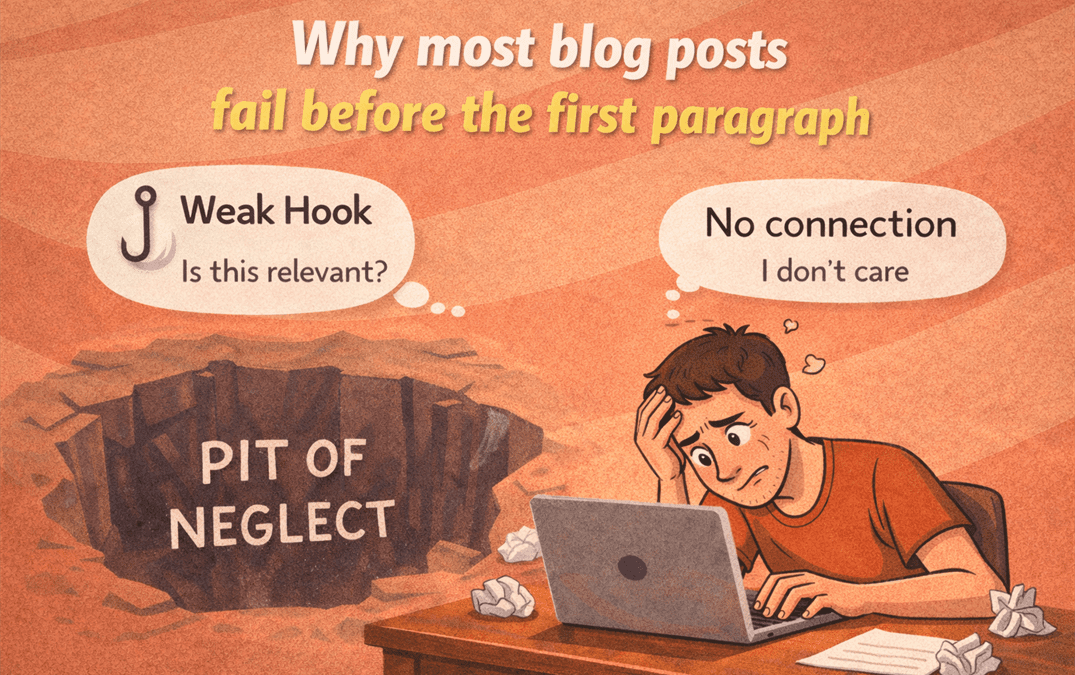
Turns out, most posts don’t fail in the middle. They don’t even fail at the end.
They fail before the first paragraph.
- Before the scroll.
- Before the second sentence.
- Before the reader decides whether you’re worth their next three minutes.
And yes, I’ve done it. Many times.
I have a digital graveyard of beautifully written posts that opened with the energy of a lukewarm conference keynote.
Let’s talk about why it happens.
The hook problem nobody wants to admit
Writers love warming up.
We like a gentle runway. A bit of context. A thoughtful scene. Maybe a philosophical musing. Something that feels intelligent and composed.
Readers don’t care about your runway.
Readers arrive with intent. They’ve typed something into Google. They’ve clicked a link from social media. They have a problem, a curiosity, a tension.
And what do we give them?
“Since the dawn of the internet…” or “In the modern digital landscape…”
No.
Hook psychology is brutally simple. In the first few lines, the reader asks one question:
Is this for me?
If the answer is unclear, they leave.
It doesn’t matter how brilliant your third paragraph is. If the opening doesn’t mirror the reader’s mental state, you’ve lost them before you’ve earned the chance to impress them.
I used to write openings that tried to sound wise.
Now I try to sound accurate.
Accurate to the reader’s problem. Accurate to their level of awareness. Accurate to what they’re actually thinking when they land on the page.
That shift alone changed everything.
Search intent mismatch is the silent killer
You can write an excellent article and still miss completely.
Why?
Because you answered the wrong question.
Let’s say someone searches “how to price freelance writing.”
They don’t want a philosophical essay on self worth and abundance. They want numbers. Structures. Models. Examples.
If you open with a reflective meditation on confidence, you’ve already lost.
Search intent is not a technical SEO checkbox. It’s empathy in disguise. When someone searches, they are revealing urgency.
Your job in the opening is to acknowledge that urgency and signal that you understand it.
Not in a robotic “in this article we will explore” way. Please. Let’s retire that sentence forever.
But in a way that says, I know why you’re here.
The more precise your opening, the less convincing you need to do later.
Weak framing makes strong writing invisible
Here’s something I learned the hard way. You can have strong insights buried inside a post that feels weak overall.
Why?
Because framing is everything. Framing is the lens you give the reader before they consume the information.
Take productivity tips. Something I have written a lot about over the years.
You could write 1,500 perfectly reasonable words.
Or you could frame it as:
“Why your productivity system keeps collapsing after two weeks.”
Now there’s tension. There’s specificity. There’s a subtle promise.
The second framing creates curiosity before the first paragraph even begins.
This is where I now spend most of my time.
Not drafting.
Framing.
I’ll sit with a title for 30 minutes. I’ll test angles. I’ll ask, what’s the real tension here? What belief am I challenging? What assumption am I poking gently with a stick?
Once the framing is strong, the writing flows.
When the framing is weak, you’re pushing uphill for 1,200 words.
The coffee shop test
I have a test I run on my own work. Imagine I’m explaining the article to you in a coffee shop.
If I say, “It’s about content marketing strategies,” your eyes glaze over mid sip.
If I say, “It’s about why most content strategies fail because they optimise for volume instead of clarity,” you lean forward slightly.
That lean is the hook.
Before the first paragraph, your reader is deciding whether to lean or scroll. And that decision is emotional before it’s rational.
Writers sometimes overestimate how much goodwill they’re given.
You don’t get five paragraphs to warm up. You get five seconds.
Why I rewrite the beginning more than the rest
Here’s the behind the scenes bit. I rarely keep my original introduction.
I write the whole piece. I find the real argument somewhere in the middle. Then I go back and rebuild the beginning to match what the post is actually about.
Because most of us don’t fully understand what we’re saying until we’ve said it.
The first draft opening is usually me clearing my throat. The final opening is me saying, right, here’s what this is really about.
So what should you actually do?
If you want your blog posts to survive past the first paragraph, focus here:
- Clarify the reader’s intent before you write.
- Frame the tension clearly in the headline.
- Open with accuracy, not atmosphere.
- Cut throat clearing context.
- Promise something specific.
You don’t need drama. You don’t need outrage. You don’t need exaggerated claims.
You need alignment.
When the reader feels understood in the first few lines, they’ll give you the rest of their attention.
And once you have attention, everything else becomes easier.
The irony?
Most blog posts fail before the first paragraph because we’re trying too hard to sound like writers.
The real trick is sounding like someone who knows exactly why the reader showed up.
Which, if you think about it, is a much more interesting job. At least I think so anyway!