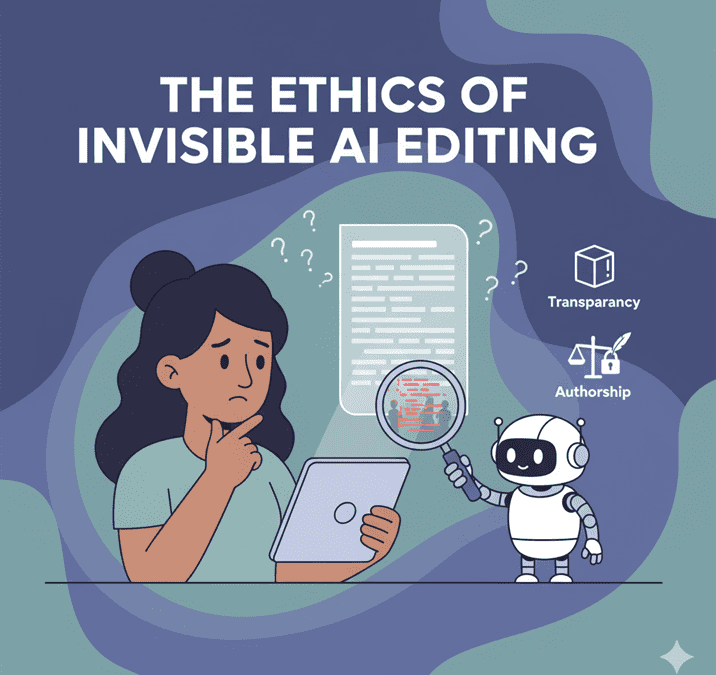
The ethics of invisible AI editing: When to disclose and when it doesn’t matter
Here’s the thing nobody wants to say out loud, half the internet has been quietly edited by AI and everyone’s pretending it hasn’t.
It’s the linguistic equivalent of airbrushing. Polished, flawless and conveniently unmentioned.
This isn’t a rant about deception or deepfakes.
It’s about the greyer, subtler question every writer and editor using AI faces, when should you tell people a robot helped you and when is it just… editing?
Because, let’s be honest, if Grammarly is AI and ChatGPT is AI, we’re all already guilty.
The real question isn’t “Did AI touch this?” It’s “Does anyone actually need to know?”
Why this conversation even exists
Writers have always had tools. We’ve used spellcheck, thesauruses, editors, coffee, and the occasional breakdown to get words right.
The difference now is that AI doesn’t just fix what you write, it rewrites it.
It smooths your rough edges, adjusts your tone and occasionally decides you should sound like a train announcer on a mission.
That’s where things get weird. Readers expect authenticity, but what does that even mean when the machine is part of the process?
Are we lying by omission if we don’t mention it?
If Microsoft Word had been this smart twenty years ago, half of us would have had “Co-authored by Clippy” on our dissertations.
The truth is that this debate isn’t about technology. It’s about trust.
Readers don’t want to know whether you used AI, they want to know whether they can believe what you wrote.
The spectrum of AI involvement
Let’s break it down, because not all AI use is equal.
- Level 1: Spellcheck and tone tweaks. Invisible editing. Nobody cares. It’s basically spellcheck with better hair.
- Level 2: Structural suggestions or sentence rewrites. You’re still the writer, but the AI is your stylist. Think “editor who works for free and never sleeps.”
- Level 3: AI drafts, human edits. The co-authorship zone. You’re shaping, not just polishing. Disclosure here starts to matter.
- Level 4: AI writes, you nod and hit publish. That’s not editing. That’s ghostwriting with plausible deniability.
The higher you climb that ladder, the more important transparency becomes.
If your AI is just fixing commas, fine. If it’s ghostwriting your memoir, we need to talk.
When disclosure does matter
There are moments when you owe it to your audience, or your client, to be upfront.
- If you’re in journalism or research, credibility depends on accountability. Readers trust you to have verified facts, not your favourite chatbot.
- If you’re ghostwriting for clients, they have every right to know how much of their voice came from you versus your machine assistant.
- If you’re teaching, influencing, or building authority, people assume your words reflect your own mind. Transparency maintains that trust.
Disclosure isn’t about guilt. It’s about respect.
Nobody needs a legal disclaimer for every prompt you run, but if AI shaped the actual message, say so.
And please, if AI wrote 80% of it and you added adjectives, don’t sign off like you’re channelling Hemingway.
When disclosure doesn’t really matter
Not every line of text needs a robot disclaimer. Some AI edits are just the modern version of copyediting.
If AI fixed your commas, trimmed a redundant paragraph, or made your transitions smoother, congratulations, you’re still the author.
That’s not a moral crisis. That’s workflow efficiency.
I don’t add “Edited with AI” every time ChatGPT suggests a stronger synonym, just like I don’t credit Google Docs for catching a typo.
The line isn’t whether AI helped. It’s whether that help changed ownership or intent.
If the machine didn’t decide what you said, only how you said it, you’re in the clear.
The new transparency playbook
Here’s a practical way to approach AI disclosure without turning your writing into a confession booth.
- Be open when AI contributed creatively. If it wrote substantial sections or helped shape the argument, that’s worth noting.
- Disclose process, not prompts. “Edited with AI assistance” is plenty. No one needs your temperature settings.
- Keep humans in the loop. Every AI-edited piece should go through human review. Accountability is what separates craft from automation.
- Create internal policies. If you’re part of a team or agency, set clear rules for disclosure now. That way, you’re not improvising every time a client asks, “Wait, did AI write this?”
You don’t need a blinking banner screaming “Assisted by AI.” Just transparency that matches the context.
What invisible AI editing says about creativity
Here’s the part I secretly love about this whole debate. AI editing doesn’t kill creativity. It exposes how much of creativity has always been editing.
We romanticise the blank page, but the real magic has always happened in the margins, rearranging, tightening, refining. AI just happens to be good at the fiddly parts.
I’ve used AI to fix sentences that were on life support. It didn’t make me less of a writer, it made me a faster editor.
Sometimes the tool helps me express what I meant all along, it just removes the linguistic clutter I was too tired or distracted to fix manually.
So, is that unethical? Or just efficient self-expression?
The paradox of authenticity
Here’s the kicker. Readers say they want “authentic human voice,” but even the most authentic writing is usually polished to within an inch of its life.
It’s like those girls on dating shows. You know the ones. Girls with fake tan, fake lips, fake lashes, fake nails and fake chests who always want a ‘real’ man.
Editors remove tangents. Proofreaders clean syntax. AI now joins that invisible chain of improvement.
If AI helps me sound more like myself, not less, is that dishonest? Or is it the digital equivalent of wearing a good outfit to a meeting, still me, just tidier?
Authenticity isn’t about the absence of tools. It’s about intention.
If your meaning, personality and perspective survive the edit, the process doesn’t make it fake.
Disclosure as trust, not confession
So where does that leave us? Somewhere between honesty and overexposure.
Ethical AI editing isn’t about writing manifestos or disclaimers. It’s about respecting your audience’s expectations.
Disclose when AI shapes your message. Don’t worry when it just smooths your style. Always keep a human brain in charge of final judgment.
And above all, remember that disclosure isn’t an act of guilt, it’s a gesture of trust.
It’s the digital equivalent of saying, “By the way, a robot helped me polish this. But the ideas, the humour, and the overuse of commas? That’s all me.”