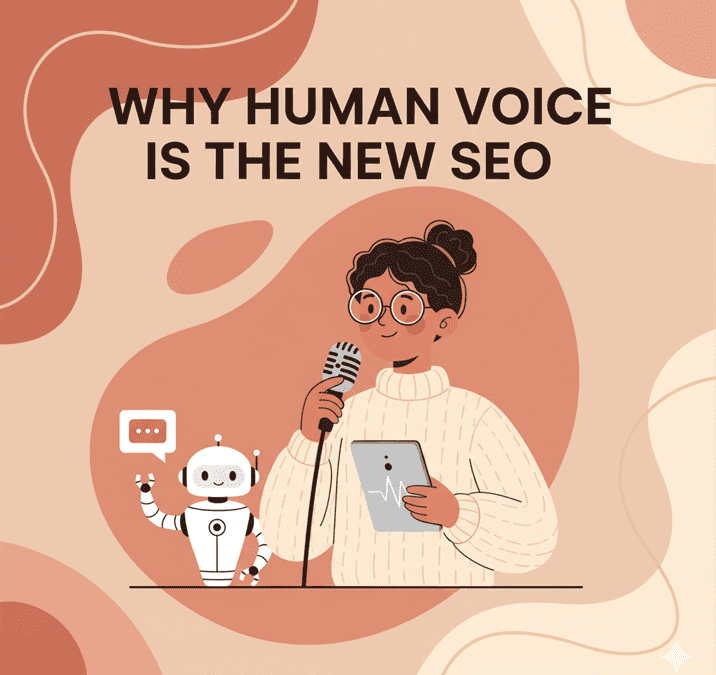
The authenticity arms race: Why human voice is the new SEO
There’s a quiet panic in the content world right now.
You can almost hear it humming behind every Reddit post on search: “Will Google still rank me if I sound like a person?”
The irony, of course, is that sounding like a person has become the thing Google seems to want most.
We’ve come full circle. The algorithm that trained a generation of writers to remove personality is now begging for it back.
The paradox of scale vs soul
Here’s the problem, AI can write faster than you, me and an entire newsroom armed with double espressos. But it still can’t make anyone care.
Google’s Helpful Content updates made that painfully clear.
You can’t fake lived experience. You can’t keyword your way into credibility. And you can’t out-scale sincerity.
I call this the paradox of scale vs soul.
You can flood the internet with perfect sentences and still have zero readers who trust you.
Meanwhile, some grinning blogger who just shared how they accidentally deleted their entire WordPress site will outrank you, because their panic attack felt real.
Why the human touch is now a ranking factor
Technically speaking, Google doesn’t have a ranking factor called vibes. But it might as well have.
The search giant’s latest fixation is E-E-A-T—Experience, Expertise, Authoritativeness, Trustworthiness. It’s algorithm-speak for “Please stop writing like a chatbot.”
Experience is the big one here.
If you’ve actually done the thing you’re talking about, Google wants receipts, screenshots, opinions, offhand jokes about how it almost broke you.
AI can’t replicate that, at least not convincingly.
Think of it as metadata for humanity. Every piece of real commentary, every tiny imperfection, every detail that says “I was there, and it was messy” is a signal that you exist.
I have a mixed opinion of EEAT, especially headlines but I covered that already so I won’t bore you with it again. That doesn’t take away from its value though, just do it right.
Leveraging personal experience and expertise
Now, before this turns into a kumbaya circle about “authentic storytelling,” let’s get practical.
If you run a business or personal brand, your experience is your moat.
Write from it. Lean on it. Quote yourself like you’re your own favourite source.
Example: instead of “Businesses should test different landing pages,” try “When I changed one headline from ‘Start free trial’ to ‘Let’s do this,’ my click rate jumped 18% and my ego inflated 200%.”
That’s experience. It’s proof wrapped in personality.
It’s also measurable. Posts that feature first-hand insights tend to get longer dwell times and more backlinks.
Not because readers are romantic about truth, they just like to learn from someone who’s actually been in the trenches rather than someone who’s read the Wikipedia summary of the trenches.
And yes, you can absolutely use AI to help you shape that story. Just make sure you’re the one providing the heartbeat.
Brand storytelling as a moat
Authenticity isn’t just about “being real.” It’s about being recognisable.
In a sea of AI sameness, your brand’s voice becomes a form of intellectual property. Call it voice equity, the distinctive way your brand says “hello” that no generic model can copy.
Think about the brands you recognise instantly, Innocent Drinks, Mailchimp, Wendy’s Twitter before it went weird.
They didn’t win because of algorithms, they won because you could hear them in your head.
Voice is what makes content sticky. It builds trust, keeps people coming back, and quietly says, “There’s a human behind this mess and they care enough to sound like one.”
If you’re an agency or creator, you can make this your superpower.
Every project should leave behind a little DNA, a tone, a rhythm, a wink.
Because once readers fall in love with how you say things, SEO stops being a fight for visibility and starts being an invitation to listen.
Real-world proof: Authenticity found me by accident
For years, my blog was a well-behaved portfolio. Every sentence wore its best shirt. Every opinion had been politely ironed.
The goal was simple, sound like the kind of writer businesses would trust not to scare their brand managers.
And it worked. Sort of. I was “a safe pair of hands.” The kind of writer who never offends, never experiments, never misses a semicolon.
Which was fine if you want to read something that feels like it was approved by twelve middle managers and a mood board.
The approach served me well for 18 years and I have made a comfortable living out of it. But it wasn’t completely satisfying.
Then, in 2025, I decided to start again. No content strategy, no positioning deck, no imaginary LinkedIn audience whispering in my ear.
Just… me.
I stopped writing to impress and started writing like I actually think. Messy. Honest. Occasionally sarcastic.
I had no grand authenticity plan. I just ran out of patience pretending to be the neutral narrator of my own ideas.
And here’s the plot twist, that’s when people started paying attention. Comments, DMs, new projects, all because I sounded like an actual human being again.
I didn’t “build an authentic voice.” I accidentally became one by dropping the performance.
Turns out, authenticity isn’t something you craft, it’s what’s left when you stop sanding off every edge.
The irony: AI can make you more human
AI can actually help you sound more human if you use it correctly.
I’ll use AI to tidy structure, flag repetition, or even help find a stronger metaphor. But the moment it starts polishing the voice too much, it’s like someone applying a beauty filter to your personality.
Clean, symmetrical, and lifeless.
AI should support your truth, not sanitise it. Think of it as your mildly pedantic co-editor, not your ghostwriter.
The trick is knowing when to stop. If the text starts sounding like an HR-approved mission statement, you’ve gone too far.
Voice is the new ranking signal
In the race to optimise everything, voice has become the last authentic advantage left.
SEO used to be about visibility. Now it’s about credibility. And credibility comes from being unmistakably human, not perfectly optimised.
So write the way you talk. Leave in the weird phrasing. Admit when you’re uncertain. Drop a joke that might only land with five readers. Those five are the ones who’ll stay.
In a world where anyone can publish anything, sincerity has become the scarcest resource online.
And if that’s not worth ranking for, what is?