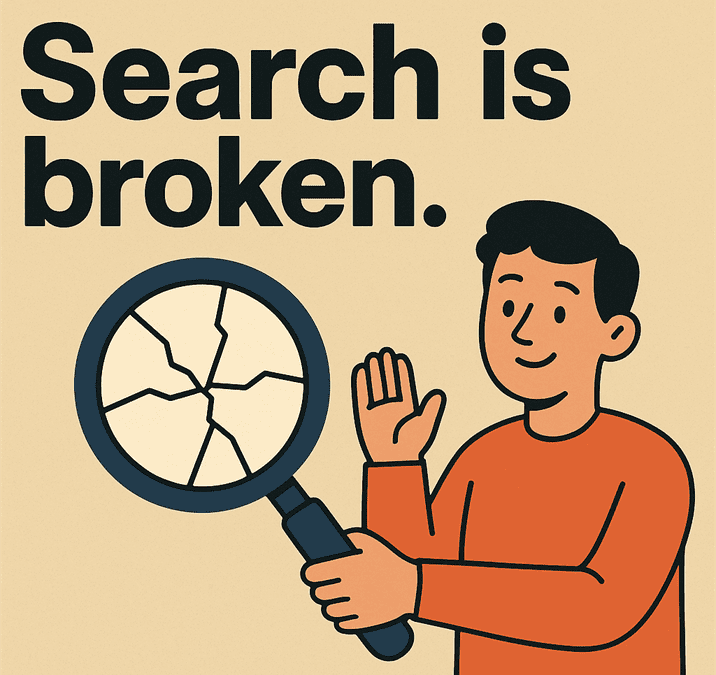
Search is broken. Will AI keep making it worse?
Here’s a confession, I no longer know what “good SEO” means and haven’t for a while.
Once upon a time, it was about keywords, backlinks, and hoping Google didn’t roll out another algorithm named after a cute but vengeful animal.
Now it feels like throwing darts in a dark room while a robot whispers “semantic relevance” in your ear.
Everyone’s an expert, yet nobody agrees on anything. Ask 100 SEOs how to handle the rise of AI search engines and you’ll get 100 answers, each delivered with the confidence of someone who definitely hasn’t just guessed like the rest of us.
But fine. Let’s pretend we’re not spiralling and talk about where search is heading and whether AI is the hero or the chaos gremlin of this story.
Current issues in search quality
You’ve probably noticed something’s… off.
Search results used to feel curated, like a librarian guiding you to the right shelf. Now it’s more like rummaging through a bargain bin labelled “possibly relevant.”
You ask for a recipe and get twelve affiliate sites, three rewrites of the same content, and a 2,000 word life story about someone’s sourdough starter trauma.
The problem? Everyone’s chasing what they think Google wants.
That leads to the same safe, over-optimised sludge repeated across the internet. The result: a web where ten sites say the same thing, all pretending to be “definitive.”
Meanwhile, actual value, clarity, expertise, personality, gets buried under keyword confetti.
Which is wild, because users don’t want “optimised.” They want useful.
AI-powered search: Promise vs pitfalls
Enter AI in search, stage left, wearing a shiny “Generative Search Experience” badge and promising to fix everything.
In theory, it sounds great. You ask a question, and AI summarises the best bits from across the web into one neat, conversational answer.
No more endless scrolling. No more SEO bingo.
Except, hang on, those “best bits” came from someone else’s hard-earned writing. Usually a blogger, journalist, or poor intern who spent six hours researching that one paragraph.
AI search now hands their knowledge to users without sending them to the source.
It’s like asking a friend for restaurant recommendations and having them read every review aloud without telling you where they found them.
And sometimes the AI gets it almost right, which is worse than being wrong.
“Almost right” is how you end up confidently telling people that the Eiffel Tower is in Berlin because your “smart assistant” seemed so sure.
So yes, AI-powered search could improve discovery, but it could also flatten creativity and reward conformity. Depends on which robot wins.
AI search: The good, the bad and the occasionally hallucinatory
Pros:
- Saves time: One neat answer instead of 30 open tabs.
- Reduces fluff: Skips the SEO filler and gives the gist.
- Learns context: Can handle complex, multi-part queries.
Cons:
- Eats creators’ traffic for breakfast.
- Sometimes makes things up with confidence.
- Struggles with nuance, humour and human intent.
- Turns original work into a mashed-up smoothie of “probably accurate.”
So yes, convenient, but at what cost? (Other than everyone’s sanity.)
Impact on publishers and independent creators
For writers, this new era feels like standing outside a nightclub you helped build while the bouncer (AI) lets in everyone else except you.
Publishers are anxious. Independent creators are quietly panicking.
Traffic is already down and it’s not clear whether AI summaries will send anyone to the source content.
When AI becomes the middleman, what happens to the people making the stuff it summarises?
It’s not all doom, though. There’s a counter movement forming: the “write for humans and hope for the best” brigade.
I’m in that one.
Because even if the algorithms can’t decide what they want, readers still can.
Real people recognise value, authenticity and voice. They know when something’s written by a human who cared (and maybe drank too much coffee while doing it).
User trust and credibility concerns
Here’s the plot twist, users don’t trust anyone right now.
Not the search engines. Not the AI summaries. Not even the websites, because half of them sound like they were generated by a robot trained on fortune cookies.
That’s the real challenge for AI search engines, not just delivering results, but rebuilding trust.
Because trust is earned through transparency: showing where the information comes from, crediting the creators and letting readers verify things for themselves.
Strip that away and the whole system collapses into a swirling soup of “maybe true” content.
Remember “screenshot or it didn’t happen?” This is that and then some!
As creators, our best defence is consistency. Keep showing up. Keep delivering genuine value. Keep writing like a person, not a keyword cloud in a trench coat.
The honest conclusion
Search is broken. AI might fix it, or it might just put glitter on the cracks.
But while the machines figure themselves out, we can choose to write things worth finding.
That’s my entire SEO strategy right now. Make good stuff, give it structure, hope Google (or whatever sentient toaster replaces it) notices.
Because maybe the point isn’t to game search anymore. Maybe it’s to remind it why humans started searching in the first place.
If you want that approach for your site, I can help.